What’s in Today’s Article:
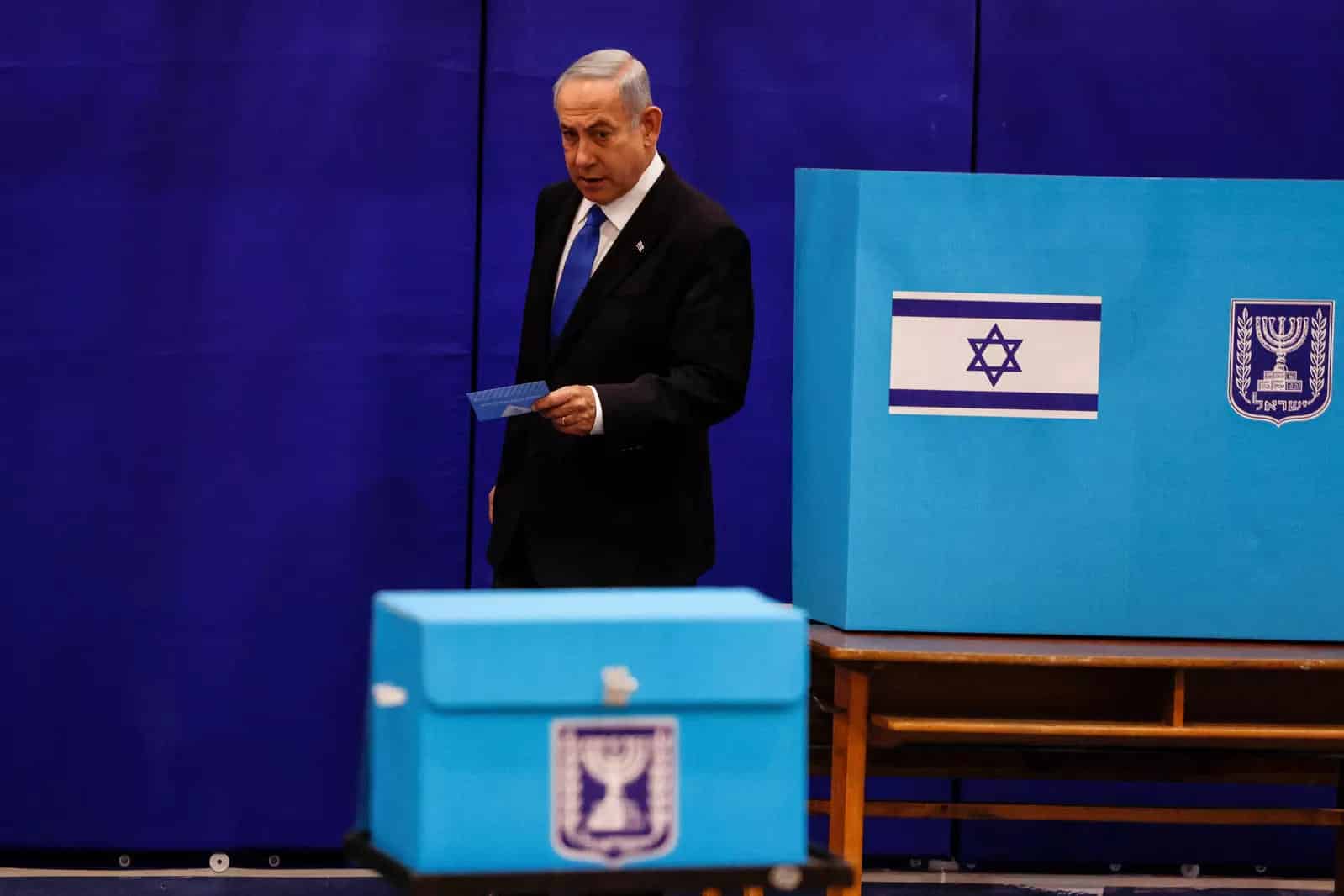
- Electoral Process of Israel
- News Summary
Why in news?
- As per the Israel’s electoral commission, former Prime Minister Benjamin Netanyahu and his right-wing allies secured a clear victory and a majority in the Parliament.
- According to final results released, Mr Netanyahu’s Likud party and its far-right and religious allies won 64 of the 120 seats in parliament.
- On the other hand, caretaker Prime Minister Yair Lapid’s centrist bloc won 51 seats.
Electoral Process of Israel
- Israel is a parliamentary democracy, where people vote for the party they support.
- Every Israeli citizen who is at least 18 years old has the right to vote; every Israel citizen who is at least 21 years old has the right to be elected.
- Under Israel’s Basic Law, national Knesset (Parliament) elections are scheduled to take place every four years in the Jewish month of Cheshvan.
- But early elections are a frequent occurrence.
- Israel follows a “closed-list” method of party-list proportional representation.
- In this system, citizens have the chance to vote for a party or group of parties but not for individual candidates to the Knesset.
- The 120 seats in the Knesset are then assigned proportionally to each party that received votes, provided that the party gained votes which met or exceeded the electoral threshold, which is currently 3.25%.
- Parties have various ways of choosing the order of candidates on their list.
- Party leaders may appoint candidates directly, the party may vote amongst themselves, or they can hold primaries with voters.
- When seat distributions are over, the President steps in to select a Knesset member who is most likely to be able to form a stable government.
- This is usually the leader of the party who received the most seats. If a party ever wins more than 50% it could form a government without coalition.
News Summary
- Netanyahu-led right-wing bloc has taken a comfortable lead with 64 seats in the 120-member Knesset, paving way for his triumphant return.
- For many years, Netanyahu appeared to be politically invincible. He holds the record of being the longest-serving Prime Minister in the country’s history.
- But he met with a rude jolt after being ousted in 2021 by an unprecedented coalition of parties whose only common goal was to see his ouster.


Background:
- Earlier this year in April, lawmaker Idit Silman resigned from PM Naftali Bennett’s religious-nationalist Yamina party, essentially leaving the party without a majority.
- As a result, on November 1, Israel went to the polls again, for the fifth time in a span of three years to elect a new Knesset or the country’s parliament.
Why does Israel have elections so often?
- Israel has a parliamentary system made up of several parties – none of which have ever received enough votes to secure a majority on their own.
- That means parties must team up to form coalitions and reach the 61 seats needed to form a ruling government.
- The other factor is Benjamin Netanyahu. He is in the midst of a corruption trial.
- Some top politicians on the center-right, who agree with him ideologically, refuse to work with him for personal or political reasons.
- That made it difficult for him to build lasting governing majorities following the previous four elections.
- Last year, his opponents managed to cobble together a coalition of parties from across the political spectrum to keep him out of power.
- But that coalition only held together for about a year and a quarter before its leaders, Yair Lapid and Naftali Bennett, pulled the plug and called for new elections.
- Some top politicians on the center-right, who agree with him ideologically, refuse to work with him for personal or political reasons.

 Last updated on Oct, 2026
→ UPSC 2027 Notification will be released on 13 January 2027 at upsconline.nic.in.
→ Asian Games 2026 are being held in Aichi-Nagoya, Japan, from 19 September to 4 October.
→ Check Nobel Prize 2026 Winners List here.
→ Download PIB PRiSM Monthly Magazine 2026 here.
→ Check UPSC Monthly Current Affairs Magazine The Recitals here.
→ Check out the latest UPSC Syllabus here.
→ Download UPSC Model Answers for Mains 2026
→ UPSC Mains Question Paper 2026 is out now for Essay & GS Paper 1, 2, 3 & 4.
→ UPSC Calendar 2027 has been released.
→ Enroll in Vajiram & Ravi’s UPSC Mains Test Series 2027 for structured answer writing practice, expert evaluation, and exam-oriented feedback.
→ Join Vajiram & Ravi’s UPSC Mentorship Program 2027 for personalized guidance, strategy planning, and one-to-one support from experienced mentors.
→ Go through the UPSC Mains Previous Year Papers to enhance your preparation.
→ UPSC has released UPSC Toppers List 2025 with the Civil Services final result on its official website.
→ Also check Best UPSC Coaching in India