What’s in today’s article?
- Why in news?
- The new Post Office Bill
- Criticism of the new post office bill
Why in news?
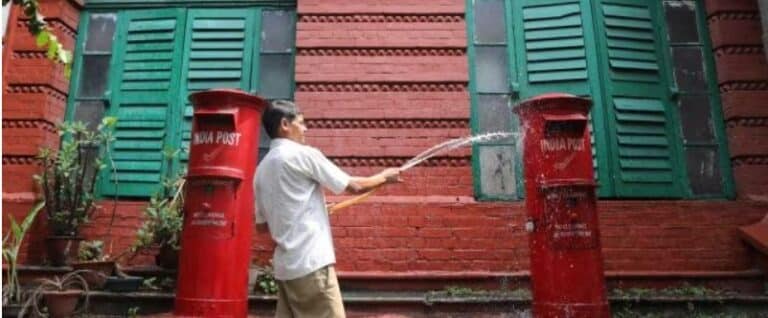
- After being passed in the Rajya Sabha recently, the Post Office Bill, 2023 was brought to the Lok Sabha for consideration.
- The bill seeks to repeal the 125-year-old Indian Post Office Act of 1898.





The new Post Office Bill
- Need
- There was need to consolidate and amend the law relating to Post Office in India, which today provides many services beyond simply mail delivery.
- Mail delivery was the primary concern of the Indian Post Office Act of 1898.
- The Post Office network today has become a vehicle for delivery of different citizen-centric services, which necessitated the repeal enactment of a new law.
- There was need to consolidate and amend the law relating to Post Office in India, which today provides many services beyond simply mail delivery.
- Post officers can intercept any item
- Section 9 of the Bill allows the Centre to, by notification, empower any officer to intercept, open or detain any item.
- This can be done in the interest of state security, friendly relations with foreign states, public order, emergency, public safety, or contravention of other laws.
- Postal items to be handed over to customs authorities
- This provision also allows post officers to hand over postal items to customs authorities.
- They can do so if these items are suspected to contain any prohibited item, or if such items are liable to duty.
- The Post Office exempt from liability
- Section 10 says that the Post Office and its officers are not responsible if something goes wrong, like if there is a loss, the wrong delivery, a delay, or damage during any services provided by the Post Office.
- They are not liable for these issues, unless there are specific rules saying they are responsible for certain things.
- Section 10 says that the Post Office and its officers are not responsible if something goes wrong, like if there is a loss, the wrong delivery, a delay, or damage during any services provided by the Post Office.
- Penalties and offences
- The 2023 Bill removes all penalties and offences under the 1898 Act.
- For example, offences committed by post office officials such as misconduct, fraud, and theft, among others, have been deleted entirely.
- At the same time, if anyone refuses or neglects to pay the charges for availing a service provided by the Post Office, such amount shall be recoverable as if it were an arrear of land revenue due from them.
- Removes Centre’s exclusivity
- The present Bill has removed Section 4 of the 1898 Act, which allowed the Centre the exclusive privilege of conveying by post, from one place to another, all letters.
- Effectively, this exclusivity was already lost by the 1980s, with the rise of private courier services.
- Neither the Post Office Act of 1898 nor the Indian Post Office Rules, 1933 had defined the term letter anywhere.
- Hence, courier services bypassed the 1898 law by simply calling their couriers “documents” and “parcels”, rather than “letters.”
- The 2023 Bill, for the first time, regulates private courier services by bringing it under its ambit.
- While the government acknowledges its lack of exclusivity, it has also widened the ambit of the law in order to intercept and detain any postal article, as opposed to just letters.
- The present Bill has removed Section 4 of the 1898 Act, which allowed the Centre the exclusive privilege of conveying by post, from one place to another, all letters.
Criticism
- Several analysts have criticised the Bill, saying that despite promising to update the Colonial law, it keeps the most draconian provisions that it contained.
- It has eliminated the burden of accountability which a governmental enterprise like India Post ought constitutionally to shoulder.
Q1) What is the role of customs authorities?
Customs authorities are responsible for a range of regulatory controls that protect the safety and security of citizens and businesses, as well as the country’s revenues and prosperity. They also manage border controls.
Q2) What are parcels?
A parcel is a package or collection of things wrapped together. It can also be a part of something, or a division. For example, land is divided into parcels that are purchasable.
Source: What is the new Post Office Bill, and why did Shashi Tharoor criticise it?

 Last updated on March, 2026
→ UPSC Final Result 2025 is now out.
→ UPSC has released UPSC Toppers List 2025 with the Civil Services final result on its official website.
→ Anuj Agnihotri secured AIR 1 in the UPSC Civil Services Examination 2025.
→ UPSC Marksheet 2025 is now out.
→ UPSC Notification 2026 & UPSC IFoS Notification 2026 is now out on the official website at upsconline.nic.in.
→ UPSC Calendar 2026 has been released.
→ Check out the latest UPSC Syllabus 2026 here.
→ UPSC Prelims 2026 will be conducted on 24th May, 2026 & UPSC Mains 2026 will be conducted on 21st August 2026.
→ The UPSC Selection Process is of 3 stages-Prelims, Mains and Interview.
→ Prepare effectively with Vajiram & Ravi’s UPSC Prelims Test Series 2026 featuring full-length mock tests, detailed solutions, and performance analysis.
→ Enroll in Vajiram & Ravi’s UPSC Mains Test Series 2026 for structured answer writing practice, expert evaluation, and exam-oriented feedback.
→ Join Vajiram & Ravi’s Best UPSC Mentorship Program for personalized guidance, strategy planning, and one-to-one support from experienced mentors.
→ Shakti Dubey secures AIR 1 in UPSC CSE Exam 2024.
→ Also check Best UPSC Coaching in India