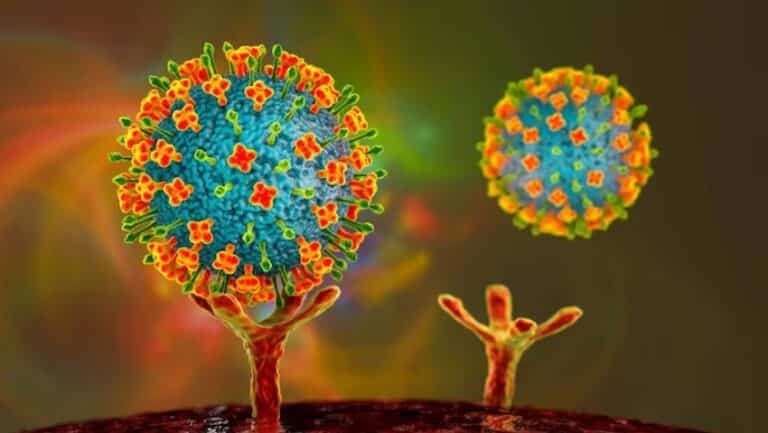
What’s in today’s article?
- Why in news?
- What is Nipah virus?
Why in news?
- Two people have died and four others are under treatment after contracting Nipah virus in Kerala’s Kozhikode district.
- While the Nipah virus does not spread as quickly as the Covid-19 virus, it is more deadly.
Nipah virus
- About

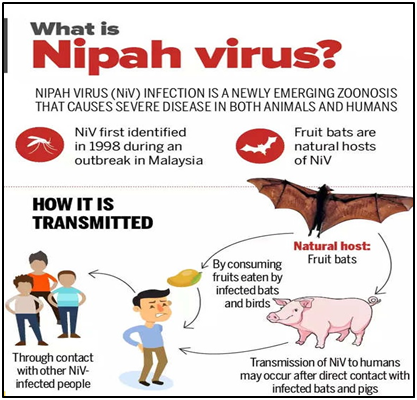
- Nipah is a zoonotic disease, which means it is transmitted to humans through infected animals or via contaminated food.
- First identified during an outbreak in Malaysia and Singapore, primarily affecting pigs and the people who worked closely with them.
- The virus is named after the Malaysian village of Sungai Nipah, where the outbreak occurred. No new outbreaks have been reported in Malaysia since 1999.
- Family & Natural hosts
- Nipah virus is part of the Paramyxoviridae family and is closely related to the Hendra virus.
- The Paramyxoviridae family is a group of single-stranded RNA viruses that cause infections in vertebrates.
- Fruit bats are the natural hosts for Nipah virus. There is no apparent disease in fruit bats.
- Nipah virus is part of the Paramyxoviridae family and is closely related to the Hendra virus.
- Transmission
- It is primarily transmitted to humans through contact with infected animals, particularly fruit bats (flying foxes).
- Fruit bats are known to transmit this virus to other animals like pigs, and also dogs, cats, goats, horses and sheep.
- The transmission from animals happens mainly through consumption of contaminated food.
- Human-to-human transmission can also occur, mainly through close contact with the bodily fluids of infected individuals.
- It is primarily transmitted to humans through contact with infected animals, particularly fruit bats (flying foxes).
- How fast does the Nipah virus spread?
- The Nipah virus is known to spread far more slowly than SARS-CoV-2. However, it is its ability to kill that is the biggest concern.
- According to WHO, the overall global case fatality rate of Nipah is estimated at 40% to 75% .
- However, so far, all outbreaks of the Nipah virus have been localised and contained relatively quickly.
- One of the main reasons for a relatively quick end to an outbreak is the fact that Nipah virus is not very infectious and human-to-human transmission is not very easy.
- Further, the very high death rates also contribute to low transmission.
- Signs and symptoms
- Human infections range from asymptomatic infection to acute respiratory infection (mild, severe), and fatal encephalitis.
- Infected people initially develop symptoms including fever, headaches, myalgia (muscle pain), vomiting and sore throat.
- The incubation period (interval from infection to the onset of symptoms) is believed to range from 4 to 14 days.
- Diagnosis
- Initial signs and symptoms of Nipah virus infection are nonspecific, and the diagnosis is often not suspected at the time of presentation.
- Nipah virus infection can be diagnosed with clinical history during the acute and convalescent phase of the disease.
- The main tests used are real time polymerase chain reaction (RT-PCR) from bodily fluids and antibody detection via enzyme-linked immunosorbent assay (ELISA).
- Treatment
- There are currently no drugs or vaccines specific for Nipah virus infection although WHO has identified Nipah as a priority disease for the WHO Research and Development Blueprint.
- Intensive supportive care is recommended to treat severe respiratory and neurologic complications.
- Past Outbreaks
- It was also recognized in Bangladesh in 2001, and nearly annual outbreaks have occurred in that country since.
- The disease has also been identified periodically in eastern India.
- Evidence of the virus has been found in the known natural reservoir and several other bat species in a number of countries, including Cambodia, Ghana, Indonesia, Madagascar, the Philippines, and Thailand.
Q1) What is enzyme-linked immunosorbent assay (ELISA) test?
Enzyme-linked immunosorbent assay, commonly known as ELISA, is a widely used laboratory technique in the field of immunology and biochemistry. It is employed to detect and quantify the presence of specific proteins, peptides, antibodies, or antigens in biological samples such as blood, serum, urine, and other body fluids.
Q2) What is Paramyxoviridae family?
The Paramyxoviridae family is a family of viruses that belong to the order Mononegavirales. Viruses in this family are characterized by their single-stranded, negative-sense RNA genomes. They are known to infect a wide range of vertebrate hosts, including humans and other animals. Paramyxoviruses are responsible for a variety of diseases in humans and animals, and some of them are significant pathogens with public health and veterinary importance.
Source: WHO | Times of India | The Hindu






 Last updated on March, 2026
→ UPSC Final Result 2025 is now out.
→ UPSC has released UPSC Toppers List 2025 with the Civil Services final result on its official website.
→ Anuj Agnihotri secured AIR 1 in the UPSC Civil Services Examination 2025.
→ UPSC Marksheet 2025 is now out.
→ UPSC Notification 2026 & UPSC IFoS Notification 2026 is now out on the official website at upsconline.nic.in.
→ UPSC Calendar 2026 has been released.
→ Check out the latest UPSC Syllabus 2026 here.
→ UPSC Prelims 2026 will be conducted on 24th May, 2026 & UPSC Mains 2026 will be conducted on 21st August 2026.
→ The UPSC Selection Process is of 3 stages-Prelims, Mains and Interview.
→ Prepare effectively with Vajiram & Ravi’s UPSC Prelims Test Series 2026 featuring full-length mock tests, detailed solutions, and performance analysis.
→ Enroll in Vajiram & Ravi’s UPSC Mains Test Series 2026 for structured answer writing practice, expert evaluation, and exam-oriented feedback.
→ Join Vajiram & Ravi’s Best UPSC Mentorship Program for personalized guidance, strategy planning, and one-to-one support from experienced mentors.
→ Shakti Dubey secures AIR 1 in UPSC CSE Exam 2024.
→ Also check Best UPSC Coaching in India