NITI Aayog Governing Council Latest News
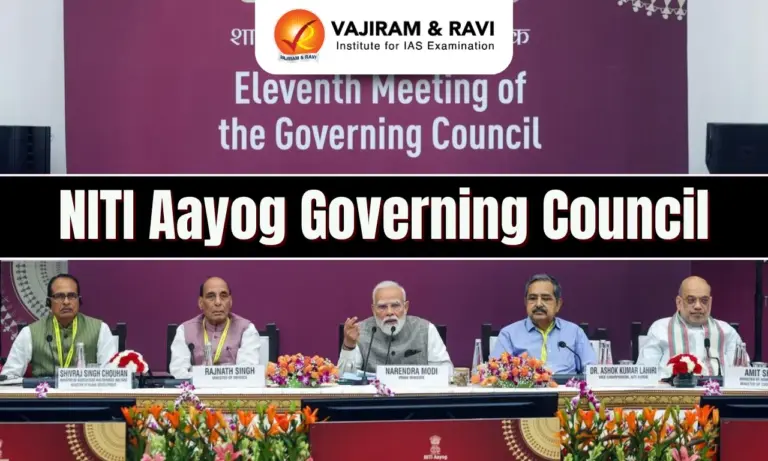
- The 11th Governing Council Meeting of NITI Aayog, chaired by Prime Minister Narendra Modi, saw participation from all 28 state Chief Ministers for the first time, with discussions focused on district-level GDP estimates, affordable energy, and inclusive human development.
About NITI Aayog
- NITI Aayog (National Institution for Transforming India) is the premier policy think tank of the Government of India, established on 1st January 2015 to replace the Planning Commission.
- It serves as the apex body for cooperative federalism, providing strategic and technical advice to both the Central and State governments.


Composition of NITI Aayog
- NITI Aayog has a multi-layered structure designed to facilitate collaboration between the Centre and states:
- Chairperson: The Prime Minister of India serves as the ex-officio Chairperson.
- Governing Council: The Governing Council is the primary body for inter-governmental engagement and includes:
- Prime Minister (Chairperson).
- Chief Ministers of all states.
- Lieutenant Governors/Administrators of Union Territories.
- Vice-Chairperson of NITI Aayog.
- Members and special invitees.
- Regional Councils: Convened by the Prime Minister and comprising Chief Ministers and Lt. Governors of relevant states or regions, these councils address specific regional issues.
Role of the Governing Council
- The Governing Council is the apex body of NITI Aayog and serves as the most important platform for cooperative and competitive federalism in India. Its key functions include:
- Policy Direction
- Setting national priorities and strategic directions for India’s development.
- Facilitating policy dialogue between the Centre and states.
- Reviewing major policy initiatives and their implementation.
- Cooperative Federalism
- Providing a structured platform for Centre-state engagement.
- Resolving inter-state and Centre-state issues.
- Promoting state-level innovation and best practices.
- Monitoring and Evaluation
- Reviewing the performance of states on various development parameters.
- Assessing the implementation of national programmes.
- Identifying bottlenecks in policy delivery.
- Strategic Planning
- Discussing long-term development goals like Viksit Bharat 2047.
- Aligning state plans with national priorities.
- Promoting convergence of resources and efforts.
News Summary
- The 11th Governing Council Meeting of NITI Aayog, held on June 11, 2026, marked a historic moment as all 28 Chief Ministers participated for the first time.
- The theme of the meeting was “Inclusive Human Development Framework,” anchored around four core pillars:
- Foundational human capital and future-ready skills.
- Productive employment, entrepreneurship and decentralised growth.
- Health, nutrition and wellbeing.
- Equity and dignity for all.
Key Highlights of PM Modi’s Address
- District-Level GDP Estimates
- PM Modi made a significant call for district-level GDP estimates to enable grassroots-level growth analysis:
- States were urged to develop district GDP estimates to identify local development challenges.
- This would help in targeted interventions at the grassroots level.
- Supports the broader vision that Viksit Bharat cannot be achieved without all states becoming developed.
- Viksit Bharat 2047
- The PM emphasised that the vision of Viksit Bharat (Developed India by 2047) should become the collective resolve of every state, district, block, and village:
- The roadmap is being broken down into medium-term and short-term goals.
- Application of the backward integration principle, planning intermediate milestones to achieve the long-term goal.
- Requires planned implementation with specific deadlines.
- Foreign Investment and Trade Agreements
- Referring to India’s recently concluded trade agreements with several countries, PM Modi:
- Asked states to create opportunities for youth and MSMEs.
- Urged states to attract investments from partner countries.
- Encouraged rapid grievance redressal to facilitate foreign investment.
- Manufacturing and Defence
- The PM identified defence manufacturing as an emerging sector where India is establishing a distinct identity:
- States should formulate policies to leverage growth opportunities in defence manufacturing.
- Focus on next-generation manufacturing capabilities.
- Encouragement for One District One Product (ODOP) initiatives with export-oriented strategies.
- Women-Led Development
- PM Modi emphasised women-led development as a key priority:
- States were asked to work on doubling Lakhpati Didis from 3 crore to 6 crore.
- Ensuring a safe and secure environment for Nari Shakti.
- Artificial Intelligence and Digital Economy
- The PM called for balancing AI opportunities with safeguards:
- Viewing AI as an opportunity for India’s development.
- Equipping people with future-ready skills.
- Strengthening focus on data centres and AI sectors.
- Addressing emerging social challenges like cyber fraud and drug abuse.
- Climate and Water Conservation
- PM Modi warned of risks posed by El Nino conditions and called for:
- Stronger water conservation measures.
- Sustainable resource management.
- Climate-resilient agriculture practices.
- Demographic Dividend
- The PM termed India’s 70 crore youth as the country’s biggest asset:
- Urged states to transform this “demographic dividend into development dividend”.
- Emphasised the importance of skilling and education.
Significance of the Meeting
- Strengthening Cooperative Federalism
- The participation of all 28 Chief Ministers represents:
- A historic milestone in cooperative federalism.
- Reinforces NITI Aayog’s role as a consensus-building platform.
- Signals political maturity across party lines on developmental issues.
- Focus on Grassroots Development
- The call for district-level GDP estimates marks a significant shift toward:
- Granular planning and policy formulation.
- Evidence-based decision-making.
- Targeted interventions for backward districts.
- Addressing Contemporary Challenges
- External challenges like the West Asia crisis.
- Energy security and affordability.
- Climate change and water conservation.
- Technology disruption through AI.
- Social challenges like cyber fraud and drug abuse.
- Roadmap for Viksit Bharat 2047
- A structured approach with medium-term milestones.
- Whole-of-government mobilisation.
- State-level ownership of national goals.

 Last updated on Oct, 2026
→ UPSC 2027 Notification will be released on 13 January 2027 at upsconline.nic.in.
→ Check Nobel Prize 2026 Winners List here.
→ Download PIB PRiSM Monthly Magazine 2026 here.
→ Check UPSC Monthly Current Affairs Magazine The Recitals here.
→ Check out the latest UPSC Syllabus here.
→ Download UPSC Model Answers for Mains 2026
→ UPSC Mains Question Paper 2026 is out now for Essay & GS Paper 1, 2, 3 & 4.
→ UPSC Calendar 2027 has been released.
→ Enroll in Vajiram & Ravi’s UPSC Mains Test Series 2027 for structured answer writing practice, expert evaluation, and exam-oriented feedback.
→ Join Vajiram & Ravi’s UPSC Mentorship Program 2027 for personalized guidance, strategy planning, and one-to-one support from experienced mentors.
→ Go through the UPSC Mains Previous Year Papers to enhance your preparation.
→ UPSC has released UPSC Toppers List 2025 with the Civil Services final result on its official website.
→ Also check Best UPSC Coaching in India
NITI Aayog Governing Council FAQs
Q1. When was NITI Aayog established?+
Q2. Who chairs the NITI Aayog Governing Council?+
Q3. What was unique about the 11th Governing Council Meeting?+
Q4. What was the theme of the 11th Governing Council Meeting?+
Q5. What is the Lakhpati Didi initiative mentioned by PM Modi?+
Tags: mains articles NITI Aayog Governing Council upsc current affairs upsc mains current affairs