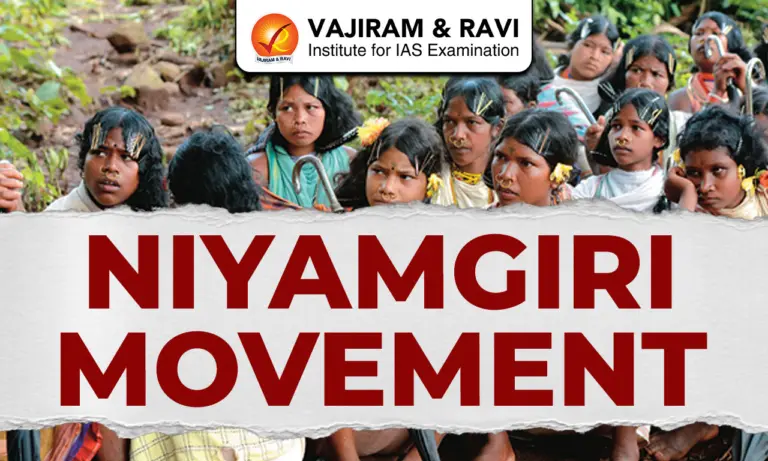
The Niyamgiri Movement refers to the struggle led by the Dongria Kondh tribe against bauxite mining in the Niyamgiri Hills of Odisha. The movement opposed the proposal by Vedanta Resources, a multinational mining company, to extract bauxite from the hills, which are considered sacred by the tribal community.
The movement began in the early 2000s and became a powerful symbol of the fight for tribal rights, environmental conservation, and sustainable development.
Niyamgiri Movement Causes
The Niyamgiri Movement emerged due to the conflict between industrial mining interests and the rights of indigenous communities over their land and resources.
- Violation of Tribal Rights: The mining project ignored the rights of the Dongria Kondh under the Forest Rights Act, 2006, threatening their traditional ownership of forest land.
- Religious and Cultural Threat: The Niyamgiri Hills are sacred to the tribe, who worship Niyam Raja. Mining was seen as an attack on their faith and identity.
- Environmental Degradation: Large-scale mining would lead to deforestation, soil erosion, and loss of biodiversity in an ecologically sensitive region.
- Livelihood Loss: The tribal community depends on forests for food, water, and shelter. Mining would disrupt their sustainable way of life.
- Displacement and Rehabilitation Issues: The project risked displacing thousands of tribal families without proper rehabilitation measures.
- Corporate Exploitation Concerns: The involvement of a multinational company raised fears of exploitation of natural resources without benefiting local communities.
- Lack of Consent (Gram Sabha Ignored): The project initially moved forward without proper consent from local Gram Sabhas, violating democratic processes.
Niyamgiri Movement Importance
The Niyamgiri Movement is highly significant as it highlights the protection of tribal rights, environmental conservation, and democratic decision-making in India.
- Protection of Tribal Rights: It safeguarded the rights of the Dongria Kondh tribe over their ancestral land under the Forest Rights Act, 2006.
- Environmental Conservation: The movement prevented large-scale deforestation and protected the rich biodiversity of the Niyamgiri Hills.
- Empowerment of Gram Sabhas: It strengthened the role of village councils by giving them the authority to decide on development projects affecting their land.
- Landmark Judicial Precedent: The Supreme Court’s decision became a milestone in promoting decentralized governance and tribal autonomy.
- Promotion of Sustainable Development: It emphasized that development should be inclusive and not harm nature or local communities.
- Global Recognition: The movement gained international attention as a successful example of indigenous resistance and environmental justice.
- Model for Future Movements: It inspired similar protests across India against environmentally harmful and socially unjust projects.





Who are the Dongoria Kondhs?
The Dongria Kondh are an indigenous tribal community living in the Niyamgiri Hills of Odisha, mainly in the Rayagada and Kalahandi districts. They are known for their deep connection with nature and depend on forests for food, livelihood, and shelter. The community practices sustainable agriculture and worships Niyam Raja, considering the hills sacred. They gained national recognition for leading the Niyamgiri Movement against bauxite mining to protect their land and culture.
About Niyamgiri Hill
- The Niyamgiri Hills are located in the Odisha, mainly across Kalahandi and Rayagada districts.
- These hills are part of the Eastern Ghats mountain range and are known for their rich mineral deposits, especially bauxite.
- They are home to the Dongria Kondh tribe, a Particularly Vulnerable Tribal Group (PVTG).
- The hills are considered sacred, and the tribe worships Niyam Raja, their supreme deity.
- Niyamgiri Hills are rich in biodiversity, including dense forests, rare wildlife, and medicinal plants.
- They act as a water source, giving rise to important rivers like Vamsadhara and Nagavali.
- The region supports traditional livelihoods such as shifting cultivation (podu farming), hunting, and gathering forest produce.
- The hills are an ecologically sensitive zone, crucial for maintaining regional climate and ecology.

 Last updated on April, 2026
→ UPSC Final Result 2025 is now out.
→ UPSC has released UPSC Toppers List 2025 with the Civil Services final result on its official website.
→ Anuj Agnihotri secured AIR 1 in the UPSC Civil Services Examination 2025.
→ UPSC Marksheet 2025 is now out.
→ UPSC Notification 2026 & UPSC IFoS Notification 2026 is now out on the official website at upsconline.nic.in.
→ UPSC Calendar 2026 has been released.
→ Check out the latest UPSC Syllabus 2026 here.
→ UPSC Prelims 2026 will be conducted on 24th May, 2026 & UPSC Mains 2026 will be conducted on 21st August 2026.
→ The UPSC Selection Process is of 3 stages-Prelims, Mains and Interview.
→ Prepare effectively with Vajiram & Ravi’s UPSC Prelims Test Series 2026 featuring full-length mock tests, detailed solutions, and performance analysis.
→ Enroll in Vajiram & Ravi’s UPSC Mains Test Series 2026 for structured answer writing practice, expert evaluation, and exam-oriented feedback.
→ Join Vajiram & Ravi’s Best UPSC Mentorship Program for personalized guidance, strategy planning, and one-to-one support from experienced mentors.
→ Shakti Dubey secures AIR 1 in UPSC CSE Exam 2024.
→ Also check Best UPSC Coaching in India
Niyamgiri Movement FAQs
Q1. What is the Niyamgiri Movement?+
Q2. Which tribe led the movement?+
Q3. Which company was involved in the mining project?+
Q4. What was the Supreme Court’s role?+
Q5. Why is the movement important?+
Tags: environmental studies niyamgiri movement sociology