No-Fault Vaccine Compensation Latest News
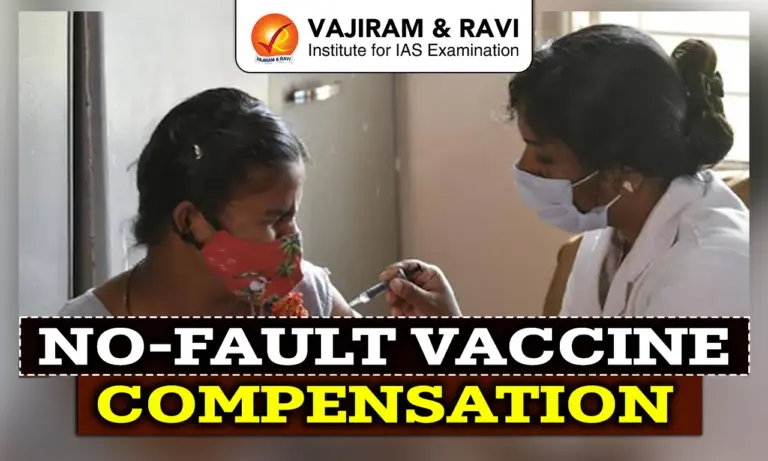
- The Supreme Court directed the Centre to create a “no-fault” compensation policy for people who suffered serious side effects or died after receiving Covid vaccines.
- The Court said victims’ families should not have to prove negligence in courts and that the State must provide a structured compensation mechanism as part of its public health responsibility during the vaccination drive.
Background: Vaccine Injury Cases Before the Supreme Court
- The Supreme Court heard petitions filed by families who lost their children or spouses, aged between 18 and 40 years, due to rare complications such as blood clotting disorders after receiving Covishield and Covaxin vaccines in 2021.
Petitioners’ Arguments
- Lack of Informed Consent – The petitioners argued that the government failed to ensure proper informed consent and did not adequately communicate the potential risks associated with the Covid vaccines.
- Vaccination Effectively Mandatory – They also contended that although vaccination was officially voluntary, administrative restrictions on unvaccinated individuals effectively made it mandatory, thereby infringing their fundamental rights.
Government’s Defence
- Safety and Regulatory Approval – The Union government maintained that the vaccines had undergone rigorous regulatory approvals and that India’s system for detecting Adverse Events Following Immunisation (AEFI) was robust.
- Rare Incidence of Vaccine-Related Deaths – It argued that vaccine-related deaths were extremely rare, citing a reporting rate of 0.001 per one lakh doses for certain clotting disorders.
- Existing Legal Remedies – The government suggested that affected families could seek compensation by approaching civil or consumer courts and proving negligence by vaccine manufacturers.
Supreme Court’s Observations
- The Bench rejected the suggestion of pursuing individual cases in lower courts.
- It noted that proving negligence in vaccine injury cases involves complex scientific evidence, which places an excessive burden on families.
- The Court also warned that forcing families into multiple individual legal battles could lead to inconsistent outcomes and unequal access to relief, undermining the principle of equality under Article 14 of the Constitution.





No-Fault Liability and the Right to Health
- To address vaccine injury claims, the Supreme Court invoked the principle of “no-fault liability,” which allows victims or their families to receive compensation without proving negligence or wrongdoing.
- The Court noted that this principle already exists in Indian law, such as in motor vehicle accident compensation, and is commonly used in vaccine injury compensation schemes in countries like Australia, the United Kingdom, and Japan.
Constitutional Basis under Article 21
- The judgment relied on Article 21 of the Constitution, which guarantees the right to life and the right to health.
- The Court emphasised that the State cannot remain a passive observer to human suffering but must act as a guardian of welfare and dignity.
- Since the Covid-19 vaccination programme was a State-led public health initiative, the government has a responsibility to support those who suffered serious adverse outcomes, regardless of how rare they are.
Reference to Earlier Supreme Court Ruling
- The Court clarified that it was not reviewing the scientific validity of the vaccines.
- It cited its 2022 judgment in Jacob Puliyel vs Union of India, which upheld the legality of the vaccine approval process and the AEFI monitoring system, while affirming that bodily integrity under Article 21 means vaccination cannot be forcibly imposed.
Adequacy of Existing AEFI Mechanisms
- Based on the earlier ruling, the Court refused to establish a separate expert medical board to investigate vaccine-related deaths.
- It stated that the existing AEFI committees are sufficient for monitoring and investigation.
Directive to Formulate Compensation Framework
- The Supreme Court directed the Ministry of Health and Family Welfare to quickly develop and publish a no-fault compensation policy for serious adverse events related to the Covid-19 vaccination drive.
- It clarified that such a policy should not be treated as an admission of liability or fault by the Union government.
Supreme Court’s Direction on Compensation for Covid-19 Deaths
- The Supreme Court’s recent judgment on vaccine injury compensation reflects its earlier intervention during the pandemic in the 2021 case of Gaurav Kumar Bansal vs Union of India, which dealt with financial relief for families of Covid-19 victims.
- It directed the NDMA to frame guidelines for providing ex gratia compensation to families of those who died due to Covid-19.
NDMA Guidelines on Ex Gratia Compensation
- Following the Court’s direction, the NDMA issued guidelines in September 2021, fixing an ex gratia amount of ₹50,000 for each Covid-19 death, to be paid by states through the State Disaster Response Fund (SDRF).
- To ensure fair access to compensation, a simplified procedure was introduced.
- Deaths occurring within 30 days of a positive Covid-19 test were treated as Covid deaths, and district-level grievance redressal committees were established to resolve disputes over death certificates.

 Last updated on March, 2026
→ UPSC Final Result 2025 is now out.
→ UPSC has released UPSC Toppers List 2025 with the Civil Services final result on its official website.
→ Anuj Agnihotri secured AIR 1 in the UPSC Civil Services Examination 2025.
→ UPSC Marksheet 2025 is now out.
→ UPSC Notification 2026 & UPSC IFoS Notification 2026 is now out on the official website at upsconline.nic.in.
→ UPSC Calendar 2026 has been released.
→ Check out the latest UPSC Syllabus 2026 here.
→ UPSC Prelims 2026 will be conducted on 24th May, 2026 & UPSC Mains 2026 will be conducted on 21st August 2026.
→ The UPSC Selection Process is of 3 stages-Prelims, Mains and Interview.
→ Prepare effectively with Vajiram & Ravi’s UPSC Prelims Test Series 2026 featuring full-length mock tests, detailed solutions, and performance analysis.
→ Enroll in Vajiram & Ravi’s UPSC Mains Test Series 2026 for structured answer writing practice, expert evaluation, and exam-oriented feedback.
→ Join Vajiram & Ravi’s Best UPSC Mentorship Program for personalized guidance, strategy planning, and one-to-one support from experienced mentors.
→ Shakti Dubey secures AIR 1 in UPSC CSE Exam 2024.
→ Also check Best UPSC Coaching in India
No-Fault Vaccine Compensation FAQs
Q1. What is No-Fault Vaccine Compensation?+
Q2. Why did the Supreme Court order No-Fault Vaccine Compensation? +
Q3. What constitutional principle supports No-Fault Vaccine Compensation?+
Q4. What earlier case influenced the Supreme Court’s reasoning?+
Q5. How does the ruling relate to earlier Covid compensation policies?+
Tags: mains articles No-Fault Vaccine Compensation upsc current affairs upsc mains current affairs