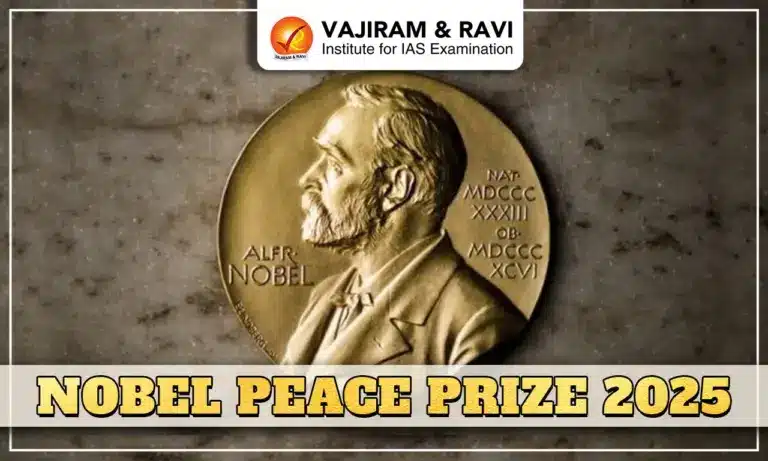
The Nobel Peace Prize 2025 is one of the six prestigious awards established by Alfred Nobel’s will in 1895. It is awarded annually by the Norwegian Nobel Committee, elected by the Norwegian Parliament (Stortinget), to individuals or organisations that have made outstanding contributions to promoting peace, reducing armed conflict, and fostering international fraternity. The prize aims to encourage efforts that bring the greatest benefit to humanity, in line with Nobel’s vision of social progress and global harmony.
Why Nobel Peace Prize in News?
Venezuela’s María Corina Machado presented her Nobel Peace Prize medal to Donald Trump during a meeting at the White House, calling it a symbolic gesture of gratitude for his role in supporting Venezuelan freedom.
Nobel Peace Prize 2025
The Nobel Peace Prize 2025 was awarded to Maria Corina Machado on Friday, 10 October 2025 at 11:00 CEST for her tireless efforts in promoting democratic rights in Venezuela and striving for a peaceful transition from dictatorship to democracy. The Norwegian Nobel Committee, responsible for selecting laureates, received a total of 338 nominations, including 94 organisations, reflecting global recognition of peace efforts. The committee considers candidates whose work aligns with Alfred Nobel’s stipulation of promoting fraternity between nations, reducing standing armies, or supporting peace congresses. Nominations are strictly confidential and cannot be made posthumously, ensuring that the prize reflects ongoing contributions to global peace.
Also Check: Nobel Prize 2025 in Medicine





Nobel Peace Prize 2025 Historical Background
The Nobel Peace Prize 2025, established in 1901 by Alfred Nobel, recognizes individuals or organisations promoting peace, disarmament, and global harmony.
- Foundation and Purpose (1895-1901)
- 1895: Alfred Nobel’s will specified a prize for those promoting fraternity between nations, reducing standing armies, or supporting peace congresses.
Influence: Nobel was inspired by Bertha von Suttner, a peace activist, to include the peace category. - Awarding Body: The prize is administered by the Norwegian Nobel Committee, elected by Norway’s Parliament (Stortinget).
- Early Years (1901-1940s)
- First Award: The prize was first awarded in 1901.
- Organisations Recognized: The International Committee of the Red Cross won the prize in 1917 and 1944 for humanitarian efforts during wars.
- Post-War Era (1950s-1970s)
- 1954: The Office of the UN High Commissioner for Refugees (UNHCR) received the prize for assisting refugees, repeated in 1981.
- Focus shifted to reconstruction, diplomacy, and refugee aid after World War II.
- Modern Era (1980s-2000s)
- Recognized individuals and organisations working on human rights, democracy, and disarmament.
- Women Laureates: Increased recognition of women leaders in peace, with 19 women receiving the prize historically.
- Recent Trends (2010s-2024)
- Focus on grassroots activism, nuclear disarmament, and social justice movements.
- 2024 Award: Nihon Hidankyo, representing Hiroshima and Nagasaki atomic bomb survivors, honored for raising awareness on nuclear weapons and advocating disarmament.
Also Check: Nobel Prize Winners 2025 in Physics
Nobel Peace Prize Laureates
The following table lists all Nobel Peace Prize laureates from 1901 to 2024, highlighting their outstanding contributions to peace, human rights, and international cooperation.
| Nobel Prize in Peace 2025 Laureates | ||
| Year | Name | Contribution |
|
2025 |
Maria Corina Machado |
for her tireless work promoting democratic rights for the people of Venezuela and for her struggle to achieve a just and peaceful transition from dictatorship to democracy |
|
2024 |
Nihon Hidankyo |
For efforts to achieve a world free of nuclear weapons and demonstrating through witness testimony that nuclear weapons must never be used again |
|
2023 |
Narges Mohammadi |
For her fight against oppression of women in Iran and promotion of human rights and freedom |
|
2022 |
Ales Bialiatski, Memorial, Center for Civil Liberties |
Representing civil society, promoted the right to criticise power, documented war crimes, and protected fundamental rights |
|
2021 |
Maria Ressa, Dmitry Muratov |
For efforts to safeguard freedom of expression, a precondition for democracy and lasting peace |
|
2020 |
World Food Programme |
For combating hunger, contributing to peace in conflict areas, and preventing hunger as a weapon of war |
|
2019 |
Abiy Ahmed Ali |
For achieving peace and international cooperation, especially resolving the border conflict with Eritrea |
|
2018 |
Denis Mukwege, Nadia Murad |
For efforts to end sexual violence as a weapon of war and armed conflict |
|
2017 |
International Campaign to Abolish Nuclear Weapons |
For highlighting catastrophic humanitarian consequences of nuclear weapons and promoting treaty-based prohibition |
|
2016 |
Juan Manuel Santos |
For resolute efforts to end Colombia’s 50-year-long civil war |
|
2015 |
National Dialogue Quartet |
For decisive contribution to building a pluralistic democracy in Tunisia after the Jasmine Revolution |
|
2014 |
Kailash Satyarthi, Malala Yousafzai |
For struggle against suppression of children and promoting the right of all children to education |
|
2013 |
Organisation for the Prohibition of Chemical Weapons |
For extensive efforts to eliminate chemical weapons |
|
2012 |
European Union |
For over six decades contributing to peace, reconciliation, democracy, and human rights in Europe |
|
2011 |
Ellen Johnson Sirleaf, Leymah Gbowee, Tawakkol Karman |
For non-violent struggle for women’s safety and participation in peace-building |
|
2010 |
Liu Xiaobo |
For long and non-violent struggle for fundamental human rights in China |
|
2009 |
Barack H. Obama |
For extraordinary efforts to strengthen international diplomacy and cooperation between peoples |
|
2008 |
Martti Ahtisaari |
For efforts to resolve international conflicts on several continents over three decades |
|
2007 |
Intergovernmental Panel on Climate Change, Al Gore |
For disseminating knowledge about man-made climate change and laying foundations for countermeasures |
|
2006 |
Muhammad Yunus, Grameen Bank |
For creating economic and social development from below |
|
2005 |
International Atomic Energy Agency, Mohamed ElBaradei |
For efforts to prevent nuclear energy from being used militarily and ensuring safe peaceful use |
|
2004 |
Wangari Maathai |
For contribution to sustainable development, democracy, and peace |
|
2003 |
Shirin Ebadi |
For efforts for democracy and human rights, especially women and children’s rights |
|
2002 |
Jimmy Carter |
For decades of effort to find peaceful solutions, advance democracy and human rights, and promote economic and social development |
|
2001 |
United Nations, Kofi Annan |
For work towards a better organized and more peaceful world |
|
2000 |
Kim Dae-jung |
For work for democracy, human rights, and peace and reconciliation with North Korea |
|
1999 |
Doctors Without Borders |
For pioneering humanitarian work on several continents |
|
1998 |
John Hume, David Trimble |
For efforts to find a peaceful solution to the conflict in Northern Ireland |
|
1997 |
International Campaign to Ban Landmines, Jody Williams |
For work in banning and clearing anti-personnel mines |
|
1996 |
Carlos Filipe Ximenes Belo, José Ramos-Horta |
For efforts towards a just and peaceful solution to the conflict in East Timor |
|
1995 |
Joseph Rotblat, Pugwash Conferences |
For efforts to diminish nuclear arms’ role in politics and eliminate them in the long run |
|
1994 |
Yasser Arafat, Shimon Peres, Yitzhak Rabin |
For efforts to create peace in the Middle East |
|
1993 |
Nelson Mandela, F.W. de Klerk |
For work to end apartheid peacefully and lay foundations for democratic South Africa |
|
1992 |
Rigoberta Menchú Tum |
For struggle for social justice and ethno-cultural reconciliation respecting indigenous peoples’ rights |
|
1991 |
Aung San Suu Kyi |
For non-violent struggle for democracy and human rights |
|
1990 |
Mikhail Gorbachev |
For leading role in radical changes in East-West relations |
|
1989 |
The 14th Dalai Lama |
For advocating peaceful solutions based on tolerance and mutual respect to preserve cultural heritage |
|
1988 |
United Nations Peacekeeping Forces |
For preventing armed clashes and creating conditions for negotiations |
|
1987 |
Oscar Arias Sánchez |
For work for lasting peace in Central America |
|
1986 |
Elie Wiesel |
For being a messenger of peace, atonement, and dignity |
|
1985 |
International Physicians for the Prevention of Nuclear War |
For spreading awareness of catastrophic consequences of nuclear war |
|
1984 |
Desmond Tutu |
For role as unifying leader in non-violent campaign to end apartheid in South Africa |
|
1983 |
Lech Wałęsa |
For non-violent struggle for free trade unions and human rights in Poland |
|
1982 |
Alva Myrdal, Alfonso García Robles |
For work for disarmament and nuclear-free zones |
|
1981 |
Office of the United Nations High Commissioner for Refugees |
For promoting fundamental rights of refugees |
|
1980 |
Adolfo Pérez Esquivel |
For being an inspiration to repressed people, especially in Latin America |
|
1979 |
Mother Teresa |
For work bringing help to suffering humanity |
|
1978 |
Anwar al-Sadat, Menachem Begin |
For jointly negotiating peace between Egypt and Israel |
|
1977 |
Amnesty International |
For promoting worldwide respect for human rights |
|
1976 |
Betty Williams, Mairead Corrigan |
For founding a movement to end violent conflict in Northern Ireland |
|
1975 |
Andrei Sakharov |
For struggle for human rights, disarmament, and international cooperation |
|
1974 |
Seán MacBride |
For securing and developing human rights globally |
|
1974 |
Eisaku Satō |
For stabilizing conditions in the Pacific and signing the Nuclear Non-Proliferation Treaty |
|
1973 |
Henry Kissinger, Le Duc Tho |
For negotiating a ceasefire in Vietnam |
|
1972 |
Not awarded |
Prize money allocated to the Main Fund |
|
1971 |
Willy Brandt |
For paving way for meaningful dialogue between East and West |
|
1970 |
Norman Borlaug |
For providing hope via the Green Revolution |
|
1969 |
International Labour Organization |
For creating international legislation ensuring working condition norms |
|
1968 |
René Cassin |
For struggle to ensure human rights as stipulated in UN Declaration |
|
1967 |
Not awarded |
1/3 to main fund, 2/3 to special fund |
|
1966 |
Not awarded |
Prize money allocated to Special Fund |
|
1965 |
United Nations Children’s Fund |
For enhancing solidarity between nations and reducing differences between rich and poor states |
|
1964 |
Martin Luther King Jr. |
For non-violent struggle for civil rights for Afro-Americans |
|
1963 |
International Committee of the Red Cross, League of Red Cross Societies |
For promoting Geneva Convention principles and cooperation with UN |
|
1962 |
Linus Pauling |
For fight against the nuclear arms race |
|
1961 |
Dag Hammarskjöld |
For developing UN into an effective international organization |
|
1960 |
Albert Lutuli |
For non-violent struggle against apartheid |
|
1959 |
Philip Noel-Baker |
For longstanding contribution to disarmament and peace |
|
1958 |
Georges Pire |
For helping refugees leave camps and return to life of dignity |
|
1957 |
Lester Bowles Pearson |
For crucial contribution to UN Emergency Force deployment after Suez Crisis |
|
1956 |
Not awarded |
1/3 to main fund, 2/3 to special fund |
|
1955 |
Not awarded |
Prize money allocated to Special Fund |
|
1954 |
Office of UN High Commissioner for Refugees |
For helping refugees worldwide and healing war wounds |
|
1953 |
George C. Marshall |
For proposing and supervising Europe’s economic recovery plan |
|
1952 |
Albert Schweitzer |
For altruism, reverence for life, and humanitarian work |
|
1951 |
Léon Jouhaux |
For fight against war via social justice and brotherhood |
|
1950 |
Ralph Bunche |
For work as mediator in Palestine (1948-49) |
|
1949 |
Lord Boyd Orr |
For lifelong effort to conquer hunger, removing a major cause of conflict |
|
1948 |
Not awarded |
1/3 to main fund, 2/3 to special fund |
|
1947 |
Friends Service Council, American Friends Service Committee |
For pioneering work in international peace movement and relieving human suffering |
|
1946 |
Emily Greene Balch |
For lifelong work for peace |
|
1946 |
John R. Mott |
For contribution to peace-promoting religious brotherhood across nations |
|
1945 |
Cordell Hull |
For indefatigable work for international understanding and UN establishment |
|
1944 |
International Committee of the Red Cross |
For humanitarian work during the war |
|
1943 |
Not awarded |
1/3 to main fund, 2/3 to special fund |
|
1942 |
Not awarded |
1/3 to main fund, 2/3 to special fund |
|
1941 |
Not awarded |
1/3 to main fund, 2/3 to special fund |
|
1940 |
Not awarded |
1/3 to main fund, 2/3 to special fund |
|
1939 |
Not awarded |
1/3 to main fund, 2/3 to special fund |
|
1938 |
Nansen International Office for Refugees |
For work benefiting refugees across Europe |
|
1937 |
Robert Cecil, Viscount Cecil of Chelwood |
For efforts supporting League of Nations, disarmament, and peace |
|
1936 |
Carlos Saavedra Lamas |
For Argentine Antiwar Pact mediation and peace efforts |
|
1935 |
Carl von Ossietzky |
For advocating freedom of thought and contributing to peace |
|
1934 |
Arthur Henderson |
For untiring efforts as Chairman of League of Nations Disarmament Conference |
|
1933 |
Sir Norman Angell |
For exposing illusion of war and promoting international cooperation |
|
1932 |
Not awarded |
Prize money allocated to Special Fund |
|
1931 |
Jane Addams, Nicholas Murray Butler |
For assiduous effort to revive and rekindle peace spirit |
|
1930 |
Nathan Söderblom |
For promoting Christian unity and creating mindset necessary for peace |
|
1929 |
Frank B. Kellogg |
For crucial role in Briand-Kellogg Pact |
|
1928 |
Not awarded |
Prize money allocated to Special Fund |
|
1927 |
Ferdinand Buisson, Ludwig Quidde |
For promoting public opinion favoring peaceful international cooperation |
|
1926 |
Aristide Briand, Gustav Stresemann |
For crucial role in Locarno Treaty |
|
1925 |
Sir Austen Chamberlain |
For role in Locarno Treaty |
|
1925 |
Charles G. Dawes |
For role in Dawes Plan |
|
1924 |
Not awarded |
Prize money allocated to Special Fund |
|
1923 |
Not awarded |
Prize money allocated to Special Fund |
|
1922 |
Fridtjof Nansen |
For repatriation of prisoners of war, international relief work, and UN refugee work |
|
1921 |
Hjalmar Branting, Christian Lange |
For lifelong contributions to peace and organized internationalism |
|
1920 |
Léon Bourgeois |
For contributions to peace, justice, and League of Nations establishment |
|
1919 |
Woodrow Wilson |
For role as founder of League of Nations |
|
1918 |
Not awarded |
Prize money allocated to Special Fund |
|
1917 |
International Committee of the Red Cross |
For efforts to care for wounded soldiers, POWs, and their families |
|
1916 |
Not awarded |
Prize money allocated to Special Fund |
|
1915 |
Not awarded |
Prize money allocated to Special Fund |
|
1914 |
Not awarded |
Prize money allocated to Special Fund |
|
1913 |
Henri La Fontaine |
For contribution to peaceful internationalism |
|
1912 |
Elihu Root |
For better understanding between North and South America, initiating arbitration agreements |
|
1911 |
Tobias Asser |
For co-founding Institut de droit international and initiating Hague Conferences |
|
1911 |
Alfred Fried |
For efforts exposing and fighting causes of war |
|
1910 |
Permanent International Peace Bureau |
For linking peace societies worldwide and organizing international peace rallies |
|
1909 |
Auguste Beernaert, Paul Henri d’Estournelles de Constant |
For prominent positions in international peace and arbitration movement |
|
1908 |
Klas Pontus Arnoldson, Fredrik Bajer |
For long-time work for peace as politicians, leaders, and authors |
|
1907 |
Ernesto Teodoro Moneta |
For press and peace meetings promoting understanding between France and Italy |
|
1907 |
Louis Renault |
For decisive influence on Hague and Geneva Conferences |
|
1906 |
Theodore Roosevelt |
For ending war between Japan and Russia |
|
1905 |
Bertha von Suttner |
For audacity opposing the horrors of war |
|
1904 |
Institute of International Law |
For striving to develop peaceful international ties and humane laws of war |
|
1903 |
Randal Cremer |
For devoted effort in favor of peace and arbitration |
|
1902 |
Élie Ducommun |
For untiring direction of Bern Peace Bureau |
|
1902 |
Albert Gobat |
For practical administration of Inter-Parliamentary Union |
|
1901 |
Henry Dunant |
For humanitarian efforts helping wounded soldiers and creating international understanding |
|
1901 |
Frédéric Passy |
For lifelong work for international peace conferences, diplomacy, and arbitration |

 Last updated on March, 2026
→ UPSC Final Result 2025 is now out.
→ UPSC has released UPSC Toppers List 2025 with the Civil Services final result on its official website.
→ Anuj Agnihotri secured AIR 1 in the UPSC Civil Services Examination 2025.
→ UPSC Marksheet 2025 is now out.
→ UPSC Notification 2026 & UPSC IFoS Notification 2026 is now out on the official website at upsconline.nic.in.
→ UPSC Calendar 2026 has been released.
→ Check out the latest UPSC Syllabus 2026 here.
→ UPSC Prelims 2026 will be conducted on 24th May, 2026 & UPSC Mains 2026 will be conducted on 21st August 2026.
→ The UPSC Selection Process is of 3 stages-Prelims, Mains and Interview.
→ Prepare effectively with Vajiram & Ravi’s UPSC Prelims Test Series 2026 featuring full-length mock tests, detailed solutions, and performance analysis.
→ Enroll in Vajiram & Ravi’s UPSC Mains Test Series 2026 for structured answer writing practice, expert evaluation, and exam-oriented feedback.
→ Join Vajiram & Ravi’s Best UPSC Mentorship Program for personalized guidance, strategy planning, and one-to-one support from experienced mentors.
→ Shakti Dubey secures AIR 1 in UPSC CSE Exam 2024.
→ Also check Best UPSC Coaching in India
Nobel Peace Prize 2025 FAQs
Q1. When will the Nobel Peace Prize 2025 be announced?+
Q2. Who awards the Nobel Peace Prize?+
Q3. Can organisations win the Nobel Peace Prize?+
Q4. How many Nobel Peace Prize 2025 have been awarded till now?+
Q5. Are nominations for the Nobel Peace Prize 2025 public?+
Tags: nobel peace prize 2025