Nobel Prize in Medicine Latest News
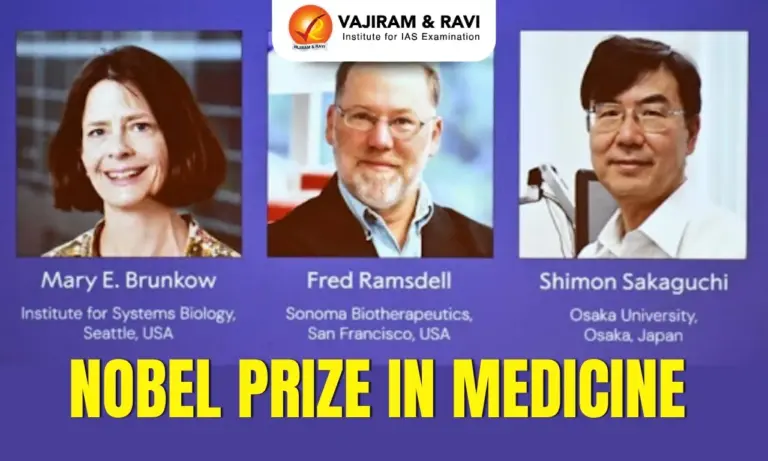
- The 2025 Nobel Prize in Physiology or Medicine, the first of this year’s awards, has been jointly given to Mary E. Brunkow and Fred Ramsdell of the USA, and Shimon Sakaguchi of Japan, for their groundbreaking discoveries on the human immune system.
- Their work represents two interconnected phases — Sakaguchi’s earlier research laid the foundation, while Brunkow and Ramsdell’s later findings complemented and completed it, together advancing understanding of immune regulation and tolerance.
- The Medicine Prize traditionally opens the Nobel season, followed by those for Physics, Chemistry, Literature, Peace, and Economics.
The Discovery: Key Cells That Prevent the Body from Attacking Itself
- The 2025 Nobel Prize in Medicine laureates — Mary Brunkow, Fred Ramsdell, and Shimon Sakaguchi — were honoured for discovering the mechanism of peripheral immune tolerance.
- Their research revealed regulatory T cells, the body’s “immune security guards,” which prevent immune cells from attacking healthy tissues.
- This breakthrough has been crucial to understanding autoimmune diseases and developing targeted therapies for immune-related disorders and cancers.
- For years, scientists were puzzled by how the immune system fights infections without harming the body’s own cells.
- By the 1980s, they understood central tolerance, where self-reactive T cells are eliminated. But this couldn’t explain all immune regulation.
- In 1995, Shimon Sakaguchi provided groundbreaking evidence for a special class of T cells, later called regulatory T cells, which act as “police” preventing other T cells from attacking healthy tissues.
Read About: Nobel Prize Winners 2025





The Immune System and the Discovery of Regulatory T Cells
- The immune system protects the body from thousands of microbes daily, distinguishing between harmful invaders and the body’s own healthy cells.
- When this identification fails, it leads to autoimmune diseases or organ transplant rejection.
- T cells are central to this defence: helper T cells detect threats, while killer T cells destroy them.
- Traditionally, scientists believed the thymus gland ensured immune tolerance by filtering out self-attacking T cells — a process called central tolerance.
- However, the 2025 Nobel laureates — Mary Brunkow, Fred Ramsdell, and Shimon Sakaguchi — discovered an additional layer of control.
- This control involved regulatory T cells, which act as immune system “security guards”, preventing other T cells from attacking the body’s own tissues.
- This breakthrough transformed the understanding of immune regulation and opened new paths for treating autoimmune and transplant-related disorders.
Shimon Sakaguchi’s Discovery of Regulatory T Cells
- In the mid-1990s, Shimon Sakaguchi challenged prevailing scientific views by proposing that certain specialised T cells act as “security guards” of the immune system, preventing excessive immune reactions.
- Through experiments on mice without a thymus, into which mature T cells were later injected, he identified a unique class of cells — now known as regulatory T cells — that suppress other T cells attacking the body’s own tissues.
- Although initially overlooked due to skepticism from earlier unconvincing studies, Sakaguchi’s insight later became a cornerstone of modern immunology, redefining how the body maintains self-tolerance.
Brunkow and Ramsdell Linked the FOXP3 Gene to Immune Regulation
- Working independently from Sakaguchi, Mary Brunkow and Fred Ramsdell studied sick male mice and traced their condition to a mutation linked to a rare human autoimmune disorder called IPEX.
- Both the mouse disease and IPEX were caused by defects in the FOXP3 gene.
- Subsequent research confirmed that the FOXP3 gene is crucial for the development of regulatory T cells — the same immune “security guards” that Sakaguchi had discovered earlier.
- Together, their complementary findings explained how the immune system maintains self-tolerance and laid the scientific foundation for the 2025 Nobel Prize in Medicine.
How the Nobel-Winning Discoveries Are Transforming Medicine
- The discoveries of regulatory T cells and the FOXP3 gene have revolutionised immune-regulation research, opening new therapeutic pathways for several major diseases.
- In cancer, scientists are exploring ways to block regulatory T cells that shield tumours from immune attacks, helping the body’s defences target cancer cells more effectively.
- In contrast, for autoimmune diseases, treatments aim to enhance regulatory T cell activity to suppress harmful immune responses that damage healthy tissues.
- These insights are also improving organ transplant success, helping prevent rejection by fine-tuning the immune system’s response.
- Overall, the discoveries have laid the groundwork for precision immunotherapy and targeted treatment innovations.

 Last updated on March, 2026
→ UPSC Final Result 2025 is now out.
→ UPSC has released UPSC Toppers List 2025 with the Civil Services final result on its official website.
→ Anuj Agnihotri secured AIR 1 in the UPSC Civil Services Examination 2025.
→ UPSC Marksheet 2025 is now out.
→ UPSC Notification 2026 & UPSC IFoS Notification 2026 is now out on the official website at upsconline.nic.in.
→ UPSC Calendar 2026 has been released.
→ Check out the latest UPSC Syllabus 2026 here.
→ UPSC Prelims 2026 will be conducted on 24th May, 2026 & UPSC Mains 2026 will be conducted on 21st August 2026.
→ The UPSC Selection Process is of 3 stages-Prelims, Mains and Interview.
→ Prepare effectively with Vajiram & Ravi’s UPSC Prelims Test Series 2026 featuring full-length mock tests, detailed solutions, and performance analysis.
→ Enroll in Vajiram & Ravi’s UPSC Mains Test Series 2026 for structured answer writing practice, expert evaluation, and exam-oriented feedback.
→ Join Vajiram & Ravi’s Best UPSC Mentorship Program for personalized guidance, strategy planning, and one-to-one support from experienced mentors.
→ Shakti Dubey secures AIR 1 in UPSC CSE Exam 2024.
→ Also check Best UPSC Coaching in India
Nobel Prize in Medicine FAQs
Q1. Who won the 2025 Nobel Prize in Medicine?+
Q2. What did the laureates discover?+
Q3. What is the role of regulatory T cells?+
Q4. Why is the FOXP3 gene important?+
Q5. How do these discoveries impact medicine?+
Tags: mains articles Nobel prize in medicine upsc current affairs upsc mains current affairs