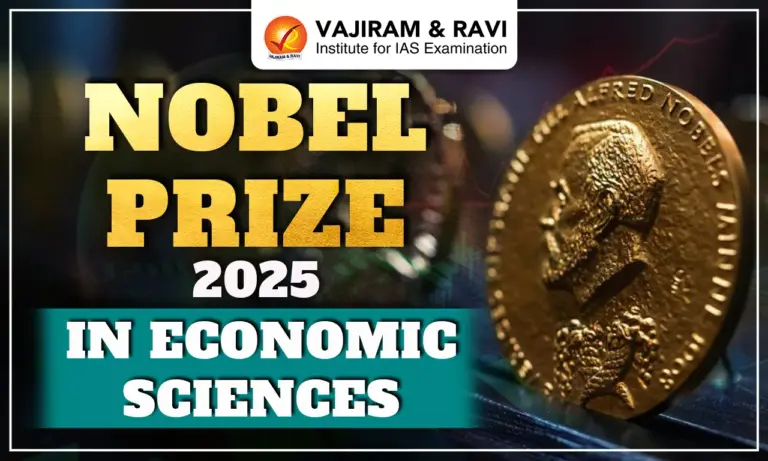
The Sveriges Riksbank Prize in Economic Sciences in Memory of Alfred Nobel, also called Nobel Prize in Economic Sciences 2025, established in 1968, recognizes outstanding contributions to economic theory, policy, and societal welfare. Awarded by the Royal Swedish Academy of Sciences, Stockholm, it follows the same principles as other Nobel Prizes and highlights work that deepens understanding of markets, institutions, and economic development, inspiring research and policy globally.
Nobel Prize in Economic Sciences 2025
The Nobel Prize in Economic Sciences 2025 was announced on Monday, 13 October 2025, at 11:45 CEST. This year, the prize recognizes Joel Mokyr, Philippe Aghion, and Peter Howitt for their pioneering research on innovation-driven economic growth. Mokyr identified the historical prerequisites for sustained technological progress, while Aghion and Howitt developed the theory of creative destruction, showing how new innovations replace old products. Since 1969, the prize has been awarded 57 times to 97 laureates, reflecting contributions from both emerging and experienced economists.
Also Check: Nobel Prize 2025 in Medicine
Nobel Prize in Economic Sciences Historical Background
The Nobel Prize in Economic Sciences was established to honor research that improves human understanding of economic systems and societal welfare.
- 1968- Prize created by Sveriges Riksbank, funding a donation to the Nobel Foundation on its 300th anniversary.
- 1969- First prize awarded; institutionally aligned with other Nobel Prizes.
- Focused on theoretical and empirical analysis of economic processes, including growth, trade, and consumption.
- Early emphasis on quantitative modeling and dynamic economic systems.
- Expanded in scope to include behavioral economics, governance, welfare, and development.
Also Check: Nobel Prize Winners 2025 in Physics





Nobel Prize in Economic Sciences Laureates
This table presents all Nobel Prize winners in Economic Sciences from 1969 to 2025, showing the laureates and their contributions:
| Nobel Prize in Economic Sciences Laureates | ||
| Year | Laureate(s) | Contribution / Citation |
|
2025 |
Joel Mokyr; Philippe Aghion and Peter Howitt |
“for having explained innovation-driven economic growth”
|
|
2024 |
Daron Acemoglu, Simon Johnson, James A. Robinson |
For studies of how institutions are formed and affect prosperity |
|
2023 |
Claudia Goldin |
For advancing understanding of women’s labour market outcomes |
|
2022 |
Ben Bernanke, Douglas Diamond, Philip Dybvig |
For research on banks and financial crises |
|
2021 |
David Card |
For his empirical contributions to labour economics |
|
2021 |
Joshua D. Angrist, Guido W. Imbens |
For methodological contributions to analysis of causal relationships |
|
2020 |
Paul R. Milgrom, Robert B. Wilson |
For improvements to auction theory and inventions of new auction formats |
|
2019 |
Abhijit Banerjee, Esther Duflo, Michael Kremer |
For experimental approach to alleviating global poverty |
|
2018 |
William D. Nordhaus |
For integrating climate change into long-run macroeconomic analysis |
|
2018 |
Paul M. Romer |
For integrating technological innovations into long-run macroeconomic analysis |
|
2017 |
Richard H. Thaler |
For contributions to behavioural economics |
|
2016 |
Oliver Hart, Bengt Holmström |
For contributions to contract theory |
|
2015 |
Angus Deaton |
For analysis of consumption, poverty, and welfare |
|
2014 |
Jean Tirole |
For analysis of market power and regulation |
|
2013 |
Eugene F. Fama, Lars Peter Hansen, Robert J. Shiller |
For empirical analysis of asset prices |
|
2012 |
Alvin E. Roth, Lloyd S. Shapley |
For theory of stable allocations and market design |
|
2011 |
Thomas J. Sargent, Christopher A. Sims |
For empirical research on cause and effect in the macroeconomy |
|
2010 |
Peter A. Diamond, Dale T. Mortensen, Christopher A. Pissarides |
For analysis of markets with search frictions |
|
2009 |
Elinor Ostrom |
For analysis of economic governance, especially the commons |
|
2009 |
Oliver E. Williamson |
For analysis of economic governance, especially boundaries of the firm |
|
2008 |
Paul Krugman |
For analysis of trade patterns and location of economic activity |
|
2007 |
Leonid Hurwicz, Eric S. Maskin, Roger B. Myerson |
For laying the foundations of mechanism design theory |
|
2006 |
Edmund S. Phelps |
For analysis of intertemporal tradeoffs in macroeconomic policy |
|
2005 |
Robert J. Aumann, Thomas C. Schelling |
For understanding conflict and cooperation through game theory |
|
2004 |
Finn E. Kydland, Edward C. Prescott |
For contributions to dynamic macroeconomics and business cycles |
|
2003 |
Robert F. Engle III |
For analyzing economic time series with time-varying volatility (ARCH) |
|
2003 |
Clive W.J. Granger |
For analyzing economic time series with common trends (cointegration) |
|
2002 |
Daniel Kahneman |
For integrating insights from psychology into economic science |
|
2002 |
Vernon L. Smith |
For establishing lab experiments as a tool in empirical economic analysis |
|
2001 |
George A. Akerlof, A. Michael Spence, Joseph E. Stiglitz |
For analyses of markets with asymmetric information |
|
2000 |
James J. Heckman |
For theory and methods for analyzing selective samples |
|
2000 |
Daniel L. McFadden |
For theory and methods for analyzing discrete choice |
|
1999 |
Robert Mundell |
For analysis of monetary and fiscal policy and optimum currency areas |
|
1998 |
Amartya Sen |
For contributions to welfare economics |
|
1997 |
Robert C. Merton, Myron Scholes |
For a new method to determine the value of derivatives |
|
1996 |
James A. Mirrlees, William Vickrey |
For contributions to economic theory of incentives under asymmetric information |
|
1995 |
Robert E. Lucas Jr. |
For developing and applying rational expectations, transforming macroeconomic analysis |
|
1994 |
John C. Harsanyi, John F. Nash Jr., Reinhard Selten |
For pioneering analysis of equilibria in non-cooperative games |
|
1993 |
Robert W. Fogel, Douglass C. North |
For renewing economic history research with theory and quantitative methods |
|
1992 |
Gary Becker |
For extending microeconomic analysis to human behaviour including nonmarket behaviour |
|
1991 |
Ronald H. Coase |
For clarifying significance of transaction costs and property rights |
|
1990 |
Harry M. Markowitz, Merton H. Miller, William F. Sharpe |
For pioneering work in theory of financial economics |
|
1989 |
Trygve Haavelmo |
For probability foundations of econometrics and analysis of simultaneous economic structures |
|
1988 |
Maurice Allais |
For contributions to theory of markets and efficient utilization of resources |
|
1987 |
Robert M. Solow |
For contributions to theory of economic growth |
|
1986 |
James M. Buchanan Jr. |
For contractual and constitutional bases for economic and political decision-making |
|
1985 |
Franco Modigliani |
For pioneering analyses of saving and financial markets |
|
1984 |
Richard Stone |
For contributions to development of national accounts for empirical economic analysis |
|
1983 |
Gerard Debreu |
For incorporating new analytical methods and reformulating general equilibrium theory |
|
1982 |
George J. Stigler |
For studies of industrial structures, markets, and effects of public regulation |
|
1981 |
James Tobin |
For analysis of financial markets and relation to expenditure, employment, production, prices |
|
1980 |
Lawrence R. Klein |
For creating econometric models for economic fluctuations and policies |
|
1979 |
Theodore W. Schultz, Sir Arthur Lewis |
For pioneering research into economic development of developing countries |
|
1978 |
Herbert Simon |
For research into decision-making within economic organizations |
|
1977 |
Bertil Ohlin, James E. Meade |
For contribution to theory of international trade and capital movements |
|
1976 |
Milton Friedman |
For achievements in consumption analysis, monetary theory, and stabilization policy |
|
1975 |
Leonid V. Kantorovich, Tjalling C. Koopmans |
For contributions to theory of optimum allocation of resources |
|
1974 |
Gunnar Myrdal, Friedrich von Hayek |
For pioneering work in theory of money, economic fluctuations, and interdependence of phenomena |
|
1973 |
Wassily Leontief |
For development of input-output method and application to economic problems |
|
1972 |
John R. Hicks, Kenneth J. Arrow |
For contributions to general economic equilibrium and welfare theory |
|
1971 |
Simon Kuznets |
For empirical interpretation of economic growth and social structure |
|
1970 |
Paul A. Samuelson |
For developing static and dynamic economic theory and raising level of analysis |
|
1969 |
Ragnar Frisch, Jan Tinbergen |
For developing and applying dynamic models for analysis of economic processes |

 Last updated on March, 2026
→ UPSC Final Result 2025 is now out.
→ UPSC has released UPSC Toppers List 2025 with the Civil Services final result on its official website.
→ Anuj Agnihotri secured AIR 1 in the UPSC Civil Services Examination 2025.
→ UPSC Marksheet 2025 is now out.
→ UPSC Notification 2026 & UPSC IFoS Notification 2026 is now out on the official website at upsconline.nic.in.
→ UPSC Calendar 2026 has been released.
→ Check out the latest UPSC Syllabus 2026 here.
→ UPSC Prelims 2026 will be conducted on 24th May, 2026 & UPSC Mains 2026 will be conducted on 21st August 2026.
→ The UPSC Selection Process is of 3 stages-Prelims, Mains and Interview.
→ Prepare effectively with Vajiram & Ravi’s UPSC Prelims Test Series 2026 featuring full-length mock tests, detailed solutions, and performance analysis.
→ Enroll in Vajiram & Ravi’s UPSC Mains Test Series 2026 for structured answer writing practice, expert evaluation, and exam-oriented feedback.
→ Join Vajiram & Ravi’s Best UPSC Mentorship Program for personalized guidance, strategy planning, and one-to-one support from experienced mentors.
→ Shakti Dubey secures AIR 1 in UPSC CSE Exam 2024.
→ Also check Best UPSC Coaching in India
Nobel Prize 2025 in Economic Sciences FAQs
Q1. When will the Nobel Prize in Economic Sciences 2025 be announced?+
Q2. Who awards the Nobel Prize in Economic Sciences?+
Q3. How many times has the Nobel Prize in Economic Sciences 2025 been awarded?+
Q4. When was the Nobel Prize in Economic Sciences 2025 established?+
Q5. Are women recognized in the Nobel Prize in Economic Sciences 2025?+
Tags: nobel prize 2025 in economic sciences