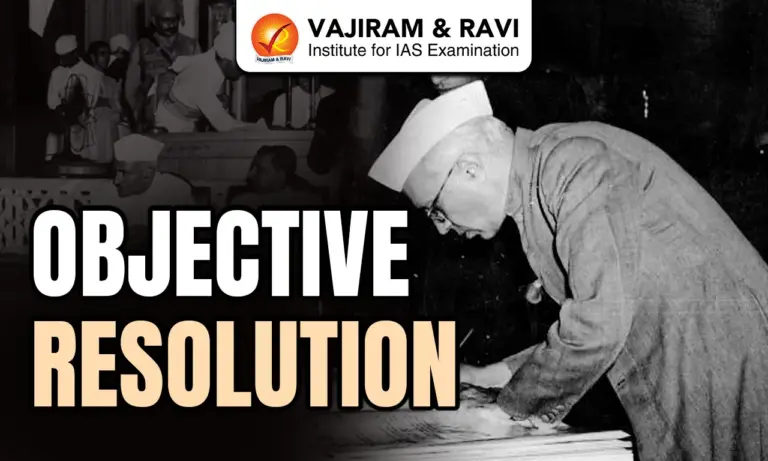
The Objective Resolution was a statement of goals and guiding principles for the making of the Indian Constitution. It explained what kind of country India wanted to become after independence. It expressed the idea of India as a sovereign republic and promised justice, equality and freedom to all people. The Resolution later became the foundation of the Preamble of the Indian Constitution.
Objective Resolution Historical Background
- In 1946, before the Constitution was written, Jawaharlal Nehru introduced the Objective Resolution in the Constituent Assembly. This Resolution explained the main aims and guiding principles for making the Constitution of India.
- It declared that India would become an Independent and Sovereign Republic. It also promised important values like justice, equality, liberty and democracy for all citizens. The Resolution ensured that the rights of minorities, backward classes and weaker sections would be protected.
- The Constituent Assembly accepted this Resolution on 22 January 1947. Later, its ideas were included in the Preamble of the Indian Constitution, which reflects the philosophy and basic spirit of the Constitution.
Objective Resolution Constituents
The Objective Resolution ideas reflect the basic values on which modern India is built. It clearly stated the vision for independent India. Its main points were:
- Sovereign Republic: India would be an independent and sovereign republic.
- Union of States: India would be a Union made up of former British Indian provinces, princely states and other areas willing to join.
- Autonomy of Units: The states would have powers in their own areas, except those given to the Union (central government).
- Power from the People: All authority of the government and the Constitution would come from the people of India.
- Justice and Equality: Every citizen would get social, economic and political justice, equality before law and equal opportunities.
- Fundamental Freedoms: People would enjoy freedoms like speech, belief, faith, worship, association and occupation, within the limits of law and morality.
- Protection of Weaker Sections: Minorities, backward classes, tribal groups and disadvantaged sections would be given proper safeguards.
- Unity and Integrity: India’s territorial integrity and sovereign rights over land, sea and air would be protected.
- World Peace: India would work for international peace and the welfare of humanity.






Reasons Behind the Adoption of the Objectives Resolution
Jawaharlal Nehru, while introducing the Objectives Resolution in the Constituent Assembly, shared the main reasons for adopting it:
- Unity in Diversity: India is a diverse country. The resolution was meant to show people the vision of the new Constitution and encourage them to take part in shaping the nation.
- Guiding Force: It was intended to guide the Constitution-makers on the principles and values India should follow.
- Explaining the Spirit: Since legal language can be technical, the resolution explained the spirit and purpose behind the Constitution in simple terms. Nehru said, “Laws are made of words, but this Resolution is something higher than the law.”
- Inclusive Vision: The resolution reflected the hope of creating a Constitution that included and protected all sections of Indian society.
- Moral Appeal: It was not legally binding but appealed to the conscience of the framers to uphold core values of justice, equality, and freedom.
- Message to the World: It was a way to communicate India’s vision as an independent, modern, and responsible nation to both its citizens and the world.
Objectives Resolution Significance
The Objective Resolution is significant because it laid the foundation of India’s Constitution and defined the vision of India as a sovereign, democratic, and republic nation. It guaranteed social, economic, and political justice, ensured fundamental freedoms like speech, belief, worship, and association, and provided protection to minorities, backward classes and tribal communities. It also emphasized India’s unity and territorial integrity while serving as a guiding moral force for the Constitution-makers, reflecting the aspirations of an independent and modern India to its citizens and the world.

 Last updated on March, 2026
→ UPSC Final Result 2025 is now out.
→ UPSC has released UPSC Toppers List 2025 with the Civil Services final result on its official website.
→ Anuj Agnihotri secured AIR 1 in the UPSC Civil Services Examination 2025.
→ UPSC Marksheet 2025 is now out.
→ UPSC Notification 2026 & UPSC IFoS Notification 2026 is now out on the official website at upsconline.nic.in.
→ UPSC Calendar 2026 has been released.
→ Check out the latest UPSC Syllabus 2026 here.
→ UPSC Prelims 2026 will be conducted on 24th May, 2026 & UPSC Mains 2026 will be conducted on 21st August 2026.
→ The UPSC Selection Process is of 3 stages-Prelims, Mains and Interview.
→ Prepare effectively with Vajiram & Ravi’s UPSC Prelims Test Series 2026 featuring full-length mock tests, detailed solutions, and performance analysis.
→ Enroll in Vajiram & Ravi’s UPSC Mains Test Series 2026 for structured answer writing practice, expert evaluation, and exam-oriented feedback.
→ Join Vajiram & Ravi’s Best UPSC Mentorship Program for personalized guidance, strategy planning, and one-to-one support from experienced mentors.
→ Shakti Dubey secures AIR 1 in UPSC CSE Exam 2024.
→ Also check Best UPSC Coaching in India
Objective Resolution FAQs
Q1. What is the Objective Resolution?+
Q2. Who introduced the Objectives Resolution and when?+
Q3. When was the Objectives Resolution adopted?+
Q4. How is the Objective Resolution related to the Preamble?+
Q5. Was the Objectives Resolution legally binding?+
Tags: Objective Resolution polity polity notes