Obstructive Sleep Apnea Latest News
Scientists have found that those living with obstructive sleep apnea (OSA) have a 71 per cent higher risk of cardiovascular events (CVEs).
About Obstructive Sleep Apnea
- It is the most common sleep-related breathing disorder.
- People with OSA repeatedly stop and start breathing while they sleep.
- These breath pauses are known as apneas.
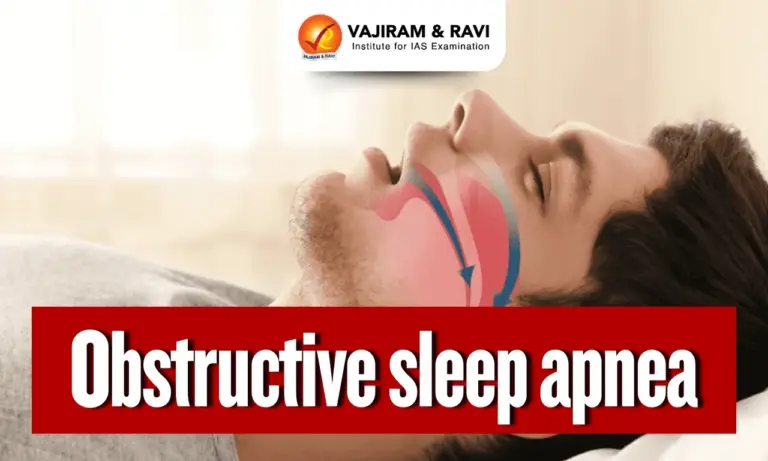
- It is characterised by recurrent upper airway obstruction during sleep and is associated with reduced quality of sleep and life and increased cardiovascular risk.
- There are several types of sleep apnea. OSA occurs when the throat muscles relax and block the airway.
- Anyone at any age can have OSA. But it’s most common in middle-aged and older adults.
- This condition has significant implications for cardiovascular health, mental well-being, and quality of life.





Symptoms of Obstructive Sleep Apnea
- Loud snoring
- Pauses in breathing during sleep, often noticed by a partner.
- Waking during the night gasping or choking.
Treatment for OSA
- Making lifestyle changes like sleeping position adjustments (not sleeping on your back) or maintaining a weight that’s healthy for you.
- Using a continuous positive airway pressure (CPAP) machine
- Wearing oral appliances (mouthpieces)
Source: DD News

 Last updated on April, 2026
→ UPSC Final Result 2025 is now out.
→ UPSC has released UPSC Toppers List 2025 with the Civil Services final result on its official website.
→ Anuj Agnihotri secured AIR 1 in the UPSC Civil Services Examination 2025.
→ UPSC Marksheet 2025 is now out.
→ UPSC Notification 2026 & UPSC IFoS Notification 2026 is now out on the official website at upsconline.nic.in.
→ UPSC Calendar 2026 has been released.
→ Check out the latest UPSC Syllabus 2026 here.
→ UPSC Prelims 2026 will be conducted on 24th May, 2026 & UPSC Mains 2026 will be conducted on 21st August 2026.
→ The UPSC Selection Process is of 3 stages-Prelims, Mains and Interview.
→ Prepare effectively with Vajiram & Ravi’s UPSC Prelims Test Series 2026 featuring full-length mock tests, detailed solutions, and performance analysis.
→ Enroll in Vajiram & Ravi’s UPSC Mains Test Series 2026 for structured answer writing practice, expert evaluation, and exam-oriented feedback.
→ Join Vajiram & Ravi’s Best UPSC Mentorship Program for personalized guidance, strategy planning, and one-to-one support from experienced mentors.
→ Shakti Dubey secures AIR 1 in UPSC CSE Exam 2024.
→ Also check Best UPSC Coaching in India
Obstructive Sleep Apnea FAQs
Q1. What is the primary cause of Obstructive Sleep Apnea?+
Q2. How is OSA typically diagnosed?+
Tags: obstructive sleep apnea