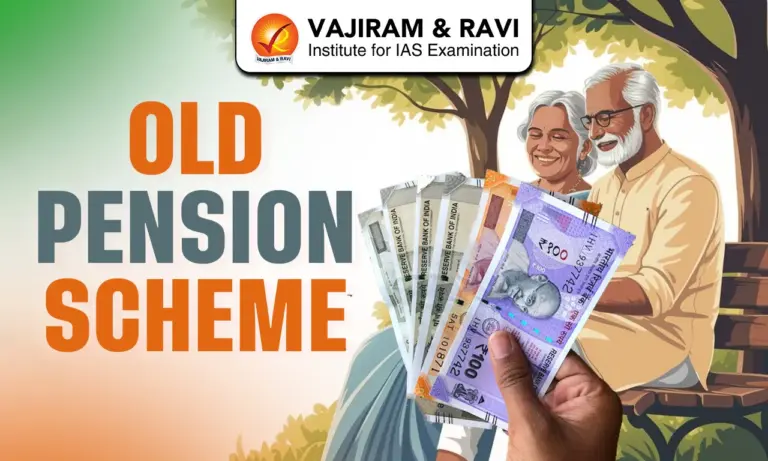
Old Pension Scheme (OPS) was the traditional pension system for government employees in India before 1 January 2004. Its origin can be traced to the colonial period under the Pensions Act, 1871. After Independence, the scheme continued as a welfare measure to provide social security to retired government employees.
Key Features of Old Pension Scheme (OPS)
Features of Old Pension Scheme (OPS) are as follows:
- Defined Benefit System: OPS guarantees a fixed pension. The pension is generally 50% of the last drawn basic salary. For example, if a government officer retires with a last basic salary of ₹60,000 per month, the pension will be around ₹30,000 per month for life.
- No Employee Contribution: Employees do not contribute separately towards pension. The government pays pensions from its budget under a “pay-as-you-go” system. This means the pension of today’s retirees is paid from current tax revenues.
- Dearness Relief (DR): Pension increases with inflation through Dearness Relief. For instance, if DR increases by 4%, the pension of ₹30,000 will also increase accordingly, protecting the retiree from rising prices.
- Family Pension: After the death of the pensioner, the spouse receives a portion of the pension. For example, if the pension was ₹30,000, the spouse may receive around ₹18,000-₹20,000 as family pension.
- General Provident Fund (GPF): Employees contribute to GPF during service, and this amount is returned with interest at retirement as a lump sum.If an employee saved ₹5,000 per month in GPF for 30 years, this accumulated amount would be paid at retirement along with pension. OPS therefore provides certainty, stability, and social security.
Issues with Old Pension Scheme (OPS)
Despite its welfare benefits, OPS faced serious financial challenges.
- First, it was an unfunded scheme. No separate pension corpus was created in advance. Pensions were paid directly from government revenues.
- Second, pension expenditure kept rising over time due to the increasing number of retirees and longer life expectancy. According to Union Budget data, pension expenditure of the Central Government has grown sharply over the decades and now runs into lakhs of crores annually.
- Third, it raised concerns of intergenerational equity. Since employees did not contribute to a pension fund, future taxpayers had to bear the cost of past pension commitments.
Because of these fiscal pressures, the Government of India replaced OPS with the National Pension System (NPS) in 2004 for new entrants. In recent years, several States such as Rajasthan, Chhattisgarh, Punjab, Himachal Pradesh and Jharkhand have chosen to revert to OPS for their employees. Employee unions argue that OPS provides social security and protects retirees from market risks associated with NPS.
On the other hand, institutions like the Reserve Bank of India (RBI) have cautioned that returning fully to OPS may create large future fiscal liabilities for States.






 Last updated on March, 2026
→ UPSC Final Result 2025 is now out.
→ UPSC has released UPSC Toppers List 2025 with the Civil Services final result on its official website.
→ Anuj Agnihotri secured AIR 1 in the UPSC Civil Services Examination 2025.
→ UPSC Marksheet 2025 is now out.
→ UPSC Notification 2026 & UPSC IFoS Notification 2026 is now out on the official website at upsconline.nic.in.
→ UPSC Calendar 2026 has been released.
→ Check out the latest UPSC Syllabus 2026 here.
→ UPSC Prelims 2026 will be conducted on 24th May, 2026 & UPSC Mains 2026 will be conducted on 21st August 2026.
→ The UPSC Selection Process is of 3 stages-Prelims, Mains and Interview.
→ Prepare effectively with Vajiram & Ravi’s UPSC Prelims Test Series 2026 featuring full-length mock tests, detailed solutions, and performance analysis.
→ Enroll in Vajiram & Ravi’s UPSC Mains Test Series 2026 for structured answer writing practice, expert evaluation, and exam-oriented feedback.
→ Join Vajiram & Ravi’s Best UPSC Mentorship Program for personalized guidance, strategy planning, and one-to-one support from experienced mentors.
→ Shakti Dubey secures AIR 1 in UPSC CSE Exam 2024.
→ Also check Best UPSC Coaching in India
Old Pension Scheme FAQs
Q1. What is the Old Pension Scheme (OPS)?+
Q2. How was the pension calculated under the Old Pension Scheme (OPS)?+
Q3. Did employees contribute to Old Pension Scheme (OPS)?+
Q4. Why was the Old Pension Scheme (OPS) discontinued?+
Q5. Can employees still benefit from the Old Pension Scheme (OPS) today?+
Tags: old pension scheme