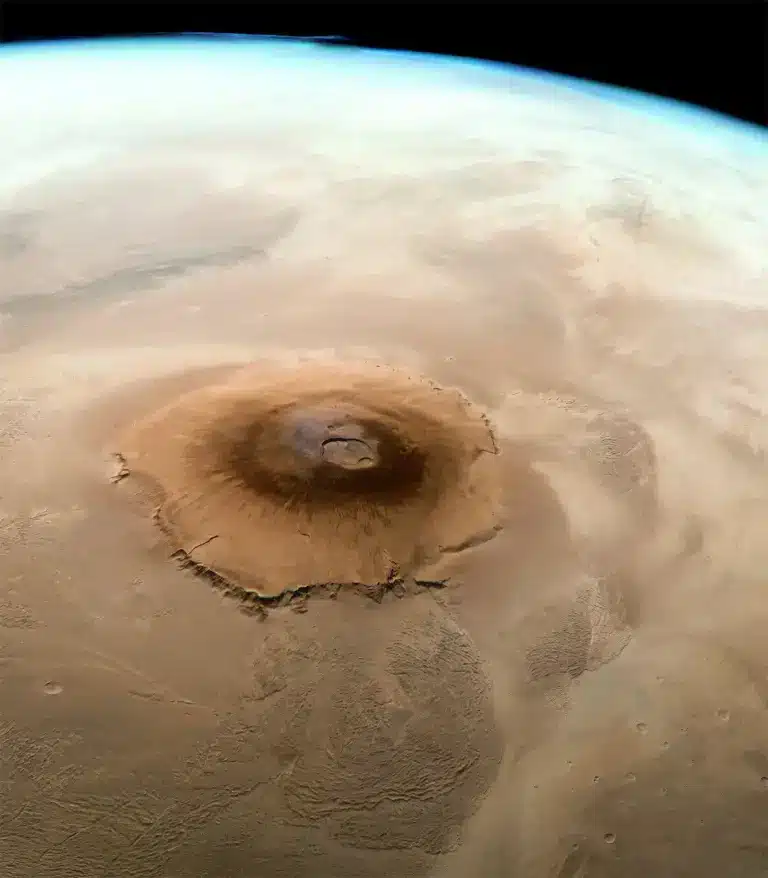
About Olympus Mons:
- It is a shield volcano located in Mars’ western hemisphere.
- It is the highest point on Mars and the largest known volcano in the solar system.
- It is 16 miles (24 kilometers) high, which makes it about three times higher than Mt. Everest.
- It is also very wide (340 miles or 550 kilometers) and covers an area larger than the entire chain of Hawaiian Islands.
- In contrast, the largest volcano on Earth, Hawaii’s Mauna Loa, is 120 kilometers across and 9 kilometers high.
- It is some 3.5 billion years old, which means the volcano formed early on in Mars’ history.
- It is a very flat mountain which slopes by only 2 to 5 degrees.
- Its summit is marked by a caldera, a large depression formed by volcanic activity, spanning 50 miles (80 kilometers) wide.
- The summit caldera consists of several overlapping pits. These pits were created by different eruptive phases.
- In contrast, many Earth-based volcanoes typically feature a single, less complex caldera.
Key Facts about Shield Volcano:
- They are the largest volcanoes on Earth.
- They do not form soaring mountains with conical peaks like composite volcanoes. Instead, they are broad volcanoes with gentle slopes.
- They are almost exclusively basalt, a type of lava that is very fluid when erupted.
- Because basalt has a low viscosity, it can flow on the surface better. So, when these types of volcanoes erupt, lava flows outwards at large distances.
- They are built by repeated eruptions that occurred intermittently over vast periods of time.
- Eruptions at shield volcanoes are only explosive if water somehow gets into the vent; otherwise, they are characterized by low-explosivity fountaining that forms cinder cones and spatter cones at the vent.
The Hawaiian shield volcanoes are the most famous examples.
Q1: What is Frost?
Frost is water vapor, or water in gas form, that becomes solid. Frost usually forms on objects like cars, windows, and plants that are outside in air that is saturated, or filled, with moisture.
Source: 1,50,000 tonnes of water frost found on Mars’ tallest volcano: What it means






 Last updated on March, 2026
→ UPSC Final Result 2025 is now out.
→ UPSC has released UPSC Toppers List 2025 with the Civil Services final result on its official website.
→ Anuj Agnihotri secured AIR 1 in the UPSC Civil Services Examination 2025.
→ UPSC Marksheet 2025 is now out.
→ UPSC Notification 2026 & UPSC IFoS Notification 2026 is now out on the official website at upsconline.nic.in.
→ UPSC Calendar 2026 has been released.
→ Check out the latest UPSC Syllabus 2026 here.
→ UPSC Prelims 2026 will be conducted on 24th May, 2026 & UPSC Mains 2026 will be conducted on 21st August 2026.
→ The UPSC Selection Process is of 3 stages-Prelims, Mains and Interview.
→ Prepare effectively with Vajiram & Ravi’s UPSC Prelims Test Series 2026 featuring full-length mock tests, detailed solutions, and performance analysis.
→ Enroll in Vajiram & Ravi’s UPSC Mains Test Series 2026 for structured answer writing practice, expert evaluation, and exam-oriented feedback.
→ Join Vajiram & Ravi’s Best UPSC Mentorship Program for personalized guidance, strategy planning, and one-to-one support from experienced mentors.
→ Shakti Dubey secures AIR 1 in UPSC CSE Exam 2024.
→ Also check Best UPSC Coaching in India