Online Gaming Act Latest News
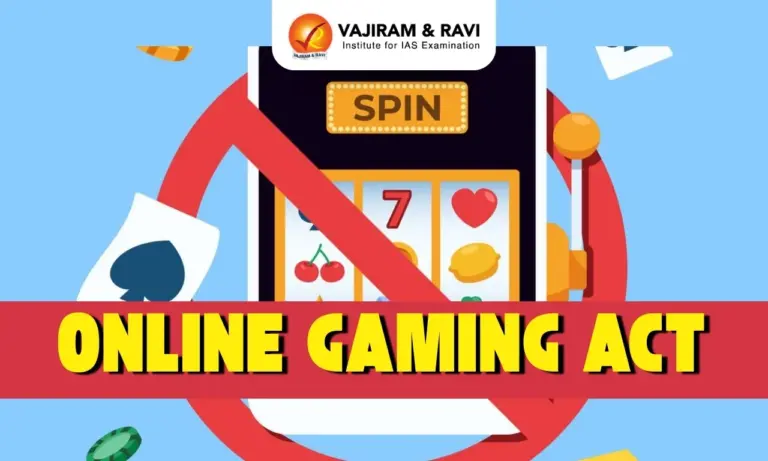
- The Online Gaming Act 2025 has been passed by Parliament, banning Real Money Games while promoting e-sports and social gaming under a regulated framework.
Introduction
- The Indian Parliament has passed the Online Gaming Act 2025, marking a decisive step in regulating the rapidly growing digital gaming industry.
- The Act aims to strike a balance between promoting innovation in e-sports and social gaming while addressing the social and economic harms caused by Real Money Games (RMGs).
- With government data estimating annual losses of Rs. 15,000 crore by Indians on such games, the legislation comes amid rising concerns of addiction, suicides, fraud, and tax evasion linked to online money gaming.





Key Provisions of the Online Gaming Act 2025
- The Act classifies online games into three categories: e-sports, social gaming, and RMGs.
- E-sports: Games officially recognised under the National Sports Governance Act, 2025. These include competitive video games with performance-based prize pools, such as Call of Duty and Grand Theft Auto.
- Social Gaming: Games played primarily for recreation or educational purposes, often without monetary stakes. The Act encourages their development through budgetary support.
- Real Money Games (RMGs): Defined as online games played with stakes involving money, credits, or convertible tokens, including Poker, Rummy, Fantasy Cricket, and Ludo variants. These have been banned outright.
- The ban extends to advertisements, celebrity endorsements, and platforms offering RMGs. Notably, several high-profile celebrities had previously endorsed such platforms, raising concerns about their influence on youth.
Penalties and Enforcement Mechanisms
- The Act prescribes stringent penalties to curb illegal activities:
- Offering or facilitating RMGs: Up to three years of imprisonment or a fine of Rs. 1 crore, or both.
- Unlawful advertisements: Two years of imprisonment or a fine of Rs. 50 lakh, or both.
- The offences are classified as cognisable and non-bailable under the Bharatiya Nagarik Suraksha Sanhita (BNSS), 2023.
- For enforcement, the government has empowered CERT-IN (Indian Computer Emergency Response Team) to block or disable non-compliant apps.
- It may also collaborate with Interpol to target offshore operators bypassing Indian laws. Importantly, the Act does not criminalise players but targets operators and promoters.
Rationale Behind the Legislation
- The government clarified that the move is not a knee-jerk reaction but a response to alarming trends:
- Addiction and suicides: WHO has linked RMGs to compulsive behaviour, and Karnataka alone reported 32 gaming-related suicides in 31 months.
- Financial fraud: A Defence Ministry report revealed Chinese app FIEWIN defrauded Indians of Rs. 400 crore.
- Tax evasion: Reports show gaming firms evaded over Rs. 30,000 crore in GST liabilities and Rs. 2,000 crore in income tax.
- Money laundering and terrorism funding: A 2023 Parliamentary Panel flagged gaming portals as potential conduits for terror financing.
- By targeting opaque algorithms and offshore operators, the Act seeks to safeguard users and restore transparency in the sector.
Legal and Constitutional Challenges
- Skill vs. chance debate – The law does not differentiate between games of skill (like Fantasy Sports or Rummy) and games of chance, which critics argue violates Article 19(1)(g), guaranteeing the right to trade and occupation.
- Jurisdictional overlap – Betting and gambling fall under State jurisdiction (Entries 34 and 62 of the State List). States like Telangana, Andhra Pradesh, and Tamil Nadu have already banned online gambling, creating legal ambiguities.
- Supreme Court intervention – Earlier rulings held Rummy and Fantasy Sports as games of skill. The SC has also stayed retrospective GST notices to gaming firms. Future judgments will determine how far the Act aligns with constitutional guarantees.
Promoting E-sports and Social Gaming
- Unlike its restrictive stance on RMGs, the Act actively promotes safe online gaming ecosystems:
- Government funding from the Consolidated Fund of India will support e-sports and social gaming.
- Provisions encourage educational and recreational games, fostering innovation and digital inclusion.
- No restrictions have been placed on minors accessing social games or e-sports, though critics argue that stronger safeguards are needed.
- This dual approach reflects India’s ambition to become a hub for competitive gaming while protecting citizens from exploitative practices.
Source: TH

 Last updated on March, 2026
→ UPSC Final Result 2025 is now out.
→ UPSC has released UPSC Toppers List 2025 with the Civil Services final result on its official website.
→ Anuj Agnihotri secured AIR 1 in the UPSC Civil Services Examination 2025.
→ UPSC Marksheet 2025 is now out.
→ UPSC Notification 2026 & UPSC IFoS Notification 2026 is now out on the official website at upsconline.nic.in.
→ UPSC Calendar 2026 has been released.
→ Check out the latest UPSC Syllabus 2026 here.
→ UPSC Prelims 2026 will be conducted on 24th May, 2026 & UPSC Mains 2026 will be conducted on 21st August 2026.
→ The UPSC Selection Process is of 3 stages-Prelims, Mains and Interview.
→ Prepare effectively with Vajiram & Ravi’s UPSC Prelims Test Series 2026 featuring full-length mock tests, detailed solutions, and performance analysis.
→ Enroll in Vajiram & Ravi’s UPSC Mains Test Series 2026 for structured answer writing practice, expert evaluation, and exam-oriented feedback.
→ Join Vajiram & Ravi’s Best UPSC Mentorship Program for personalized guidance, strategy planning, and one-to-one support from experienced mentors.
→ Shakti Dubey secures AIR 1 in UPSC CSE Exam 2024.
→ Also check Best UPSC Coaching in India
Online Gaming Act FAQs
Q1. What does the Online Gaming Act 2025 ban?+
Q2. Who will regulate online gaming under the new Act?+
Q3. What penalties does the Act prescribe for illegal RMGs?+
Q4. How does the Act treat e-sports and social gaming?+
Q5. Why has the Act faced criticism?+
Tags: mains articles online gaming act upsc current affairs upsc mains current affairs