Monument Conservation Latest News
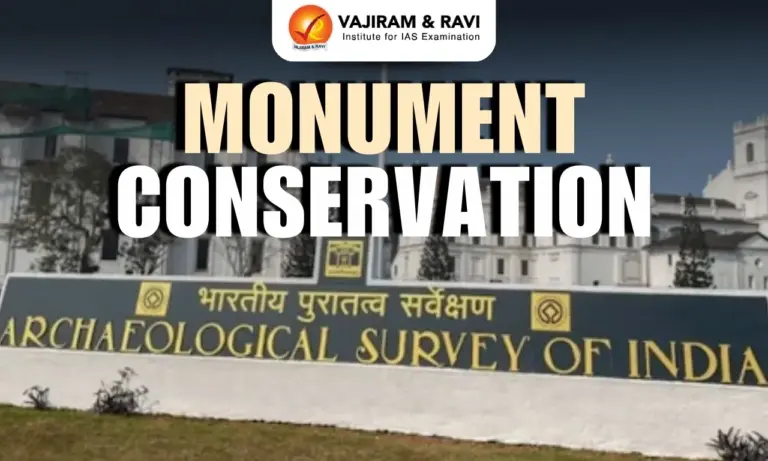
- In a significant policy shift, the Government of India is set to allow private sector participation in the core conservation of protected monuments, a domain hitherto monopolised by the Archaeological Survey of India (ASI).
- This move aims to address capacity constraints, improve efficiency, and mobilise CSR funding for heritage conservation, while retaining regulatory oversight with the ASI.
Key Developments
- The Ministry of Culture is empanelling private conservation architects and agencies through a Request for Proposal (RFP) process, closing on January 12.
- Over 20 private heritage conservation agencies from across the country have applied.
- After empanelment, corporate donors contributing via the National Culture Fund (NCF) will be allowed to directly engage conservation agencies of their choice.
- The conservation work will be undertaken within ASI-prescribed frameworks and under its overall supervision.





How the New Model Will Work
- Eligibility criteria for conservation architects:
- Experience in conservation or restoration of centrally protected monuments under ASI, State Archaeology Departments, CPWD or State PWD.
- Experience in heritage projects of PSUs, municipal corporations, and private palaces or buildings (minimum 100 years old).
- Role of donors and agencies:
- Donors provide funds to the NCF under CSR provisions.
- Donors have independence to select empanelled conservation architects.
- Projects must adhere to approved Detailed Project Reports (DPRs), timeframes fixed by donors, and established conservation norms.
- Execution will be carried out by private agencies, under guidance of conservation architects, supervision of ASI or concerned government agencies.
Reasons for the Shift – Limitations of the Existing ASI Model
- Monopoly and capacity constraints:
- ASI is responsible for conserving around 3,700 protected monuments.
- It has been the sole agency for preparing DPRs, executing conservation works.
- This led to slow project implementation, delays in utilisation of CSR funds.
- Performance of the NCF:
- Established in 1996 with an initial corpus of ₹20 crore, the fund has received ₹140 crore in donations so far.
- It has funded about 100 conservation projects – 70 completed, almost 20 ongoing.
- The corporate donors faced difficulties due to weak compliance timelines.
What is News Compared to Earlier Initiatives
- The earlier ‘Adopt a Heritage’ scheme allowed corporates to become Monument Mitras but was limited to tourist amenities (toilets, ticketing, cafes, signage).
- For the first time, private donors are being allowed into core conservation work of monuments.
- The Ministry has identified 250 monuments requiring conservation. Donors may choose from the list, or propose monuments based on regional or thematic preference (subject to approval).
Global Parallels (Best Practices)
- United Kingdom: Churches Conservation Trust with strong private participation.
- United States: Active involvement of private organisations and funding in heritage protection.
- Germany and Netherlands: Heritage foundations supported by private funding.
- These models reflect Public–Private Partnerships (PPP) under strong state regulation.
Challenges and Way Ahead
- Risk of commercialisation of heritage: Transparent audits and periodic reviews of projects. Promote community and academic involvement alongside corporates.
- Ensuring uniform conservation: Develop clear conservation guidelines and SOPs.
- Potential conflicts: Between donor preferences and archaeological integrity.
- Need for robust monitoring mechanisms: To prevent dilution of ASI’s authority. Strengthen ASI’s role as a regulator and knowledge authority.
- Capacity constraints: Capacity-building and certification of conservation professionals.
Conclusion
- Opening monument conservation to the private sector marks a paradigm shift in India’s heritage governance, moving towards a PPP-based, capacity-enhancing model.
- While the ASI retains supervisory control, private participation is expected to accelerate conservation, improve fund utilisation, and create a national talent pool in heritage management.
- Success, however, will depend on strong regulation, accountability, and adherence to conservation ethics.
Source: IE

 Last updated on April, 2026
→ UPSC Final Result 2025 is now out.
→ UPSC has released UPSC Toppers List 2025 with the Civil Services final result on its official website.
→ Anuj Agnihotri secured AIR 1 in the UPSC Civil Services Examination 2025.
→ UPSC Marksheet 2025 is now out.
→ UPSC Notification 2026 & UPSC IFoS Notification 2026 is now out on the official website at upsconline.nic.in.
→ UPSC Calendar 2026 has been released.
→ Check out the latest UPSC Syllabus 2026 here.
→ UPSC Prelims 2026 will be conducted on 24th May, 2026 & UPSC Mains 2026 will be conducted on 21st August 2026.
→ The UPSC Selection Process is of 3 stages-Prelims, Mains and Interview.
→ Prepare effectively with Vajiram & Ravi’s UPSC Prelims Test Series 2026 featuring full-length mock tests, detailed solutions, and performance analysis.
→ Enroll in Vajiram & Ravi’s UPSC Mains Test Series 2026 for structured answer writing practice, expert evaluation, and exam-oriented feedback.
→ Join Vajiram & Ravi’s Best UPSC Mentorship Program for personalized guidance, strategy planning, and one-to-one support from experienced mentors.
→ Shakti Dubey secures AIR 1 in UPSC CSE Exam 2024.
→ Also check Best UPSC Coaching in India
Monument Conservation FAQs
Q1. What is the rationale behind allowing private sector participation in the core conservation of protected monuments?+
Q2. How does the new monument conservation model balance private participation with state control?+
Q3. What is the difference between the ‘Adopt a Heritage’ scheme and the new private participation framework?+
Q4. What challenges could arise from corporatisation of heritage conservation in India?+
Q5. How do global practices support India’s move towards a PPP model in heritage conservation?+
Tags: mains articles monument conservation upsc current affairs upsc mains current affairs