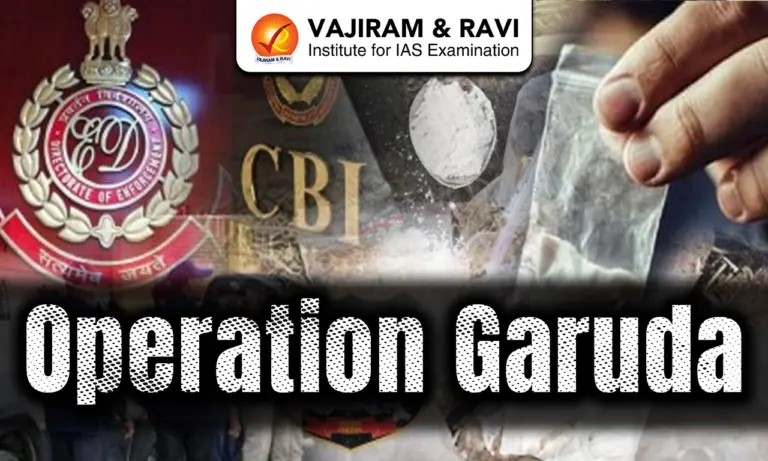
Operation Garuda was launched by the Central Bureau of Investigation in September 2022. It is a multi-phase anti-drug operation. It aims to disrupt, degrade and dismantle international drug trafficking networks. The operation focuses on drug syndicates operating across borders, especially in the Indian Ocean Region.
About Operation Garuda
- Operation Garuda was conducted in close coordination with INTERPOL and the Narcotics Control Bureau (NCB).
- The operation involves rapid sharing of criminal intelligence related to drug trafficking.
- It targets key elements of drug networks such as handlers, operatives, production centres and support systems.
- CBI and NCB coordinate with State and Union Territory police agencies for intelligence collection and joint action.
- Several States/UTs including Punjab, Himachal Pradesh, Gujarat, Maharashtra, Tamil Nadu, Delhi and Manipur have participated.
- Operation Garuda strengthens international cooperation and enhances India’s capacity to tackle transnational organised drug crime.
Drug Trafficking in India
Drug trafficking is a serious social, economic, and security challenge in India. It involves the illegal production, transport, sale, and distribution of narcotic drugs and psychotropic substances. India is affected by both international drug smuggling networks and domestic drug distribution channels.
India’s geographic location makes it vulnerable to drug trafficking. The country lies between major Golden Triangle (Myanmar-Laos-Thailand) and Golden Crescent (Afghanistan-Iran-Pakistan) drug production regions.
Drug trafficking in India is mainly controlled under the Narcotic Drugs and Psychotropic Substances Act, 1985 (NDPS Act), which provides strict punishment for illegal drug activities. Another important law is the Prevention of Illicit Traffic in Narcotic Drugs and Psychotropic Substances Act, 1988, which focuses on preventing organised drug trafficking networks.
The Narcotics Control Bureau (NCB) is the main agency responsible for combating drug trafficking in India. It works with state police, border security forces, and international organisations like INTERPOL.





Government Measures to Control Drug Trafficking
The government is following a two-pronged strategy – stopping drug supply through strict enforcement and reducing drug demand through awareness, treatment, and rehabilitation.
- The government has strengthened the NCORD coordination mechanism at the national, state, district, and local levels to improve cooperation among law enforcement agencies.
- Narco Coordination Mechanism (NCORD coordination mechanism) is a multi-level coordination system to control drug trafficking in India.
- It improves cooperation among central agencies, state police, and other law enforcement bodies.
- It helps in sharing intelligence information related to drug trafficking.
- It supports joint action and coordinated enforcement against narcotics networks.
- Special Anti-Narcotics Task Forces have been established in all States and Union Territories to monitor drug-related crimes.
- An integrated NCORD portal has been developed to provide real-time information related to narcotics enforcement.
- The 1933 MANAS helpline allows citizens to report drug-related problems and share information with authorities.
- A specialised task force monitors suspicious financial transactions involving darknet and cryptocurrency linked to drug trafficking.
- Border security forces such as BSF, SSB, Assam Rifles, and the Coast Guard have been empowered under the NDPS Act to stop drug smuggling along land and sea borders.
- The Railway Protection Force (RPF) helps prevent inter-state movement of narcotics through rail networks.
- The Narcotics Control Bureau has expanded its regional and zonal offices to improve enforcement coverage across the country.
- A Multi Agency Maritime Security Group has been created to monitor drug trafficking through sea routes.
- Databases like NIDAAN help track arrested drug offenders and support investigations.
Drug Abuse Prevention and Rehabilitation
- The government is implementing the National Action Plan for Drug Demand Reduction (NAPDDR) to reduce substance abuse among youth.
- The Nasha Mukt Bharat Abhiyaan is running awareness programmes in all districts to educate people about drug dangers.
- Rehabilitation centres, outreach centres, and addiction treatment facilities are being supported to help drug victims recover and return to society.
- Helpline number 14446 provides counselling and immediate support to people seeking help.

 Last updated on April, 2026
→ UPSC Final Result 2025 is now out.
→ UPSC has released UPSC Toppers List 2025 with the Civil Services final result on its official website.
→ Anuj Agnihotri secured AIR 1 in the UPSC Civil Services Examination 2025.
→ UPSC Marksheet 2025 is now out.
→ UPSC Notification 2026 & UPSC IFoS Notification 2026 is now out on the official website at upsconline.nic.in.
→ UPSC Calendar 2026 has been released.
→ Check out the latest UPSC Syllabus 2026 here.
→ UPSC Prelims 2026 will be conducted on 24th May, 2026 & UPSC Mains 2026 will be conducted on 21st August 2026.
→ The UPSC Selection Process is of 3 stages-Prelims, Mains and Interview.
→ Prepare effectively with Vajiram & Ravi’s UPSC Prelims Test Series 2026 featuring full-length mock tests, detailed solutions, and performance analysis.
→ Enroll in Vajiram & Ravi’s UPSC Mains Test Series 2026 for structured answer writing practice, expert evaluation, and exam-oriented feedback.
→ Join Vajiram & Ravi’s Best UPSC Mentorship Program for personalized guidance, strategy planning, and one-to-one support from experienced mentors.
→ Shakti Dubey secures AIR 1 in UPSC CSE Exam 2024.
→ Also check Best UPSC Coaching in India
Operation Garuda FAQs
Q1. What is Operation Garuda?+
Q2. When was Operation Garuda launched?+
Q3. Which region is a special focus of Operation Garuda?+
Q4. Which agencies are involved in Operation Garuda?+
Q5. What is the main objective of Operation Garuda?+
Tags: operation garuda