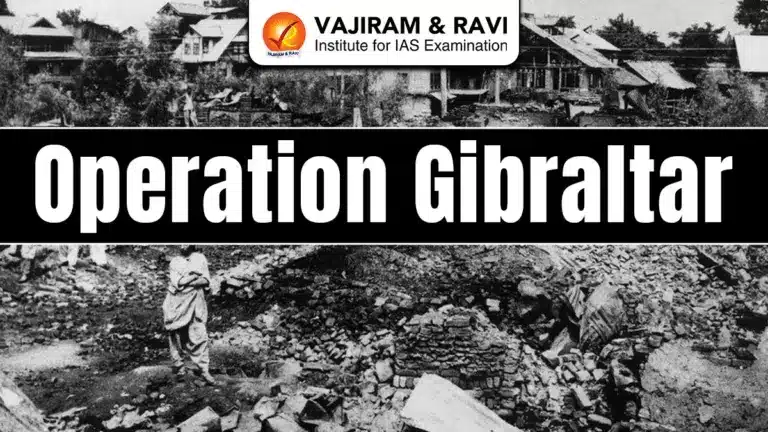
Operation Gibraltar was a covert military operation launched by Pakistan in 1965 to incite a mass rebellion among Kashmiri Muslims and weaken India’s control over the region.
The operation was named Operation Gibraltar to motivate its soldiers, by symbolising it with the Muslim conquest of Spain in 711 AD, when a small Muslim force crossed Gibraltar and successfully took control of large parts of Spain
Reasons for Operation Gibraltar
- Operation Gibraltar was based on Pakistan’s belief that India was militarily and politically weakened after the 1962 Sino-Indian War and would be unable to respond effectively to a limited infiltration.
- Pakistan assumed that discontent among the Kashmiri population would translate into mass support for infiltrators, leading to a spontaneous rebellion against Indian administration.
- A limited covert operation could internationalise the Kashmir issue without triggering a full-scale war.
Operation Gibraltar Strategy
Under Operation Gibraltar, Pakistani soldiers infiltrated into Kashmir disguised as locals. The infiltrators were organised into groups with code names such as Salahuddin, Ghaznavi, Tariq, Babur and Khalid, each assigned to operate in specific regions of Kashmir. Their tasks included sabotage of bridges and communication networks, attacks on Indian military installations, spreading propaganda, and provoking unrest among the local population.





Operation Gibraltar Outcome
- Operation Gibraltar failed as local Kashmiris did not revolt and instead informed the Army and the police about the presence of Pakistani infiltrators.
- Indian security forces detected the infiltration at an early stage, captured or eliminated a large number of infiltrators, and quickly regained control over affected areas. In response to the infiltration, India launched military counter-operations across the Line of Control, expanding the conflict beyond Kashmir.
- Pakistan escalated the situation by launching Operation Grand Slam in the Akhnoor sector, which further intensified hostilities.
- These developments resulted in the outbreak of the full-scale Indo-Pak War of 1965, involving large-scale conventional military engagement on both eastern and western fronts.
The war ended with a ceasefire mediated by the Soviet Union and formalised through the Tashkent Agreement in January 1966, restoring the pre-war territorial status quo.

 Last updated on March, 2026
→ UPSC Final Result 2025 is now out.
→ UPSC has released UPSC Toppers List 2025 with the Civil Services final result on its official website.
→ Anuj Agnihotri secured AIR 1 in the UPSC Civil Services Examination 2025.
→ UPSC Marksheet 2025 is now out.
→ UPSC Notification 2026 & UPSC IFoS Notification 2026 is now out on the official website at upsconline.nic.in.
→ UPSC Calendar 2026 has been released.
→ Check out the latest UPSC Syllabus 2026 here.
→ UPSC Prelims 2026 will be conducted on 24th May, 2026 & UPSC Mains 2026 will be conducted on 21st August 2026.
→ The UPSC Selection Process is of 3 stages-Prelims, Mains and Interview.
→ Prepare effectively with Vajiram & Ravi’s UPSC Prelims Test Series 2026 featuring full-length mock tests, detailed solutions, and performance analysis.
→ Enroll in Vajiram & Ravi’s UPSC Mains Test Series 2026 for structured answer writing practice, expert evaluation, and exam-oriented feedback.
→ Join Vajiram & Ravi’s Best UPSC Mentorship Program for personalized guidance, strategy planning, and one-to-one support from experienced mentors.
→ Shakti Dubey secures AIR 1 in UPSC CSE Exam 2024.
→ Also check Best UPSC Coaching in India
Operation Gibraltar FAQs
Q1. What was Operation Gibraltar?+
Q2. What was the main objective of the operation?+
Q3. Why was it named Operation Gibraltar?+
Q4. What was the outcome of Operation Gibraltar?+
Q5. What is the Tashkent Agreement?+
Tags: history operation gibraltar