About Organic Electrochemical Transistor
- It is an emerging class of transistor based on organic superconducting materials known for their ability to modulate electrical current in response to small changes in the voltage applied to their gate electrode.
- It is a device capable of simultaneously controlling the flow of electronic and ionic currents.
- Advantages: They have various notable advantages, including promising amplification and sensing capabilities, low power consumption, low driving voltages and a versatile structure.
- Applications: They can be used to create biosensors, wearable devices, and neuromorphic systems.
What is a transistor?
- It is a semiconductor device for amplifying, controlling, and generating electrical signals.
- It is the active components of integrated circuits, or “microchips,” which often contain billions of these minuscule devices etched into their shiny surfaces.
- There are three terminals for transistor as mentioned below:
- Base: To activate the transistor
- Collector: It is a positive lead of transistor
- Emitter: It is a negative lead of transistor
- Types of Transistors
- Bipolar Junction Transistor: It is considered one of the most common types of transistors and it can be either NPN or PNP.
- It can able to amplify the electrical signal by joining all three layers into one. In current flow, there are two types of electrical charges involved i.e., electrons and holes.
- Field effect transistor: It is a three-terminal semiconductor device. Its operation is based on a controlled input voltage.
- It uses an electric field to control the field of electric current in a semiconductor.
- They are also known as unipolar transistors since they contain single-carrier-type operations.
Q1: What is an Integrated Circuit?
An integrated circuit (IC) — commonly called a chip — is made out of a semiconductor material called silicon, in which small electronic components called transistors are formed within the silicon and then wired together with interconnects layered on top of the silicon surface.
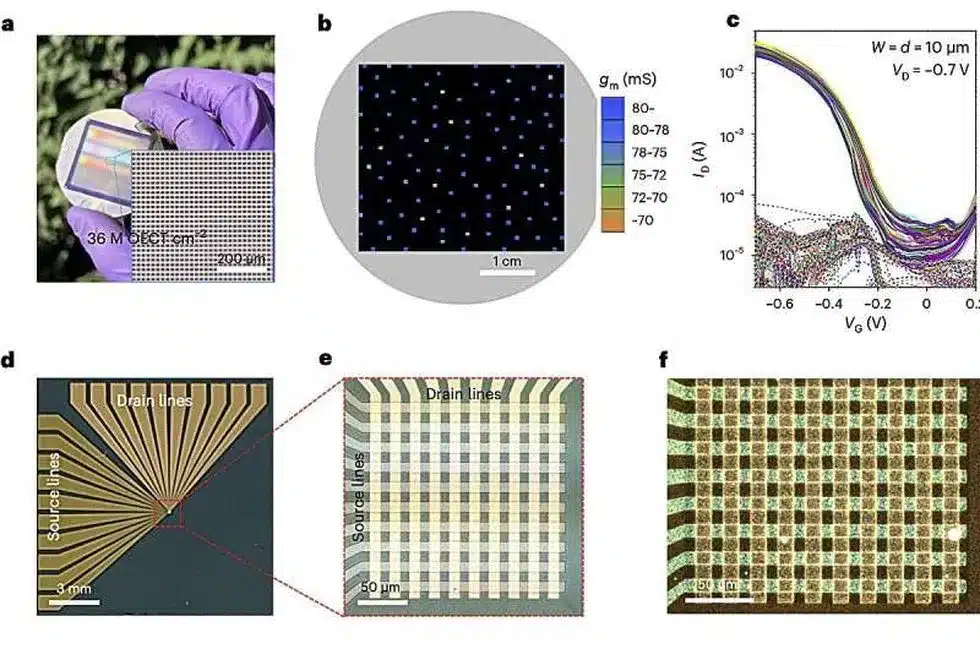
Source: A new strategy for fabricating high-density vertical organic electrochemical transistor arrays


 Last updated on Oct, 2026
→ UPSC 2027 Notification will be released on 13 January 2027 at upsconline.nic.in.
→ Check Nobel Prize 2026 Winners List here.
→ Download PIB PRiSM Monthly Magazine 2026 here.
→ Check UPSC Monthly Current Affairs Magazine The Recitals here.
→ Check out the latest UPSC Syllabus here.
→ Download UPSC Model Answers for Mains 2026
→ UPSC Mains Question Paper 2026 is out now for Essay & GS Paper 1, 2, 3 & 4.
→ UPSC Calendar 2027 has been released.
→ Enroll in Vajiram & Ravi’s UPSC Mains Test Series 2027 for structured answer writing practice, expert evaluation, and exam-oriented feedback.
→ Join Vajiram & Ravi’s UPSC Mentorship Program 2027 for personalized guidance, strategy planning, and one-to-one support from experienced mentors.
→ Go through the UPSC Mains Previous Year Papers to enhance your preparation.
→ UPSC has released UPSC Toppers List 2025 with the Civil Services final result on its official website.
→ Also check Best UPSC Coaching in India