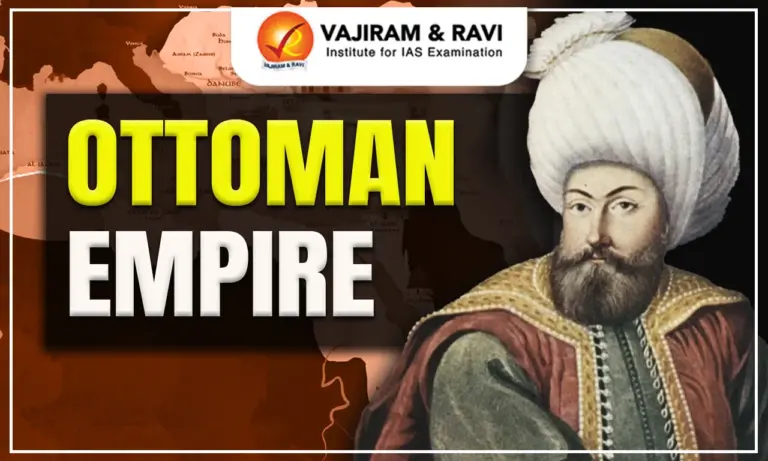
The Ottoman Empire was established in 1299 by Osman I, who brought together several independent Anatolian states under a single authority. By the mid-14th century, the Ottomans had expanded into former Byzantine lands, steadily building a powerful empire. For more than six centuries, they controlled vast regions across the Middle East and Eastern Europe. The Ottoman Empire eventually came to an end in 1922, paving the way for the modern nation of Turkey.
Ottoman Empire
By the late 13th century, Anatolia, caught between the weakening Byzantine Empire and the Mongol domains saw the rise of several small principalities. These frontier regions were dominated by ghazis, warriors devoted to fighting for Islam, and each principality was ruled by a local prince known as a bey.
Among them, Osman I, a leader of Turkmen nomads, established a principality that would later carry his name: the Ottoman state. What began as a modest frontier domain soon expanded into one of the most powerful empires in history, controlling vast stretches of Eastern Europe, the Middle East, and the Mediterranean. The Ottoman Empire sustained for centuries before finally giving way to modern-day Turkey in 1922.
Ottoman Empire History
- In the mid-11th century, the Seljuk Turks, a nomadic people from Asia who had embraced Sunni Islam, migrated into Persia and surrounding regions before pushing westward into Anatolia.
- Their victory over the Byzantine army at the Battle of Manzikert in 1071 opened the door for Turkic tribes to settle in the empire’s southeastern lands.
- By the late 13th century, Anatolia had fragmented into numerous small principalities known as beyliks. Though nominally independent, these states often fought one another for dominance.
- One of their leaders, Osman I (1299-1326), a chieftain of Bithynia near the Sea of Marmara, began pressing against Byzantine frontiers.
- He expanded his territory through persistent campaigns and established Prusa (modern Bursa) as his stronghold.
- Osman’s successors carried his vision forward, gradually conquering Byzantine lands in Anatolia and extending into southeastern Europe.
- By the end of the 14th century, the Ottomans had already made their presence felt in the Balkans.
- The turning point came in 1453, when Mehmed II captured Constantinople, transforming it into the Ottoman capital.
- From there, the empire expanded rapidly, bringing regions such as Serbia, Greece, and Bosnia under its influence.





Ottoman Empire Timeline
- 1299 – Osman I declares independence from the Seljuk Sultan and establishes the foundation of the Ottoman Empire.
- 1389 – Large parts of the Balkan Peninsula, including Serbia, fall under Ottoman control.
- 1453 – Sultan Mehmed II captures Constantinople, ending the Byzantine Empire and making the city the Ottoman capital.
- 1517 – The Ottomans conquer Egypt and annex it into their empire.
- 1520 – Suleiman the Magnificent ascends the throne, ushering in the empire’s golden age.
- 1529 – First Ottoman Siege of Vienna.
- 1533 – Ottoman forces expand eastward, conquering Iraq.
- 1551 – Libya is brought under Ottoman rule.
- 1566 – Death of Suleiman the Magnificent.
- 1569 – A massive fire devastates Istanbul, destroying nearly 36,000 houses.
- 1683 – The Ottomans suffer defeat at the Second Siege of Vienna, marking the start of the empire’s long decline.
- 1699 – Treaty of Karlowitz: the Ottomans lose Hungary and other territories to Austria.
- 1718-1730 – The Tulip Period, a rare era of peace, cultural growth, and prosperity.
- 1821 – The Greek War of Independence begins, challenging Ottoman control in Europe.
- 1914 – The Ottoman Empire enters World War I on the side of the Central Powers.
- 1922 – The Ottoman Empire is officially dissolved, replaced by the Republic of Turkey.
Ottoman Empire Religion
The Ottoman Empire Religion was Islam, but the empire did not force its conquered people to convert. Instead, Christians and Jews were allowed to continue practicing their faith without persecution.
This policy of tolerance helped reduce resistance among the conquered populations and played a key role in the empire’s stability and longevity.
Ottoman Empire Key Facts
- The Sultan resided in the Topkapi Palace, Istanbul, with several wives.
- Janissaries were the elite soldiers of the Sultan, selected at a young age from Christian families of the Balkan states.
- Though treated as slaves, Janissaries received regular salaries and allowances.
- The Tulip Period marked a time of peace and prosperity when art and culture flourished in the Ottoman Empire.
- Tulips symbolized perfection and beauty in Ottoman culture.
- Documents from Bursa, the oldest economic source of the Empire, highlight commercial relations between India and the Ottoman Empire.
- From the late 15th century, Sultan Mehmed II played a role in making the empire an outlet for Indian textiles.
Ottoman Empire Major Ruler
The Ottoman Empire Major Ruler always came from the Ottoman Dynasty (House of Osman). A total of 36 sultans ruled the empire. Their reign lasted from 1299 to 1922. The sultans are recorded in chronological order in the historical table.
| Ottoman Empire Major Ruler | ||
|
Ottoman Ruler Name |
Tenure |
Brief Description |
|
Osman Gazi or Osman I |
1299-1324 or 1326 |
Declared independence from the Anatolian Seljuk Empire in 1299. Reigned until his death. |
|
Orhan Gazi |
1326-1362 |
Son of Osman I |
|
Murad I or Sultan-i Azam |
1362-1389 |
The most exalted sultan. Reigned until his death. On June 15, 1389, Killed on the battlefield at the battle of Kosovo. |
|
Yildirim Bayazid I |
1389-1402 |
Captured on the battlefield at the battle of Ankara and died in captivity in Aksehir on 8 March 1403). |
|
Celebi Mehmet I |
1413-1421 |
Note: Ottoman Empire Interregnum (From 20 July 1402 – 5 July 1413). Bowstring maker for his support. Reigned until his death. |
|
Murad II |
First reign- 1421-1444 |
Abdicated of his own free will in favour of his son Faith Mehmet II. |
|
Fatih Mehmed II |
First reign- 1444-1446 |
Surrendered the throne to his father due to increasing threats from Janissaries. |
|
Murad II |
Second reign- 1446-1451 |
Later, the following Janissary rebellion was forced to return the throne. Reigned until his death. |
|
Mehmed II |
Second reign- 1451-1481 |
Kayser-i-rum (Caesar of the Roman Empire). Conquered Constantinople in 1453. Reigned until his death. |
|
Bayezid II |
1481-1512 |
Died near Didymoteicho on 26 May 1512. |
|
Yavuz Selim I |
1512-1520 |
Known as Hadim-ul Haramain-al-Sharifain (Servant of Mecca and Medina). Reigned until his death. |
|
Suleiman the magnificent or Suleiman I |
1520-1566 |
Most powerful Ottoman Sultan. Codified a central legal system for the Ottoman state. Expanded both territory (Into Mecca-Medina, Yemen and took Persian territory) and revenue. Built up Constantinople as the Ottoman empire’s capital. |
|
Selim II |
1566-1574 |
Son of Suleiman I. His reign was considered a Less fortune against Russia. In 1572, Before his death, the Ottomans regained control of Tunisia from Spain. |
|
Murad III |
1574-1595 |
His reign saw fighting with the Habsburg monarchy and some exhausting wars with the Safavids empire. Reigned until his death. |
|
Mehmed III |
1595-1603 |
His reign saw the Ottoman forces defeat the Habsburgs and Transylvanians forces in the decisive battle of Keresztes in 1596. He was buried in Hagia Sophia Mosque (Originally a Church, Present day- Turkey). |
|
Ahmed I |
1603-1617 |
Constructed the Blue Mosque (Present day- Istanbul, Turkey). He led the wars against Safavid Persia. Safavid offered a peace treaty (Treaty of Nasuh Pasha in 1612) agreed to end the war. Strengthened the Ottomans trade- signed a trade agreement with the Dutch republic. |
|
Mustafa I |
First reign- 1617-1618 |
Dismissed due to his non-syndromic mental retardation in favour of his young nephew Osman II. |
|
Osman II |
1618-1622 |
Dismissed from the throne in a Janissary riot on 19 May 1622. Then, He was murdered on 20 May 1622 by the Grand Vizier Kara Davud Pasha. |
|
Mustafa I |
Second reign- 1622-1623 |
Return to the throne after the assassination of his nephew Osman II. Later, Dismissed from the throne due to his poor mental health and confined until his death. |
|
Murad IV |
1623-1640 |
Baghdad was conquered by him. Reigned until his death. |
|
Ibrahim |
1640-1648 |
The Conqueror of Crete. Dismissed on 8 Aug 1648 in a coup led by the Sheikh ul-Islam. |
|
Mehmed IV |
1648-1687 |
Dismissed on 8 Nov 1687 following the Ottoman defeat at the second battle of Mohacs. |
|
Suleiman II |
1687-1691 |
Relations with the Mughal Empire, India: In 1688, Sultan Suleiman II made an urgent request for assistance from the Mughal Emperor Aurangzeb against the Austrians during the Ottoman–Habsburg War. Then, the Mughals were heavily engaged in the Deccan wars against the Marathas. |
|
Ahmed II |
1691-1695 |
He saw continued wars with the Holy League (Poland, Austria and Vence). His reigned Ottomans suffered substantial territorial losses in Hungary. |
|
Mustafa II |
1695-1703 |
Dismissed on 22 Aug 1703 by a Janissary uprising known as the Edirne event. |
|
Ahmed III |
1703-1730 |
Dismissed as a result of the Janissary rebellion led by Patrona Halil. |
|
Mahmud I |
1730-1754 |
He assumed the throne after the Patrona Halil rebellion in 1730 and maintained good relations with the Safavid and Mughal empires. Reigned until his death. |
|
Osman III |
1754-1757 |
25th Ottoman Sultan& 90th of the Islamic caliph. He lived most of his life as a prisoner and succeeded to the throne at the age of 56. |
|
Mustafa III |
1757-1774 |
By removing Osman III from the throne, He became the next Sultan of the Ottoman Empire. His reign saw the Russo-Turkish wars of 1768-1774. Later, He was removed from the throne by his brother- Abdulhamid I. |
|
Abdulhamid I |
1774-1789 |
He tried to renovate the military system. He installed new artillery troops. Reigned until his death. |
|
Selim III |
1789-1807 |
Dismissed as a result of the Janissary revolt led by Kabakci Mustafa against his reforms. Assassinated in Istanbul on 28 July 1808 at the behest of Mustafa IV. |
|
Mustafa IV |
1807-1808 |
Dismissed in an insurrection led by Alemdar Mustafa Pasha. Executed in Istanbul by order of Sultan Mahmud II. |
|
Mahmud II |
1808-1839 |
Modernization of the Ottoman empire. In 1826, The Janissaries were dissolved as a result of an auspicious event. |
|
Abdulmejid I |
1839-1861 |
Proclaimed the Hatt-i-Sharif (Imperial Edict). Launched the Tanzimat period of reforms at the behest of reformist Grand Vizier Great Mustafa Rashid Pasha. |
|
Abdulaziz I |
1861-1876 |
Deposed by his ministers. |
|
Mehmed Murad V |
Between May – Aug 1876 |
Dismissed due to his efforts to implement democratic reforms in the empire. |
|
Abdulhamid II |
1876-1909 |
He ruled the Ottomans for 33 years (Known as the Hamidian Era). |
|
Mehmed V |
1909-1918 |
Dissolution of the Ottoman Empire. |
|
Mehmed VI |
1918-1922 |
The Sultanate was abolished. Left Istanbul in Nov 1922. Died in exile in Sanremo, Italy. |
|
Abdulmejid II |
1922-1924 |
Republican Caliphate. Exiled after the abolition of the caliphate post. |
Ottoman Empire Expansion
- The Ottoman Empire was founded in 1299 after the fall of the Seljuk Turks in Anatolia (modern-day Turkey).
- By the mid-15th century, the empire expanded rapidly, especially after the conquest of Constantinople.
- Success was largely due to an efficient army and the elite Janissaries.
- The Janissaries were Christian boys taken from Balkan regions (Serbia, Albania, Macedonia, Slovenia, etc.), converted to Islam, and trained as soldiers or administrators.
- They became the Sultan’s personal bodyguards, administrators, and elite troops.
- The Ottomans were among the first gunpowder empires, using weapons like the harquebus.
- At its peak, the Ottoman Empire was one of the largest and longest-lasting empires in history.
- The empire spanned three continents:
- Southeast Europe (Balkans)
- Central Asia, Anatolia, and Arabia
- North Africa
Ottoman Empire Decline
In the 1600s, the Ottoman Empire started losing its military strength and economic dominance in Europe. Over the next century, the empire’s decline deepened, with major territories slipping from its control. In 1830, Greece successfully rebelled and gained independence. Later, the Congress of Berlin in 1878 recognized the independence of Serbia, Bulgaria, and Romania.
The Balkan Wars of 1912-1913 dealt another heavy blow, stripping the Ottomans of nearly all their remaining European lands. By the time World War I began in 1914, the empire was already fragile and in decline. The Ottomans joined the war on the side of the Central Powers, but their defeat in October 1918 sealed their fate.
In 1922, the Ottoman Empire was officially abolished, along with the title of Sultan. A year later, on October 29, 1923, Mustafa Kemal Atatürk, a military officer and visionary leader, proclaimed the Republic of Turkey, marking the final end of the Ottoman era and the birth of modern Turkey.

 Last updated on March, 2026
→ UPSC Final Result 2025 is now out.
→ UPSC has released UPSC Toppers List 2025 with the Civil Services final result on its official website.
→ Anuj Agnihotri secured AIR 1 in the UPSC Civil Services Examination 2025.
→ UPSC Marksheet 2025 is now out.
→ UPSC Notification 2026 & UPSC IFoS Notification 2026 is now out on the official website at upsconline.nic.in.
→ UPSC Calendar 2026 has been released.
→ Check out the latest UPSC Syllabus 2026 here.
→ UPSC Prelims 2026 will be conducted on 24th May, 2026 & UPSC Mains 2026 will be conducted on 21st August 2026.
→ The UPSC Selection Process is of 3 stages-Prelims, Mains and Interview.
→ Prepare effectively with Vajiram & Ravi’s UPSC Prelims Test Series 2026 featuring full-length mock tests, detailed solutions, and performance analysis.
→ Enroll in Vajiram & Ravi’s UPSC Mains Test Series 2026 for structured answer writing practice, expert evaluation, and exam-oriented feedback.
→ Join Vajiram & Ravi’s Best UPSC Mentorship Program for personalized guidance, strategy planning, and one-to-one support from experienced mentors.
→ Shakti Dubey secures AIR 1 in UPSC CSE Exam 2024.
→ Also check Best UPSC Coaching in India
Ottoman Empire FAQs
Q1. Who destroyed the Ottoman Empire?+
Q2. What is the Ottoman Empire called today?+
Q3. Who finally defeated the Ottoman Empire?+
Q4. Which country is the Ottoman Empire?+
Q5. What was the biggest empire in history?+
Tags: ottoman empire