Pakistan–Afghanistan Tensions Latest News
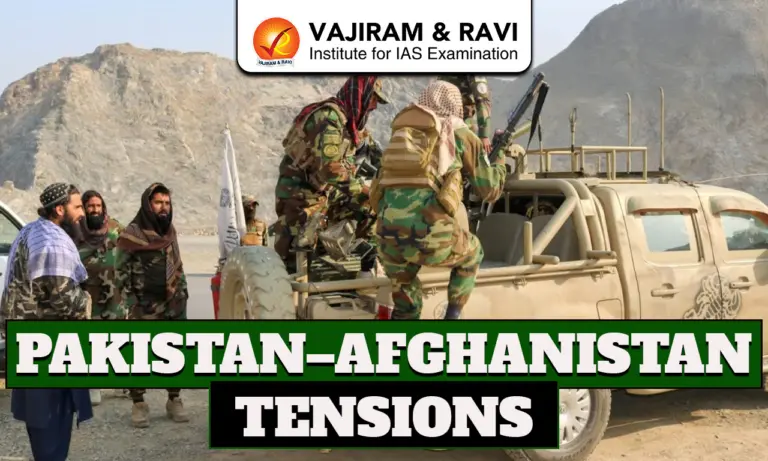
- Pakistan and Afghanistan have entered a sharp new phase of hostilities, with Pakistan bombing Kabul and other provinces after a cross-border attack on its troops.
- Pakistan’s Defence Minister termed the situation an “open war” with the Taliban-led Afghan government.
- The escalation follows months of tensions, with Islamabad accusing Kabul of sheltering militants responsible for attacks inside Pakistan. However, the strain between the two countries is rooted in a much longer history.
- Since 1947, relations have largely been marked by distrust, hostility, and recurring confrontations.
- These tensions have persisted across changes in governments in Pakistan and major upheavals in Afghanistan, including the Soviet intervention (1979–1989) and the US intervention (2001–2021), during both of which Pakistan supported Afghan resistance groups.
Regime Changes in Afghanistan: A Turbulent Political History
- End of the Monarchy and Communist Rule (1973–1989) – Afghanistan’s monarchy ended in 1973, followed by a brief nationalist phase and then 11 years of communist rule backed by the Soviet Union. The regime attempted sweeping political and social reforms but failed to stabilise the country.
- Najibullah and Collapse (1989–1992) – After the Soviet withdrawal, President Najibullah led a nationalist government for three years. His administration collapsed in 1992, paving the way for internal conflict.
- Civil War and First Taliban Rule (1992–2001) – Afghanistan descended into civil war between Mujahideen factions and the emerging Taliban movement. Formed in 1994, the Taliban — supported by Pakistan — captured Kabul in 1996 and controlled most of the country.
- US Intervention and Islamic Republic (2001–2021) – Following the September 11, 2001 attacks, the US invaded Afghanistan, ousting the Taliban and establishing the Islamic Republic of Afghanistan. However, the new political system struggled to gain lasting stability, and the Taliban insurgency persisted.
- Taliban Return to Power (2021) – After the US withdrawal in August 2021, the Taliban swiftly defeated Afghan government forces, regaining control of the entire country — once again with Pakistan’s backing — and re-establishing their rule over Afghanistan.





Persistent Fault Lines in Pakistan–Afghanistan Relations
- The Durand Line Dispute – A core dispute remains Afghanistan’s refusal to formally recognise the Durand Line as the international border, fuelling recurring tensions over sovereignty and territorial claims.
- Trade, Transit, and Strategic Control – Disagreements over transit routes and trade access have deepened mistrust, with Afghanistan accusing Pakistan of exerting undue influence and control over its affairs.
- Mutual Resentment – Many Afghans resent what they perceive as Pakistan’s interference since the fall of the monarchy. Conversely, Pakistan views Afghans as ungrateful, citing its hosting of millions of refugees and support for Afghan resistance movements against the Soviet Union and the United States.
- The India Factor – India’s presence and engagement in Afghanistan have long shaped Pakistan’s security concerns, adding another layer of complexity to bilateral tensions.
- Pakistan fears strategic encirclement by India and Afghanistan and seeks to limit Kabul’s ties with New Delhi.
- However, Afghan governments resist external influence over their foreign policy choices.
- Currently, Pakistan views the Taliban’s outreach to India as a betrayal, deepening tensions and reinforcing longstanding suspicions between the two neighbours.
The Durand Line: A Root of Pakistan–Afghanistan Tensions
- The 2,640-km Durand Line was drawn in 1893 by Sir Mortimer Durand, dividing territories of Afghan ruler Amir Abdul Rehman Khan.
- The demarcation split Pashtun tribal lands and was initially meant to define spheres of influence, not a permanent international border.
- Historical and cultural differences between Pashtuns and the Punjab-dominated Pakistani state remain significant.
- While British India later treated the Durand Line as a permanent boundary — a position inherited by Pakistan in 1947 — Afghanistan rejected this interpretation.
- It even opposed Pakistan’s entry into the United Nations, arguing that Pashtun territories ceded to British India should revert to Afghanistan.
- The Durand Line dispute remains unresolved. Even in 2018, Afghanistan objected when Pakistan integrated its Tribal Areas into Khyber Pakhtunkhwa, reaffirming Kabul’s long-standing refusal to accept the border’s finality.
Trade and Transit: A Strategic Pressure Point
- As a landlocked country, Afghanistan depends on transit access through neighbouring states — primarily Pakistan, Iran, and the Central Asian republics.
- Among these, the Pakistan route is geographically and economically the most viable.
- Successive Afghan governments have sought permission for overland trade between India and Afghanistan via the Wagah border. Pakistan has refused to allow Indian exports and aid through its territory, fuelling resentment in Kabul.
- Tensions intensify when Pakistan restricts goods entering Afghanistan through land routes or via Karachi port. Such actions are widely viewed in Afghanistan as the use of connectivity and transit access as instruments of political coercion.

 Last updated on April, 2026
→ UPSC Final Result 2025 is now out.
→ UPSC has released UPSC Toppers List 2025 with the Civil Services final result on its official website.
→ Anuj Agnihotri secured AIR 1 in the UPSC Civil Services Examination 2025.
→ UPSC Marksheet 2025 is now out.
→ UPSC Notification 2026 & UPSC IFoS Notification 2026 is now out on the official website at upsconline.nic.in.
→ UPSC Calendar 2026 has been released.
→ Check out the latest UPSC Syllabus 2026 here.
→ UPSC Prelims 2026 will be conducted on 24th May, 2026 & UPSC Mains 2026 will be conducted on 21st August 2026.
→ The UPSC Selection Process is of 3 stages-Prelims, Mains and Interview.
→ Prepare effectively with Vajiram & Ravi’s UPSC Prelims Test Series 2026 featuring full-length mock tests, detailed solutions, and performance analysis.
→ Enroll in Vajiram & Ravi’s UPSC Mains Test Series 2026 for structured answer writing practice, expert evaluation, and exam-oriented feedback.
→ Join Vajiram & Ravi’s Best UPSC Mentorship Program for personalized guidance, strategy planning, and one-to-one support from experienced mentors.
→ Shakti Dubey secures AIR 1 in UPSC CSE Exam 2024.
→ Also check Best UPSC Coaching in India
Pakistan–Afghanistan Tensions FAQs
Q1. What triggered the latest Pakistan–Afghanistan tensions?+
Q2. Why is the Durand Line central to Pakistan–Afghanistan tensions?+
Q3. How do trade disputes affect Pakistan–Afghanistan tensions?+
Q4. What role does the Pashtun issue play in Pakistan–Afghanistan tensions?+
Q5. How does India influence Pakistan–Afghanistan tensions?+
Tags: mains articles Pakistan–Afghanistan Tensions upsc current affairs upsc mains current affairs