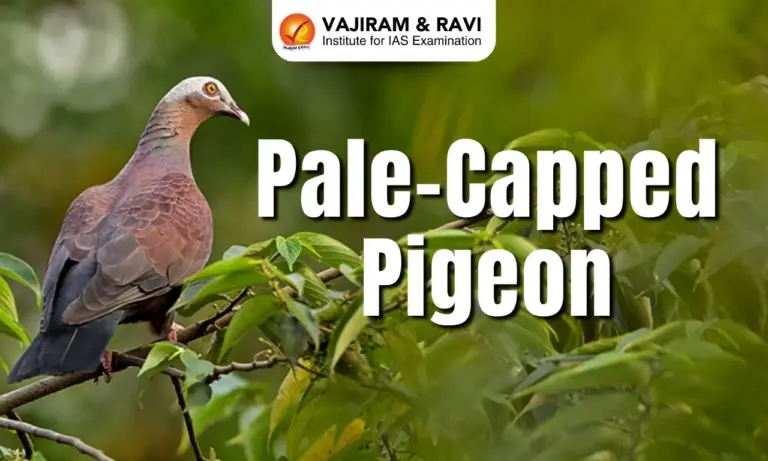
Pale-Capped Pigeon Latest News
In a significant sighting for birdwatchers and conservationists alike, the elusive Pale-capped Pigeon was recently photographed in Dehing Patkai National Park in Assam.
About Pale-Capped Pigeon
- The pale-capped pigeon, also known as the purple wood pigeon, is a large, dark purplish-maroon bird that is found in parts of the Indian Subcontinent and Southeast Asia.
- Scientific Name: Columba punicea
- Distribution: It is very locally distributed across its broad range, which encompasses parts of northern and northeastern India, Bangladesh, Myanmar, Thailand, Laos, Cambodia, and Vietnam.





Pale-Capped Pigeon Habitat
- It largely inhabits forest habitats, chiefly, primary or secondary evergreen forests, and bamboo and agricultural fields in close proximity to forests.
- Its range extends from the lowlands up to 1,600 m.
Pale-Capped Pigeon Features
- It is mainly brown above and chestnut below with a sheen of green or amethyst.
- Males have a whitish-grey-cap while females have a brownish-grey-cap and less gloss on the feathers.
- They are frugivores, foraging in small groups in the canopy of trees but sometimes descending to the ground for seeds and fallen fruit.
Pale-Capped Pigeon Conservation Status
It is classified as ‘Vulnerable‘ under the IUCN Red List.
Key Facts about Dehing Patkai National Park
- It is located in the Dibrugarh and Tinsukia districts of Assam.
- It is situated at the foothills of the Patkai Hill Ranges, on the banks of the River Dehing (a tributary of Brahmaputra), and adjacent to the Namdapha Wildlife Sanctuary.
- Also known as the ‘Amazon of the East’, it harbours the longest stretch of tropical lowland rainforests in India.
- It covers an area of 231.65 sq.km.
- The climate of the region is mostly tropical, with an annual rainfall of more than 4,000 mm.
- There are more than a dozen different ethnic groups living in the area, including the indigenous Assamese communities, particularly Tai Phake, Khamyang, Khampti, Singpho, Nocte, Ahom, Kaibarta, Moran, and Motok, Burmese, and non-indigenous Nepali people.
- Vegetation: The park is a deciduous rainforest with semi-evergreen and lush green flora.
- Flora: It is dominated by species like Hollong, Nahor, Mekai, Paroli, Simul, various orchids, ferns, cane, and bamboo.
- Fauna: The rich biodiversity includes diverse species such as slow loris, pig-tailed macaque, stump-tailed macaque, capped langur, Indian leopard, Asian elephant, royal Bengal tiger, gaur, Himalayan black bear, clouded leopard, barking deer, Chinese pangolin, etc.
Source: NEN

 Last updated on March, 2026
→ UPSC Final Result 2025 is now out.
→ UPSC has released UPSC Toppers List 2025 with the Civil Services final result on its official website.
→ Anuj Agnihotri secured AIR 1 in the UPSC Civil Services Examination 2025.
→ UPSC Marksheet 2025 is now out.
→ UPSC Notification 2026 & UPSC IFoS Notification 2026 is now out on the official website at upsconline.nic.in.
→ UPSC Calendar 2026 has been released.
→ Check out the latest UPSC Syllabus 2026 here.
→ UPSC Prelims 2026 will be conducted on 24th May, 2026 & UPSC Mains 2026 will be conducted on 21st August 2026.
→ The UPSC Selection Process is of 3 stages-Prelims, Mains and Interview.
→ Prepare effectively with Vajiram & Ravi’s UPSC Prelims Test Series 2026 featuring full-length mock tests, detailed solutions, and performance analysis.
→ Enroll in Vajiram & Ravi’s UPSC Mains Test Series 2026 for structured answer writing practice, expert evaluation, and exam-oriented feedback.
→ Join Vajiram & Ravi’s Best UPSC Mentorship Program for personalized guidance, strategy planning, and one-to-one support from experienced mentors.
→ Shakti Dubey secures AIR 1 in UPSC CSE Exam 2024.
→ Also check Best UPSC Coaching in India
Pale-Capped Pigeon FAQs
Q1. What is the scientific name of the pale-capped pigeon?+
Q2. What is the IUCN Red List status of the pale-capped pigeon?+
Q3. What distinguishing feature separates male and female pale-capped pigeons?+
Q4. Up to what elevation is the pale-capped pigeon typically found?+
Tags: pale-capped pigeon prelims pointers upsc current affairs upsc prelims current affairs