Pallas’s Gull Latest News
The rare migratory Pallas’s Gull was recently spotted in Jharkhand’s Udhwa Bird Sanctuary, marking its return after almost a decade.
About Pallas’s Gull
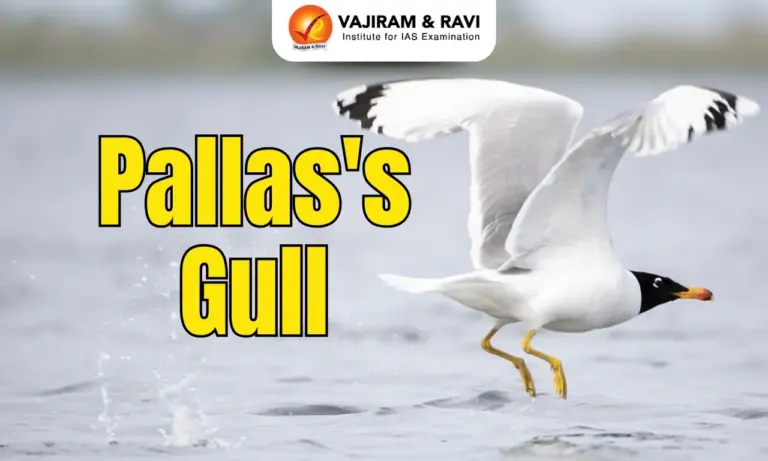
- Pallas’s Gull, also called the Great Black-headed Gull, is a large bird species.
- It is the world’s largest black-headed gull and the third-largest species of gull in the world.
- It belongs to the family Laridae.
- Scientific Name: Ichthyaetus ichthyaetus





Pallas’s Gull Distribution
- It breeds in colonies in marshes and islands from southern Russia to Mongolia.
- It is migratory, wintering in the Mediterranean Sea, the Arabian Peninsula, and India.
- Habitat: It prefers wetlands, salt lakes, lagoons, and slow-flowing rivers.
Pallas’s Gull Features
- It measures 55–72 cm in length with a 142 to 170 cm wingspan.
- Summer adults are unmistakable, since no other gull of this size has a black hood.
- The adults have grey wings and back, with conspicuous white “mirrors” at the wing tips.
- The legs are yellow, and the bill is orangey-yellow with a red tip.
- In all other plumages, a dark mask through the eye indicates the vestiges of the hood.
- Pallas’s Gulls feed on fish, including dead fish. They also prey upon insects, crustaceans, reptiles, other birds, and small mammals.
Pallas’s Gull Conservation Status
It is classified as Least Concern under the IUCN Red List.
Key Facts about Udhwa Lake Bird Sanctuary
- It is located in the Sahebganj district of Jharkhand.
- It is the state’s only bird sanctuary.
- It comprises two interconnected wetlands, Pataura Lake and Berhale Lake, which are part of the Ganga River floodplain and surrounded by the Rajmahal Hills.
- It was declared a Ramsar Site in 2025.
- It supports a diverse ecosystem with over 146 species of birds, including endangered ones like the band-tailed fish eagle, lesser adjutant stork, and common pochard.
- It also hosts a variety of aquatic plants, fish, reptiles, and mammals, such as fishing cats and otters.
- The sanctuary is an important habitat within the Central Asian flyway, attracting migratory birds during the winter.
Source: DEVD

 Last updated on April, 2026
→ UPSC Final Result 2025 is now out.
→ UPSC has released UPSC Toppers List 2025 with the Civil Services final result on its official website.
→ Anuj Agnihotri secured AIR 1 in the UPSC Civil Services Examination 2025.
→ UPSC Marksheet 2025 is now out.
→ UPSC Notification 2026 & UPSC IFoS Notification 2026 is now out on the official website at upsconline.nic.in.
→ UPSC Calendar 2026 has been released.
→ Check out the latest UPSC Syllabus 2026 here.
→ UPSC Prelims 2026 will be conducted on 24th May, 2026 & UPSC Mains 2026 will be conducted on 21st August 2026.
→ The UPSC Selection Process is of 3 stages-Prelims, Mains and Interview.
→ Prepare effectively with Vajiram & Ravi’s UPSC Prelims Test Series 2026 featuring full-length mock tests, detailed solutions, and performance analysis.
→ Enroll in Vajiram & Ravi’s UPSC Mains Test Series 2026 for structured answer writing practice, expert evaluation, and exam-oriented feedback.
→ Join Vajiram & Ravi’s Best UPSC Mentorship Program for personalized guidance, strategy planning, and one-to-one support from experienced mentors.
→ Shakti Dubey secures AIR 1 in UPSC CSE Exam 2024.
→ Also check Best UPSC Coaching in India
Pallas's Gull FAQs
Q1. What is Pallas's Gull?+
Q2. In which regions does Pallas’s Gull breed?+
Q3. Where does Pallas’s Gull migrate in winter?+
Q4. What is the IUCN conservation status of Pallas’s Gull?+
Tags: pallas's gull prelims pointers upsc current affairs upsc prelims current affairs