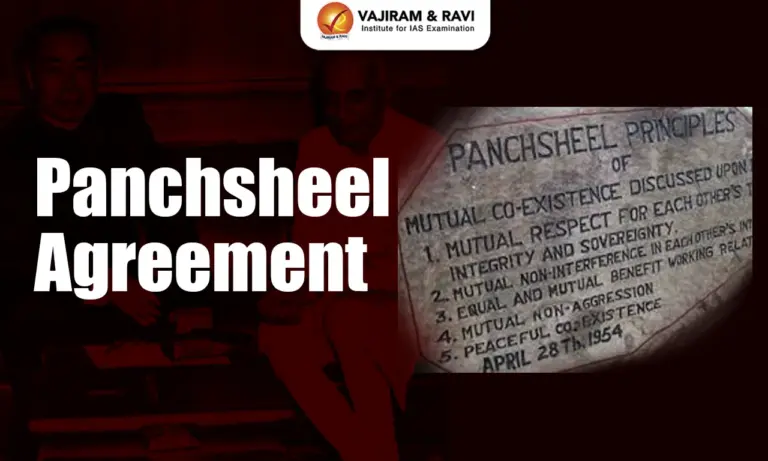
The Panchsheel Agreement refers to the Five Principles of Peaceful Coexistence that guide relations between sovereign states. These principles were formally articulated in 1954 during negotiations between India and China regarding trade and intercourse between the Tibet region of China and India. Panchsheel became a foundational concept in India’s foreign policy and later influenced global diplomatic norms, emphasising peace, sovereignty, and mutual respect.
The term Panchsheel is derived from Sanskrit, meaning five principles, and reflects India’s civilizational ethos of harmony, coexistence, and non-violence in international relations.
Panchsheel Agreement Historical Background
- The Panchsheel Agreement was a five-point agreement between India and China, signed on 29 April 1954.
- It laid down the Five Principles of Peaceful Coexistence to govern bilateral relations.
- These principles aimed to establish a framework of lasting peace, cooperation, and stability between the two nations.
- Popular slogans associated with the agreement were “Hindi-Chini Bhai Bhai” and “Asia for Asians,” reflecting the spirit of Asian solidarity.
- Panchsheel was viewed as a major step toward normalizing India–China relations during the 1950s.
- The concept of Panchsheel emerged in response to a global demand for new principles of international relations based on peace, harmony, and mutual respect.
- Panchsheel became one of the Ten Principles of International Peace and Cooperation adopted in the Bandung Declaration (April 1955) by 29 Afro-Asian countries.
- Its international relevance was reinforced when a resolution on peaceful coexistence, based on Panchsheel principles, was jointly presented by India, Yugoslavia, and Sweden and adopted by the UN General Assembly on 11 December 1957.
Five Principles of the Panchsheel Agreement
The Five Principles of the Panchsheel Agreement emphasize mutual respect for sovereignty and territorial integrity, non-aggression, and non-interference in internal affairs.
- Mutual respect for sovereignty and territorial integrity: Each country acknowledges and respects the independence, borders, and territorial unity of the other.
- Mutual non-aggression: Both states agree not to use force or military threats against one another under any circumstances.
- Mutual non-interference in internal affairs: No state should вмеш in the domestic political, economic, or social matters of another sovereign state.
- Equality and mutual benefit: Relations should be based on equality, fairness, and cooperation that benefits all parties involved.
- Peaceful coexistence: States with different political, economic, and ideological systems can live together peacefully without conflict.





Panchsheel Agreement Objectives
- To promote peaceful coexistence between India and China.
- To ensure mutual respect for sovereignty and territorial integrity.
- To prevent the use of force through mutual non-aggression.
- To avoid interference in each other’s internal affairs.
- To establish relations based on equality and mutual benefit.
- To encourage dialogue and cooperation instead of conflict.
- To create a moral and ethical framework for international relations.
- To support peace, stability, and harmony at regional and global levels.
Panchsheel and India-China Relations
- Foundation of relations (1954): Panchsheel provided the first formal diplomatic framework guiding India-China relations after independence and revolution.
- Spirit of cooperation: The agreement fostered goodwill and optimism, reflected in the slogan “Hindi-Chini Bhai-Bhai.”
- Tibet issue: Panchsheel facilitated India’s recognition of China’s sovereignty over Tibet to maintain peaceful ties.
- Cold War context: It symbolized Asian solidarity and India’s non-aligned approach in a bipolar world.
- 1962 war impact: The Sino-Indian War undermined Panchsheel, exposing violations of non-aggression and peaceful coexistence.
- Post-war mistrust: The conflict led to long-term distrust and weakened the practical relevance of Panchsheel.
- Diplomatic reference: Despite tensions, both countries continue to invoke Panchsheel in bilateral dialogues.
- Border management: Its principles inform confidence-building measures and calls for peaceful dispute resolution.
- Contemporary relevance: Panchsheel remains a normative guide, though strategic competition limits its practical application.
Role of Panchsheel in India’s Foreign Policy
- Foundation of peaceful diplomacy: Panchsheel established peace, dialogue, and non-violence as core principles of India’s foreign policy.
- Support to Non-Alignment: It reinforced India’s commitment to strategic autonomy and later became the philosophical basis of the Non-Aligned Movement.
- Respect for sovereignty: Panchsheel guided India’s consistent emphasis on sovereignty and territorial integrity in international relations.
- Opposition to power politics: The principles reflected India’s rejection of military alliances, coercion, and Cold War bloc politics.
- Promotion of South-South cooperation: Panchsheel strengthened India’s leadership role among newly independent Asian and African nations.
- Normative global influence: It enabled India to project itself as a responsible global actor advocating ethical and rule-based international conduct.
Global Influence of Panchsheel Principles
- Bandung Conference, 1955: Panchsheel formed the ideological basis of the Ten Principles of International Peace and Cooperation adopted by 29 Afro-Asian countries, promoting sovereignty, equality, and peaceful coexistence among newly independent nations.
- United Nations recognition (1957): A UN General Assembly resolution on peaceful coexistence, jointly sponsored by India, Yugoslavia, and Sweden, incorporated Panchsheel principles and was adopted in December 1957, giving them global legitimacy.
- Foundation of the Non-Aligned Movement (NAM): Panchsheel was accepted as the philosophical core of NAM at the Belgrade Conference, 1961, influencing over 120 member countries to pursue strategic autonomy during the Cold War.
- Support for decolonisation: Newly independent states in Asia, Africa, and Latin America used Panchsheel to assert sovereignty, oppose imperialism, and resist political or military intervention by major powers.
- Contribution to international norms: The principles strengthened global acceptance of non-aggression, equality of states, and peaceful dispute settlement, aligning closely with the objectives of the UN Charter.
Criticism and Limitations of the Panchsheel Agreement
- Panchsheel was overly idealistic, relying on moral principles and mutual trust while ignoring strategic realities and power politics.
- The agreement lacked any enforcement or dispute-resolution mechanism, making it declaratory rather than legally binding.
- Its credibility was seriously weakened by the 1962 Sino-Indian War, which violated the principles of non-aggression and peaceful coexistence.
- The principles were vaguely defined, allowing selective interpretation by states according to national interests.
- Panchsheel failed to address asymmetry in power and military capabilities, reducing its effectiveness in ensuring security.
- It had limited deterrence value, as ethical norms alone could not prevent conflict without supporting diplomatic and security measures.

 Last updated on April, 2026
→ UPSC Final Result 2025 is now out.
→ UPSC has released UPSC Toppers List 2025 with the Civil Services final result on its official website.
→ Anuj Agnihotri secured AIR 1 in the UPSC Civil Services Examination 2025.
→ UPSC Marksheet 2025 is now out.
→ UPSC Notification 2026 & UPSC IFoS Notification 2026 is now out on the official website at upsconline.nic.in.
→ UPSC Calendar 2026 has been released.
→ Check out the latest UPSC Syllabus 2026 here.
→ UPSC Prelims 2026 will be conducted on 24th May, 2026 & UPSC Mains 2026 will be conducted on 21st August 2026.
→ The UPSC Selection Process is of 3 stages-Prelims, Mains and Interview.
→ Prepare effectively with Vajiram & Ravi’s UPSC Prelims Test Series 2026 featuring full-length mock tests, detailed solutions, and performance analysis.
→ Enroll in Vajiram & Ravi’s UPSC Mains Test Series 2026 for structured answer writing practice, expert evaluation, and exam-oriented feedback.
→ Join Vajiram & Ravi’s Best UPSC Mentorship Program for personalized guidance, strategy planning, and one-to-one support from experienced mentors.
→ Shakti Dubey secures AIR 1 in UPSC CSE Exam 2024.
→ Also check Best UPSC Coaching in India
Panchsheel Agreement FAQs
Q1. What is the Panchsheel Agreement?+
Q2. What are the five principles of Panchsheel?+
Q3. Why was Panchsheel important?+
Q4. What slogans were associated with Panchsheel?+
Q5. What is its international significance?+
Tags: panchsheel agreement