What’s in today’s article?
- Why in News?
- Background – Reason behind the formation of Commission, formation of commission
- Previous Commissions on the issue of granting SC tag for all Dalit converts
- Centre’s Position on Dalit Converts
Why in News?
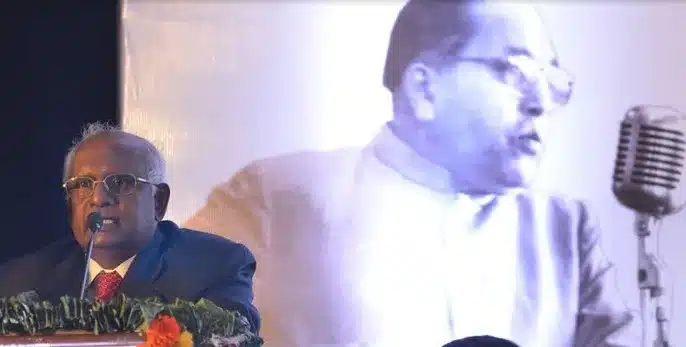
- The Commission of Inquiry, led by former Chief Justice of India Justice K.G. Balakrishnan, has received a one-year extension to submit its report on granting Scheduled Caste (SC) status to Dalit converts.
- Initially given a two-year deadline to report by October 10, 2024, the commission’s new submission date is October 10, 2025. The Ministry of Social Justice and Empowerment issued this extension following the commission’s request for additional time to finalize its findings and recommendations.
- The commission faced a delayed start due to logistical issues. It lacked a permanent office, an address, and adequate staff support for the initial months. Field visits, crucial for gathering data and public opinion, were postponed until August 2023 due to these constraints.





Background – Reason behind the formation of Commission, formation of commission
- Reason behind the formation of Commission
- Currently, the Constitution (Scheduled Castes) Order, 1950 stipulates that no person professing a religion different from Hinduism, Buddhism or Sikhism can be deemed to be a member of a Schedule Caste.
- The original order under which only Hindus were classified was later amended to include Sikhs and Buddhists.
- A batch of petitions were filed in the Supreme Court seeking the inclusion of Dalit Christians and Dalit Muslims and the removal of the religion criteria for inclusion as SCs.
- In August 2022, the Supreme Court had directed the Centre to submit its current position on the issue.
- In light of that, the Union Ministry of Social Justice & Empowerment issued a notification in October 2022 to form a three-member Commission to study the matter.
- Currently, the Constitution (Scheduled Castes) Order, 1950 stipulates that no person professing a religion different from Hinduism, Buddhism or Sikhism can be deemed to be a member of a Schedule Caste.
- The commission
- The three-member Commission is headed by former Chief Justice of India, Justice K.G. Balakrishnan.
- Objectives
- To examine the issue of whether Scheduled Caste (SC) status can be accorded to Dalits who have over the years converted to religions other than Sikhism or Buddhism.
- To look into the changes an SC person goes through after converting to another religion and its implications on the question of including them as SCs.
- These will include examining their traditions, customs, social and other forms of discrimination and how and whether they have changed as a result of the conversion.
- To examine any other related questions that it deemed appropriate, in consultation with and with the consent of the Central government.
- The Commission has been given a two-year deadline to submit a report on the issue.
Previous Commissions on the issue of granting SC tag for all Dalit converts
- Various commissions have previously recommended the inclusion of Dalit Christians and Dalit Muslims under the Scheduled Caste category.
- First Backward Classes Commission (1955) –
- The First Backward Classes Commission was headed by Kaka Kalelkar.
- The commission documented the existence of caste and caste discrimination among Indian Christians and Indian Muslims.
- It concluded that Dalit converts continued to face the same social disabilities even after leaving the Hindu fold.
- Rajinder Sachar Report (2006) –
- In the 2006 Rajinder Sachar Report, it was observed that the social and economic of Dalits Muslims and Dalit Christians did not change even after conversion.
- The report said, despite this, they have been deprived of SC status available to their Hindu counterparts.
- National Commission for Scheduled Castes/National Commission for Minorities
- Both these commissions had also recommended providing SC status to Dalit Muslims and Dalit Christians in affidavits filed before the Supreme Court in 2011.
Centre’s Position on Dalit Converts
- The Centre has repeatedly defended its stance of excluding Dalit Christians and Muslims from SC status, citing the “foreign origins” of these religions.
- In a 2019 affidavit to the SC, the Union govt rejected reports suggesting that Dalit converts to Islam and Christianity continue to face social disabilities due to caste identity.
- The govt argued there was insufficient empirical evidence to support such claims across all cited reports.
- Furthermore, it differentiated Dalit Buddhists from Dalit converts to Islam and Christianity.
- The government stated that Dalit Buddhists converted voluntarily due to “innate socio-political imperatives,” whereas Dalit conversions to Islam and Christianity may have occurred for other reasons.
- However, it has supported the formation of the commission to thoroughly examine the matter, requesting the Supreme Court to delay its decision until the commission’s findings are submitted.
Q.1. Why was the commission examining SC status for Dalit converts extended?
The Justice K.G. Balakrishnan-led commission received a one-year extension to address logistical delays and complete its report on the SC status for Dalit converts by October 2025. Field visits and public consultations are part of its mandate to assess the impact of religious conversion.
Q.2. What are the objectives of the commission on SC status for Dalit converts?
The commission aims to determine if SC status should be extended to Dalits who convert to non-Sikh, non-Buddhist religions. It studies social, economic, and discrimination impacts following conversions, including religious customs, to make comprehensive recommendations.
Source: Panel examining SC tag for all Dalit converts gets one-year extension

 Last updated on March, 2026
→ UPSC Final Result 2025 is now out.
→ UPSC has released UPSC Toppers List 2025 with the Civil Services final result on its official website.
→ Anuj Agnihotri secured AIR 1 in the UPSC Civil Services Examination 2025.
→ UPSC Marksheet 2025 is now out.
→ UPSC Notification 2026 & UPSC IFoS Notification 2026 is now out on the official website at upsconline.nic.in.
→ UPSC Calendar 2026 has been released.
→ Check out the latest UPSC Syllabus 2026 here.
→ UPSC Prelims 2026 will be conducted on 24th May, 2026 & UPSC Mains 2026 will be conducted on 21st August 2026.
→ The UPSC Selection Process is of 3 stages-Prelims, Mains and Interview.
→ Prepare effectively with Vajiram & Ravi’s UPSC Prelims Test Series 2026 featuring full-length mock tests, detailed solutions, and performance analysis.
→ Enroll in Vajiram & Ravi’s UPSC Mains Test Series 2026 for structured answer writing practice, expert evaluation, and exam-oriented feedback.
→ Join Vajiram & Ravi’s Best UPSC Mentorship Program for personalized guidance, strategy planning, and one-to-one support from experienced mentors.
→ Shakti Dubey secures AIR 1 in UPSC CSE Exam 2024.
→ Also check Best UPSC Coaching in India