PARAS-2 Spectrograph Latest News
Recently, scientists at Physical Research Laboratory (PRL) discovered a new dense sub Saturn exoplanet TOI-6038A b by using PARAS-2 Spectrograph at Mt Abu Telescope.
About PARAS-2 Spectrograph
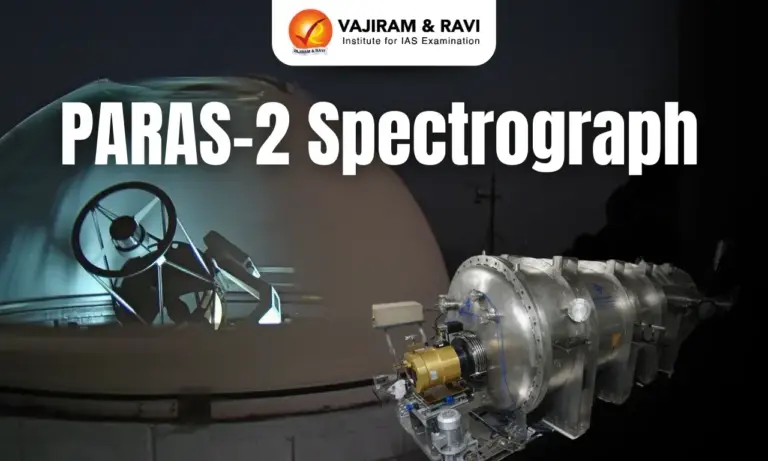
- The PRL Advanced Radial-velocity All-sky Search-2 (PARAS-2) is a cutting-edge fiber-fed spectrograph integrated with the PRL 2.5m telescope, constituting a significant advancement over its predecessor.
- It is a state-of-the-art high-resolution spectrograph that operates in 380-690 nm wave-band. It is aimed to unveil the super-Earth-like worlds.
- It was conceived with the primary objective of achieving sub-m/s precision in radial velocity (RV), a crucial capability for the detection and characterization of super-Earths or massive planets orbiting G and K dwarf stars.
- It is the highest-resolution spectrograph in Asia which is under an ultra-stable temperature and pressure environment.
What is Exoplanet?
- These are planets that orbit other stars and are beyond our solar system.
- Exoplanets come in a host of different sizes. They can be gas giants bigger than Jupiter or as small and rocky as Earth.
- They are also known to have different kinds of temperatures; boiling to cold.
- The recently discovered sub Saturn exoplanet TOI-6038A b lies in the transition region between Neptune-like and gas giant exoplanets, called as “Sub-Saturn,” a category absent in our solar system, providing a unique opportunity to study planetary formation and evolution.





PARAS-2 Spectrograph FAQs
Q1: What is a spectrograph used for?
Ans: A spectrograph is an instrument used to separate and measure the wavelengths present in Electromagnetic radiation and to measure the relative amounts of radiation at each wavelength.
Q2: What is the difference between a spectrometer and a spectrograph?
Ans: The two devices do basically the same job but using different technology. A spectrometer generates a spectrum by measuring the intensity of incoming light at a range of wavelengths in step by step increments. A spectrograph generates a spectrum in one go.
Q3: Who discovered the spectrograph?
Ans: William Hyde Wollaston
Source: ISRO

 Last updated on March, 2026
→ UPSC Final Result 2025 is now out.
→ UPSC has released UPSC Toppers List 2025 with the Civil Services final result on its official website.
→ Anuj Agnihotri secured AIR 1 in the UPSC Civil Services Examination 2025.
→ UPSC Marksheet 2025 is now out.
→ UPSC Notification 2026 & UPSC IFoS Notification 2026 is now out on the official website at upsconline.nic.in.
→ UPSC Calendar 2026 has been released.
→ Check out the latest UPSC Syllabus 2026 here.
→ UPSC Prelims 2026 will be conducted on 24th May, 2026 & UPSC Mains 2026 will be conducted on 21st August 2026.
→ The UPSC Selection Process is of 3 stages-Prelims, Mains and Interview.
→ Prepare effectively with Vajiram & Ravi’s UPSC Prelims Test Series 2026 featuring full-length mock tests, detailed solutions, and performance analysis.
→ Enroll in Vajiram & Ravi’s UPSC Mains Test Series 2026 for structured answer writing practice, expert evaluation, and exam-oriented feedback.
→ Join Vajiram & Ravi’s Best UPSC Mentorship Program for personalized guidance, strategy planning, and one-to-one support from experienced mentors.
→ Shakti Dubey secures AIR 1 in UPSC CSE Exam 2024.
→ Also check Best UPSC Coaching in India