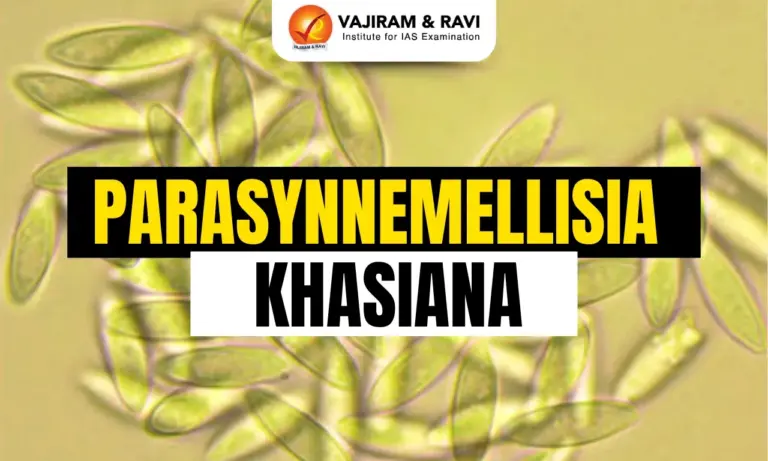
Parasynnemellisia khasiana Latest News
A previously unknown fungus named Parasynnemellisia khasiana has been discovered in the bamboo forests around Mawsynram, adding a new species — and even a new genus — to the scientific record from Meghalaya.
About Parasynnemellisia khasiana
- It is a new species of fungus.
- It was discovered in the bamboo forests around Mawsynram, Meghalaya.
- It is named after the Khasi Hills.
- The fungus was found on dead stems of a thorny bamboo species (Chimonocalamus griffithianus) while surveying bamboo litter in the Mawsynram area.
- Laboratory analysis confirmed that the organism did not belong to any existing fungal genus.
- As a result, the researchers established a new genus, Parasynnemellisia, with P. khasiana as its first described species.
- It forms a distinct evolutionary lineage within the fungal family Phaeosphaeriaceae, separating it from superficially similar bamboo-associated fungi found elsewhere in Asia.





What are Fungi?
- A fungus (plural: fungi) is a type of eukaryotic organism belonging to the kingdom Fungi, alongside plants, animals, protozoa, and monera.
- As eukaryotes, their cells contain a nucleus, mitochondria, and a complex system of internal membrane, including the endoplasmic reticulum and Golgi apparatus.
- All fungi possess cell walls made of a tough polysaccharide called chitin; the cell wall provides structural strength to the fungal body.
- Fungi are incredibly diverse, with commonly encountered forms including yeast, molds, truffles, and mushrooms.
- Fungi come in both unicellular and multicellular forms, with yeast representing the simplest unicellular type and molds like Rhizopus, Mucor, and Penicillium are examples of multicellular fungi.
- They’re the most populous kingdom on the planet – an estimated 3.8 million fungi exist worldwide – and yet, more than 90% of them are currently unknown to science.
- They are found in just about any habitat, but most live on the land, mainly in soil or plant material rather than sea or fresh water.
- They are more closely related to animals than to plants, as they do not photosynthesise.
- Different species of fungi can be mutualistic, parasitic, or serve as decomposers.
- Most of the fungi are saprobes (live on dead organisms). They are important decomposers and recyclers of nutrients within the environment.
Source: HUB

 Last updated on April, 2026
→ UPSC Final Result 2025 is now out.
→ UPSC has released UPSC Toppers List 2025 with the Civil Services final result on its official website.
→ Anuj Agnihotri secured AIR 1 in the UPSC Civil Services Examination 2025.
→ UPSC Marksheet 2025 is now out.
→ UPSC Notification 2026 & UPSC IFoS Notification 2026 is now out on the official website at upsconline.nic.in.
→ UPSC Calendar 2026 has been released.
→ Check out the latest UPSC Syllabus 2026 here.
→ UPSC Prelims 2026 will be conducted on 24th May, 2026 & UPSC Mains 2026 will be conducted on 21st August 2026.
→ The UPSC Selection Process is of 3 stages-Prelims, Mains and Interview.
→ Prepare effectively with Vajiram & Ravi’s UPSC Prelims Test Series 2026 featuring full-length mock tests, detailed solutions, and performance analysis.
→ Enroll in Vajiram & Ravi’s UPSC Mains Test Series 2026 for structured answer writing practice, expert evaluation, and exam-oriented feedback.
→ Join Vajiram & Ravi’s Best UPSC Mentorship Program for personalized guidance, strategy planning, and one-to-one support from experienced mentors.
→ Shakti Dubey secures AIR 1 in UPSC CSE Exam 2024.
→ Also check Best UPSC Coaching in India
Parasynnemellisia khasiana FAQs
Q1. What is Parasynnemellisia khasiana?+
Q2. Where was Parasynnemellisia khasiana discovered?+
Q3. After which region is Parasynnemellisia khasiana named?+
Q4. On what type of plant material was this fungus found?+
Tags: parasynnemellisia khasiana prelims pointers upsc current affairs upsc prelims current affairs