Parliament Committees in India Latest News
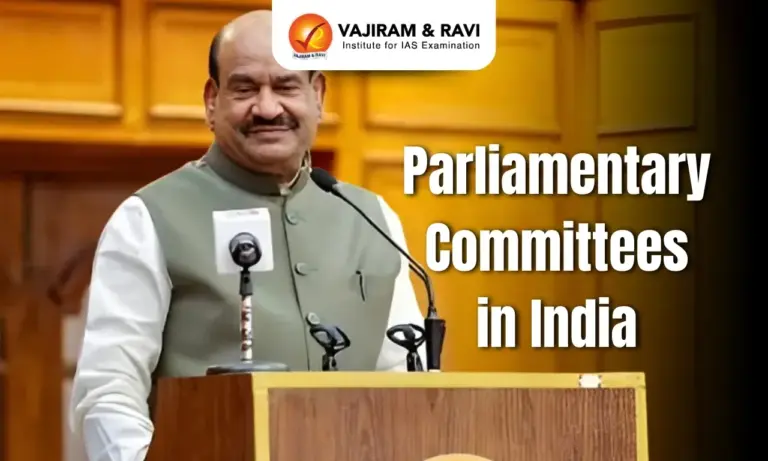
- Lok Sabha Speaker Om Birla, recently addressed the National Conference of Chairpersons of Parliamentary and Legislature Committees on Welfare of SCs and STs.
- He highlighted the increasing importance of parliamentary committees in India in ensuring accountability.
- He also highlighted the declining quality of dialogue, decorum, and discussion in legislatures.
Historical Evolution and Structure of Parliament Committees in India
- Historical evolution: Even though a structured committee system was only established in 1993, individual committees were being formed for various reasons as far back as independence. For instance, the Ad Hoc Committee on the Citizenship Clause.
- Structure:
- Standing committees: Permanent, subject-specific (finance, defence, etc.).
- Ad Hoc committees: Temporary, for specific purposes.
- Joint committees: Drawn from both Houses for common issues. For example, the JPC to evaluate the feasibility of implementing the ‘One Nation, One Election’ initiative.
- Specialised committees: e.g., Business Advisory Committee, Committee on Papers Laid on the Table.





Need for Parliament Committees
- Volume of work: The Parliament cannot deliberate on all issues on the floor due to time and procedural constraints.
- Beyond legislation: Committees handle sector-specific concerns, welfare oversight, financial scrutiny, and executive accountability.
- Behind-the-scenes contribution: Every Bill, debate, and parliamentary procedure is supported by committee work, often invisible to the public eye.
Role of Parliament and Legislature Committees
- Accountability and transparency: Committees scrutinize government functioning, schemes, and expenditure.
- Bipartisan nature and consensus building: Panels function above party lines, making them crucial for effective governance.
- Oversight on spending: Demand for Grants reports highlight expenditure gaps (e.g., Panchayati Raj Ministry’s under-utilisation of funds in 2022-23).
- Impactful interventions: Empowered to recommend improvements in implementation of schemes for SCs and STs, ensure budget allocations reach intended beneficiaries.
Significant Contributions of Parliament Committees in India
- Digital Data Protection Bill: From Justice Srikrishna Committee (2017) → Joint Parliamentary Committee (2021) → Draft Digital Personal Data Protection Bill (2022).
- Major legislations referred:
- Prohibition of Child Marriage (Amendment) Bill.
- Anti-Maritime Piracy Bill.
- Jan Vishwas Bill.
- Wildlife Protection (Amendment) Bill.
- Competition (Amendment) Bill, Electricity Bill, Criminal Procedure (Identification) Bill.
- Public Accounts Committee (2015): Flagged inefficiencies in defence shipyards — cost overruns, delays, inadequate practices.
Concerns Raised About Parliament and Legislature Committees
- Decline in deliberation: Reduced debates and disruptions in both Lok Sabha and state assemblies.
- For example, only 60% bills referred to these committees in the 14th Lok Sabha, 15th Lok Sabha (71%), 16th Lok Sabha (25%), and 17th Lok Sabha (16%), highlighting their declining role in legislative/ expert scrutiny.
- Language and conduct: Falling standards of parliamentary behaviour. Example: recent Monsoon Session of Parliament marred by daily disruptions over electoral roll revision in Bihar.
- Political polarisation: Committees could lose their influence.
- Lack of binding power: Recommendations often ignored.
The Road Ahead
- Compulsory referral of Bills: As in the U.S., every Bill should be scrutinised by relevant committees before passing.
- Strengthening powers: To avoid becoming “toothless tigers,” committees need more authority to enforce accountability.
- Institutionalisation: Formalise processes to prevent political expediency from bypassing scrutiny.
- Preserve consensus mechanism: Committees must remain bipartisan spaces of constructive deliberation.
Conclusion
- Strengthening the committee system is essential to revive deliberative democracy in India, as it provides a bipartisan space for scrutiny, accountability, and consensus-building.
- Empowering parliamentary committees in India with greater authority can ensure more informed, inclusive, and transparent law-making in the years ahead.

 Last updated on March, 2026
→ UPSC Final Result 2025 is now out.
→ UPSC has released UPSC Toppers List 2025 with the Civil Services final result on its official website.
→ Anuj Agnihotri secured AIR 1 in the UPSC Civil Services Examination 2025.
→ UPSC Marksheet 2025 is now out.
→ UPSC Notification 2026 & UPSC IFoS Notification 2026 is now out on the official website at upsconline.nic.in.
→ UPSC Calendar 2026 has been released.
→ Check out the latest UPSC Syllabus 2026 here.
→ UPSC Prelims 2026 will be conducted on 24th May, 2026 & UPSC Mains 2026 will be conducted on 21st August 2026.
→ The UPSC Selection Process is of 3 stages-Prelims, Mains and Interview.
→ Prepare effectively with Vajiram & Ravi’s UPSC Prelims Test Series 2026 featuring full-length mock tests, detailed solutions, and performance analysis.
→ Enroll in Vajiram & Ravi’s UPSC Mains Test Series 2026 for structured answer writing practice, expert evaluation, and exam-oriented feedback.
→ Join Vajiram & Ravi’s Best UPSC Mentorship Program for personalized guidance, strategy planning, and one-to-one support from experienced mentors.
→ Shakti Dubey secures AIR 1 in UPSC CSE Exam 2024.
→ Also check Best UPSC Coaching in India
Parliamentary Committees in India FAQs
Q1. Why are parliamentary committees considered the "real working space" of the Indian Parliament?+
Q2. What does the declining referral of Bills to parliamentary committees indicate about legislative scrutiny in India?+
Q3. How did Constituent Assembly committees shape India’s governance framework?+
Q4. In what way do committee reports strengthen executive accountability despite being non-binding?+
Q5. Why is compulsory referral of Bills to committees seen as a reform imperative for Indian Parliament?+
Tags: mains articles parliament committees in india upsc current affairs upsc mains current affairs