Parliamentary Decline in India Latest News
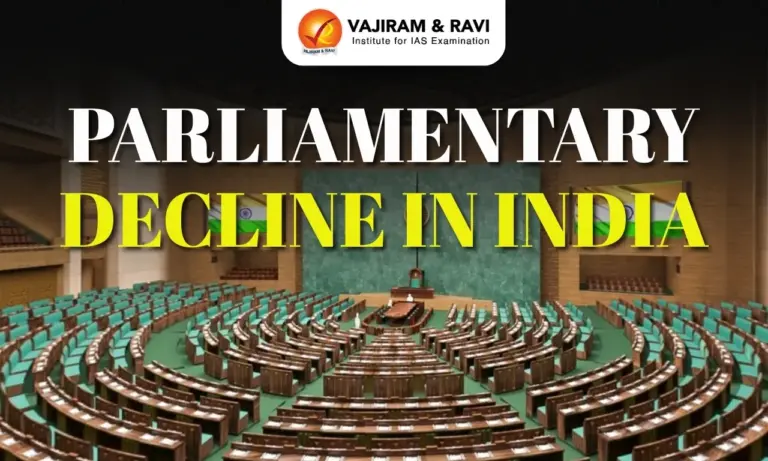
- The Winter Session of Parliament begins amid a potential deadlock over the Special Intensive Revision (SIR) of electoral rolls.
- There are persistent concerns about legislative dysfunction, erosion of parliamentary deliberation, and the growing imbalance between the executive and the legislature.
- This highlights a structural decline in productivity and oversight functions of Parliament across several Lok Sabhas.
Declining Health of Parliament
- Routine disruptions and falling productivity: According to the PRS Legislative Research’s monsoon session data (between July 21 and August 21) –
- The Lok Sabha (LS) functioned just 29% of its scheduled time and the Rajya Sabha (RS) for 34%.
- Question Hour, the institution’s core mechanisms of accountability, were also badly hit (LS completing only 23% while the RS managed only 6% of its scheduled Question Hour time).
- Bills passed with minimal debate:
- Regulation of Online Gaming Bill: Cleared in one day, with 6 minutes (LS) and 23 minutes (RS) of discussion.
- Merchant Shipping Bill 2024: 20 minutes (LS), 10 minutes (RS).
- Operation Sindoor: 50% of LS time spent on it alone.





Institutional Concerns Raised
- Warnings from constitutional experts:
- P. D. T. Achary: Declining deliberation undermines the “very purpose of Parliament”. Passage of Bills without debate is a “mockery of legislative business” under Article 107. He advocates dialogue between the PM and Leader of Opposition.
- Views from MPs:
- Manish Tewari (Congress): Parliament became a rubber-stamp legislature. Standing Committees becoming redundant. Presiding officers’ neutrality diminishing.
- Syed Naseer Husain (Congress): The government holds primary responsibility for enabling debate. Opposition protests when discussions are denied.
- Government’s position: Opposition blamed for disruptions, driven by “failed leaders”.
What the Number Indicate
- Short-term variability:
- Exceptionally high productivity in Budget Sessions 2023 and 2024 (111% LS, 112% RS).
- Sharp drop again in Winter Session 2024 (52% LS, 39% RS).
- Long-term structural decline – 17th Lok Sabha (2019–2024):
- The Lok Sabha functioned for 88% of its scheduled time and the Rajya Sabha 73%.
- However, this came with the fewest sittings of any full-term Lok Sabha since 1952 due to Covid-19 (met only 33 days in 2020).
- 11 of its 15 sessions were adjourned early, and it became the first Lok Sabha without a Deputy Speaker (absent even in the 18th LS).
- Historical decline in sittings:
- 1952–1970: 121 days/year (1st LS – 135 days/year)
- Since 2000: 68 days/year
- 17th Lok Sabha: 55 days/year
- Committee scrutiny weakened: Bills referred to committees – Over 60% in the 14th and 15th LS, around 20% in the 16th and 17th LS.
- Cross-government trend:
- Decline is not limited to one party or era.
- Example: 15th Lok Sabha (UPA-2) performed poorly (61% LS; 66% RS). The 13th and 14th Lok Sabha performed significantly better (91% and 87%).
Deeper Causes of Institutional Erosion
- Anti-Defection Law:
-
- From stability to suppression: Intended to curb defections, the law now erodes independence of MPs. MPs function as subjects of party whip, not representatives of people.
- It affects power of the purse (the foundational principle that no tax can be levied), impeachment of a president or a judge (when members are expected to act as jurors, weighing evidence with impartiality), and legislative autonomy.
- Executive dominance over legislature: Parliament becoming an approval body rather than a deliberative body. Opposition’s notices, adjournment motions often dismissed; question hour and zero hour frequently disrupted; committees weakened, reducing expert scrutiny.
- Erosion of constitutional offices’ neutrality: Presiding officers perceived as partisan. Constitutional conventions not upheld resulting in institutional imbalance.
Comparative Perspective – Westminster Model vs India
- Historical roots:
- Oxford Parliament of 1258: Established executive accountability to the legislature.
- UK and Commonwealth nations:
- PM’s Questions ensure that the head of government is held to account on a direct, weekly and public basis.
- Strong committee oversight.
- Mandatory testimony by executive officials.
- India’s divergence:
- Reversal of the Westminster model’s spirit.
- Decline in oversight, lack of routine accountability from executives.
Challenges and Way Forward
- Breakdown in government–Opposition communication: Dialogue mechanisms between PM, LoP, and House leaders.
- Declining sittings and productivity: Mandatory minimum sittings (e.g., 120 days/year) to prevent rushed legislation without debate.
- Weakening of Standing Committees: Make committee referral mandatory for all major Bills. Enhance transparency and expert consultation.
- Absence of Deputy Speaker (Constitutional requirement under Article 93): Strengthen conventions on Deputy Speaker election.
- Dominance of party whip due to anti-defection law: Limit whips to confidence motions and money bills. Restore legislative independence and conscience vote.
- Partisanship of presiding officers: Clear norms for impartial conduct of Speaker and Chairperson.
- Marginalisation of Question Hour and Zero Hour: Ensure full Question Hour and functioning of Zero Hour.
- Institutional imbalance favouring the executive: Institutionalise Prime Minister’s Question Hour (weekly). Require executive testimony before committees.
Conclusion
- The decline of parliamentary functioning in India is not a partisan or episodic problem but a structural erosion decades in the making. This has hollowed out the legislature’s constitutional role as the grand inquest of the nation.
- Reforms are essential to revive the institutional spirit envisioned by the Constitution, without which, India risks reducing Parliament to a symbolic edifice—standing tall, but silent in its duty to hold power accountable to the people.

 Last updated on April, 2026
→ UPSC Final Result 2025 is now out.
→ UPSC has released UPSC Toppers List 2025 with the Civil Services final result on its official website.
→ Anuj Agnihotri secured AIR 1 in the UPSC Civil Services Examination 2025.
→ UPSC Marksheet 2025 is now out.
→ UPSC Notification 2026 & UPSC IFoS Notification 2026 is now out on the official website at upsconline.nic.in.
→ UPSC Calendar 2026 has been released.
→ Check out the latest UPSC Syllabus 2026 here.
→ UPSC Prelims 2026 will be conducted on 24th May, 2026 & UPSC Mains 2026 will be conducted on 21st August 2026.
→ The UPSC Selection Process is of 3 stages-Prelims, Mains and Interview.
→ Prepare effectively with Vajiram & Ravi’s UPSC Prelims Test Series 2026 featuring full-length mock tests, detailed solutions, and performance analysis.
→ Enroll in Vajiram & Ravi’s UPSC Mains Test Series 2026 for structured answer writing practice, expert evaluation, and exam-oriented feedback.
→ Join Vajiram & Ravi’s Best UPSC Mentorship Program for personalized guidance, strategy planning, and one-to-one support from experienced mentors.
→ Shakti Dubey secures AIR 1 in UPSC CSE Exam 2024.
→ Also check Best UPSC Coaching in India
Parliamentary Decline in India FAQs
Q1. What factors are responsible for the declining deliberative functioning of the Indian Parliament?+
Q2. How has the anti-defection law contributed to the erosion of parliamentary autonomy in India?+
Q3. What is the significance of Parliamentary Standing Committees in legislative oversight?+
Q4. What are the trends in parliamentary productivity over recent Lok Sabhas?+
Q5. What reforms are needed to restore the balance between the executive and the legislature?+
Tags: mains articles parliamentary decline in india upsc current affairs upsc mains current affairs