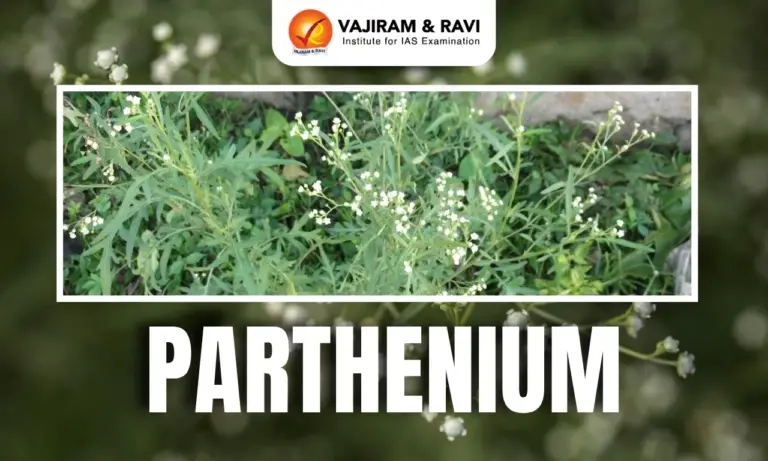
Parthenium Latest News
As a part of a three-day campaign of Parthenium Free Pobitora, about 5.2 hectares of the Pobitora Wildlife Sanctuary in Assam‘s Morigaon district were cleared of Parthenium, or Congress grass, an invasive weed, by the forest staff recently.
About Parthenium
- Parthenium hysterophorus L., commonly known as carrot weed, white top, or congress grass in India, is an herbaceous, erect, and annual plant belonging to the family Asteracae (compositae).
- It is a poisonous, pernicious, problematic, allergic, and aggressive weed posing a serious threat to human beings and livestock.
- In India, this weed has been considered as one of the greatest sources of dermatitis, asthma, nasal-dermal and nasal-bronchial types of diseases.
- Besides ill effects, it also causes several other problems, like blockage of common pathways, and reduces the aesthetic values of parks, gardens, and residential colonies.
- It is a nuisance on roadsides and railway tracks, vacant lands, wastelands, industrial areas, and on the sides of open drainage systems and irrigation canals, besides invading agricultural crops, orchards, and forest areas.
- It is most popularly known as gajar ghas due to its appearance like a carrot plant.
- The origin of parthenium is considered to be from Mexico, America, Trinidad, and Argentina.
- After the noticeable occurrence of parthenium in Pune (Maharashtra) in 1955, it has spread like a wildfire throughout India.
- At present parthenium has invaded about 35 million hectares of land in India.
- It mainly spreads through seeds.
- A single plant can produce about 5000 – 25000 seeds.
- The seeds are very small in size and light in weight.





Key Facts about Pobitora Wildlife Sanctuary
- It is located in the eastern region of Guwahati, Assam.
- It was established in 1998 and covers an area of 48.81 square kilometres.
- The Sanctuary consists of the Rajamayong Reserve Forest and Pobitora Reserve Forest.
- Flora:
- 72% of Pabitora consists of the wet savannah of Arundo donax, Erianthus ravennae, Phragmites karka, Imperata cylindrica, and Saccharum spp.
- Water hyacinth (Eichornia crassipes) is a major problem, especially to waterfowl, as it forms thick mats on the water surface.
- Fauna:
- Pobitora is mainly famous for its great Indian One-horned rhinoceros.
- It is known for holding the highest density of Greater One Horned Rhinoceros in the country.
- Besides rhinoceros, the other animals are leopard, wild boar, Barking deer, wild buffalo, etc.
- It is also home to more than 2000 migratory birds and various reptiles.
Source: NEL

 Last updated on March, 2026
→ UPSC Final Result 2025 is now out.
→ UPSC has released UPSC Toppers List 2025 with the Civil Services final result on its official website.
→ Anuj Agnihotri secured AIR 1 in the UPSC Civil Services Examination 2025.
→ UPSC Marksheet 2025 is now out.
→ UPSC Notification 2026 & UPSC IFoS Notification 2026 is now out on the official website at upsconline.nic.in.
→ UPSC Calendar 2026 has been released.
→ Check out the latest UPSC Syllabus 2026 here.
→ UPSC Prelims 2026 will be conducted on 24th May, 2026 & UPSC Mains 2026 will be conducted on 21st August 2026.
→ The UPSC Selection Process is of 3 stages-Prelims, Mains and Interview.
→ Prepare effectively with Vajiram & Ravi’s UPSC Prelims Test Series 2026 featuring full-length mock tests, detailed solutions, and performance analysis.
→ Enroll in Vajiram & Ravi’s UPSC Mains Test Series 2026 for structured answer writing practice, expert evaluation, and exam-oriented feedback.
→ Join Vajiram & Ravi’s Best UPSC Mentorship Program for personalized guidance, strategy planning, and one-to-one support from experienced mentors.
→ Shakti Dubey secures AIR 1 in UPSC CSE Exam 2024.
→ Also check Best UPSC Coaching in India
Parthenium FAQs
Q1. The origin of Parthenium is believed to be from region?+
Q2. How many seeds can a single Parthenium hysterophorus plant produce?+
Q3. Which disease is commonly caused in humans due to Parthenium exposure?+
Tags: parthenium prelims pointers upsc current affairs upsc prelims current affairs