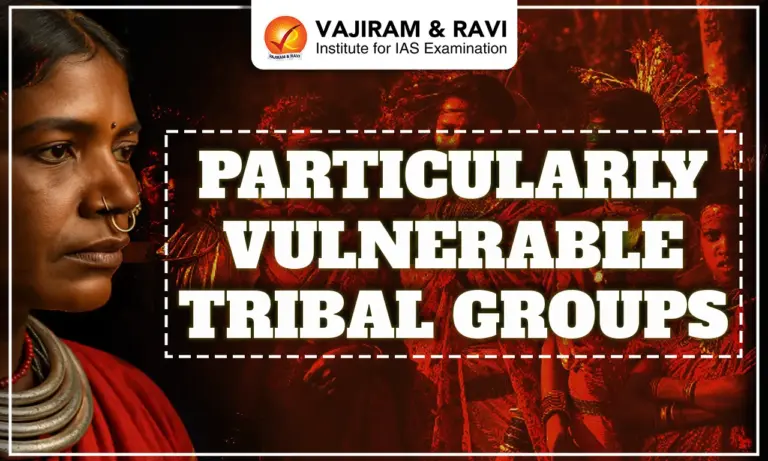
Particularly Vulnerable Tribal Groups (PVTGs) are the most disadvantaged sub-groups among India’s Scheduled Tribes. Identified for their extreme socio-economic backwardness, isolation, and fragile livelihoods, PVTGs require targeted, habitat-level interventions for survival and development. This article explains who PVTGs are, how they were identified, where they live, the scale of their deprivation, government responses, legal and programmatic safeguards, recent developments, and practical recommendations- all using authoritative, government and international sources.
Particularly Vulnerable Tribal Groups (PVTGs)
The Particularly Vulnerable Tribal Groups (PVTGs) category first emerged from the Dhebar (Tribal) Commission (1960-61) which recognised that some tribal communities were far more isolated and backward than others and needed special focus. In the Fifth Five-Year Plan (1974-79) the government officially listed 52 Primitive Tribal Groups; the category was renamed Particularly Vulnerable Tribal Groups (PVTGs) and expanded over time to 75 groups currently notified by the Government of India. The designation is meant to identify communities with features such as pre-agricultural technology, subsistence economy, stagnant or declining population, and very low literacy, so that special development measures can be designed.
Particularly Vulnerable Tribal Groups (PVTGs) Identification Criteria
PVTGs are identified using a combination of socio-economic and demographic features. Typical criteria used by official bodies include:
- Dependence on forest or pre-agricultural livelihood systems.
- Low levels of literacy and health indicators.
- Small, stagnant, or declining population.
- Relative isolation and limited contact with mainstream services.
These criteria guided the original Dhebar recommendations and subsequent government notifications; they also underpin habitat-level development planning under the central Development of PVTGs scheme.





Particularly Vulnerable Tribal Groups (PVTGs) Location
The Government of India recognises 75 PVTGs, spread across 18 States and the Union Territory of Andaman & Nicobar Islands. The official list and state-wise names are published by the Ministry of Tribal Affairs. PVTGs live in small, often remote habitations across many districts; some groups number only a few dozen persons while others run into hundreds of thousands.
Particularly Vulnerable Tribal Groups (PVTGs) Population
Population estimates and concentration: recent habitation-level surveys and ministry data indicate an estimated population around 4.5-4.8 million (≈47-48 lakh) across the country. The largest PVTG populations are concentrated in states such as Madhya Pradesh, Maharashtra, Andhra Pradesh (including Telangana) and Odisha, while many island and forest groups are numerically tiny (for example the Sentinelese and other Andaman tribes). Official and press summaries provide state-wise breakdowns used for targeted planning.
Particularly Vulnerable Tribal Groups (PVTGs) List
The list of Particularly Vulnerable Tribal Groups (PVTGs) is tabulated below as per the details of the state it is located:
| Particularly Vulnerable Tribal Groups (PVTGs) List | |||
| Sl. No. | Name of PVTG | Notified State / UT | Population (2011) |
|
1 |
Chenchu |
Andhra Pradesh, Telangana |
64,227 |
|
2 |
Bodo Gadaba |
Andhra Pradesh, Telangana |
38,081 |
|
3 |
Gutob Gadaba |
Andhra Pradesh, Telangana |
– |
|
4 |
Dongria Khond |
Andhra Pradesh, Telangana |
1,03,290 |
|
5 |
Kultia Khond |
Andhra Pradesh, Telangana |
– |
|
6 |
Kolam |
Andhra Pradesh, Telangana |
44,912 |
|
7 |
Konda Reddi |
Andhra Pradesh, Telangana |
1,07,747 |
|
8 |
Kondasavara |
Andhra Pradesh, Telangana |
1,39,424 |
|
9 |
Bondo Porja |
Andhra Pradesh, Telangana |
– |
|
10 |
Khond Porja |
Andhra Pradesh, Telangana |
– |
|
11 |
Parengi Proja |
Andhra Pradesh, Telangana |
36,502 |
|
12 |
Thoti |
Andhra Pradesh, Telangana |
4,811 |
|
13 |
Asur |
Bihar, Jharkhand |
4,129 |
|
14 |
Birhor |
Bihar, Jharkhand |
377 |
|
15 |
Birjia |
Bihar, Jharkhand |
208 |
|
16 |
Hill Kharia |
Bihar, Jharkhand |
11,569 |
|
17 |
Korwa |
Bihar, Jharkhand |
452 |
|
18 |
Mal Paharia |
Bihar, Jharkhand |
2,225 |
|
19 |
Parhaiya |
Bihar, Jharkhand |
647 |
|
20 |
Sauria Paharia |
Bihar, Jharkhand |
1,932 |
|
21 |
Savar |
Bihar, Jharkhand |
80 |
|
22 |
Kolgha |
Gujarat |
67,119 |
|
23 |
Kathodi |
Gujarat |
13,632 |
|
24 |
Kotwalia |
Gujarat |
24,249 |
|
25 |
Padhar |
Gujarat |
30,932 |
|
26 |
Siddi |
Gujarat |
8,661 |
|
27 |
Jenu Kuruba |
Karnataka |
36,076 |
|
28 |
Koraga |
Karnataka |
14,794 |
|
29 |
Cholanaikayan |
Kerala |
124 |
|
30 |
Kadar |
Kerala |
2,949 |
|
31 |
Kattunayakan |
Kerala |
18,199 |
|
32 |
Koraga |
Kerala |
1,582 |
|
33 |
Kurumba |
Kerala |
2,586 |
|
34 |
Abujh Maria |
Madhya Pradesh, Chhattisgarh |
50,93,124 |
|
35 |
Baiga |
Madhya Pradesh, Chhattisgarh |
4,14,526 |
|
36 |
Bharia |
Madhya Pradesh, Chhattisgarh |
1,93,230 |
|
37 |
Birhor |
Madhya Pradesh, Chhattisgarh |
52 |
|
38 |
Hill Korwa |
Madhya Pradesh, Chhattisgarh |
– |
|
39 |
Kamar |
Madhya Pradesh, Chhattisgarh |
666 |
|
40 |
Sahariya |
Madhya Pradesh, Chhattisgarh |
165 |
|
41 |
Katkari/Kathodi |
Maharashtra |
2,85,334 |
|
42 |
Kolam |
Maharashtra |
1,94,671 |
|
43 |
Maria Gond |
Maharashtra |
16,18,090 |
|
44 |
Maram Naga |
Manipur |
27,524 |
|
45 |
Chuktia Bhunjia |
Odisha |
2,378 |
|
46 |
Birhor |
Odisha |
596 |
|
47 |
Bondo |
Odisha |
12,231 |
|
48 |
Didayi |
Odisha |
8,890 |
|
49 |
Dongria Khond |
Odisha |
6,306 |
|
50 |
Juang |
Odisha |
47,095 |
|
51 |
Kharia |
Odisha |
2,22,844 |
|
52 |
Kutia Khond |
Odisha |
7,232 |
|
53 |
Lanjia Saura |
Odisha |
5,960 |
|
54 |
Lodha |
Odisha |
9,785 |
|
55 |
Mankirdia |
Odisha |
2,222 |
|
56 |
Paudi Bhuya |
Odisha |
5,788 |
|
57 |
Saura |
Odisha |
5,34,751 |
|
58 |
Saharia |
Rajasthan |
1,11,377 |
|
59 |
Irular |
Tamil Nadu |
1,89,661 |
|
60 |
Kattunayakan |
Tamil Nadu |
46,672 |
|
61 |
Kota |
Tamil Nadu |
308 |
|
62 |
Korumba |
Tamil Nadu |
6,823 |
|
63 |
Paniyan |
Tamil Nadu |
10,134 |
|
64 |
Toda |
Tamil Nadu |
2,002 |
|
65 |
Raing |
Tripura |
1,88,220 |
|
66 |
Buksa |
Uttar Pradesh, Uttarakhand |
4,710 |
|
67 |
Raji |
Uttar Pradesh, Uttarakhand |
2,241 |
|
68 |
Birhor |
West Bengal |
2,241 |
|
69 |
Lodha |
West Bengal |
1,08,707 |
|
70 |
Toto |
West Bengal |
66,627 |
|
71 |
Great Andamanese |
Andaman & Nicobar Islands |
44 |
|
72 |
Jarawa |
Andaman & Nicobar Islands |
380 |
|
73 |
Onge |
Andaman & Nicobar Islands |
101 |
|
74 |
Sentinelese |
Andaman & Nicobar Islands |
15 |
|
75 |
Shompen |
Andaman & Nicobar Islands |
229 |
Particularly Vulnerable Tribal Groups (PVTGs) Demographic Profile
Authoritative reports (government and UN) consistently show PVTGs as lagging behind on almost all human-development indicators: very low literacy rates, poor nutrition and health metrics, inadequate housing, limited access to safe water and sanitation, and fragile livelihoods dependent on forest produce, hunting and gathering or marginal agriculture. Many PVTG villages are not fully covered by basic services (schools, health centres, roads) and have weak market and institutional linkages, a pattern documented in government scheme appraisals and international studies.
Particularly Vulnerable Tribal Groups (PVTGs) Challenges
Key challenges faced by Particularly Vulnerable Tribal Groups (PVTGs) are:
- Geographic isolation and service exclusion. Many PVTG habitations are remote, which makes regular delivery of health, education, and social protection services difficult.
- Fragile, subsistence livelihoods. Dependence on forest resources or primitive cultivation leaves PVTGs vulnerable to ecological change and market shocks.
- Low literacy and human capital deficits. Extremely low school completion rates limit opportunities for skilled employment and socio-economic mobility.
- Land, forest and habitat rights. Lack of secure land/forest rights and weak implementation of the Forest Rights Act undermines stability and livelihoods.
- Demographic fragility. Some groups have very small and vulnerable populations; mortality, out-migration and poor reproductive health further risk their survival.
Way Forward:
The Government of India and state governments operate a set of measures specifically for PVTGs:
- Development of PVTGs Scheme (Ministry of Tribal Affairs): 100% central grants to states for habitat-level, comprehensive development plans (Conservation-cum-Development) addressing housing, health, education, livelihoods, and cultural preservation. States submit CCD plans and receive grants-in-aid.
- Forest Rights & Habitat Rights: The Scheduled Tribes and Other Traditional Forest Dwellers (Recognition of Forest Rights) Act, 2006 (FRA) provides a process for recognition of individual and community rights. Special attention has been advised for PVTG habitats to secure land and grazing rights, though implementation varies across states. UNDP and ministry guidance highlight the need to process habitat rights for PVTGs under FRA.
- Science & Technology interventions: Department of Science & Technology and other ministries run special calls and SEED projects to pilot appropriate technologies and livelihood solutions for PVTGs (for example, drought-resistant cropping, post-harvest solutions, micro-enterprises).
- Integrated flagship initiatives: Recent national efforts such as PM-JANMAN (Pradhan Mantri Janjati Adivasi Nyaya Maha Abhiyan) target tribal districts and PVTG habitations with coordinated multi-departmental interventions (housing, water, health, education, livelihoods). Media reports and official releases describe pilots in districts such as Malkangiri (Odisha) addressing PVTG needs.
Particularly Vulnerable Tribal Groups (PVTGs) Recent developments
Policymakers have recognised the need for better data on Particularly Vulnerable Tribal Groups (PVTGs). The Ministry of Tribal Affairs has promoted habitation-level surveys to identify and enumerate PVTG families more accurately; this has produced updated population estimates (around 47-48 lakh) and detailed lists for planning. Parliamentary responses and ministry documents have also reiterated the total count of 75 PVTGs and the need for separate or focused enumeration to improve service delivery. Calls for a dedicated PVTG census/enumeration and strengthened monitoring have gained traction in recent years. Success stories and targeted interventions:
- Habitat-level micro-planning: States that implement CCD plans with geo-tagging of houses, provision of identity documents, and targeted livelihood packages show measurable improvements in access to entitlements. The PIB and state schemes document examples of house construction, provisioning of essential documents, and livelihood inputs as outcomes of focused schemes.
- PM-JANMAN pilots: Integrated, multi-departmental actions in PVTG clusters (water, roads, Anganwadi expansion, mobile health units, skill training) are improving access and reducing extreme vulnerability in identified villages. Early media reports show tangible outputs like houses, drinking water systems and connectivity in tribal blocks.
Particularly Vulnerable Tribal Groups (PVTGs) Misuse Risk
While special laws and schemes exist, implementation gaps remain: under-utilisation of funds, poor convergence between departments, weak monitoring, and bureaucratic delays. Parliamentary records also reveal issues such as incomplete CCD plans or slow processing of FRA claims. Concerns raised in policy reviews stress that without community participation and culturally sensitive delivery, programs may not reach intended beneficiaries; hence robust social audits and local ownership are essential.
Particularly Vulnerable Tribal Groups (PVTGs) UPSC
Particularly Vulnerable Tribal Groups (PVTGs) are among India’s most vulnerable communities. The official identification of 75 PVTGs and recent habitation surveys give planners a clearer path to focused action. Effective change will hinge on secure habitat rights, culturally sensitive, convergent CCD plans, better data and monitoring, and PVTG leadership in development design. With measured, rights-based interventions and strong institutional commitment, it is possible to move from preservation to dignity and self-reliant development for PVTGs
Practical recommendations policy and programmatic for the Particularly Vulnerable Tribal Groups (PVTGs) has been listed below:
- Dedicated enumeration & data systems: Conduct a separate, habitable-level PVTG enumeration to create an accurate baseline for planning and tracking outcomes.
- Strengthen habitat rights via FRA: Prioritise processing of individual and community rights for PVTG habitats with technical and legal support.
- Convergent, locally led CCD plans: Ensure CCD plans are co-created with PVTG communities, reflect cultural needs, and have measurable indicators and geo-tagged deliverables.
- Resilience and livelihoods: Invest in climate-resilient, culturally appropriate livelihoods and market linkages (Van Dhan, NTFP value chains, agro-forestry tech).
- Health, education & identity: Prioritise mobile health units, bridge education models, and ensure all families have Aadhaar, ration cards and documents to access entitlements.
- Participatory monitoring: Institutionalise social audits, local grievance redress, and third-party evaluations to reduce leakages and ensure accountability.

 Last updated on March, 2026
→ UPSC Final Result 2025 is now out.
→ UPSC has released UPSC Toppers List 2025 with the Civil Services final result on its official website.
→ Anuj Agnihotri secured AIR 1 in the UPSC Civil Services Examination 2025.
→ UPSC Marksheet 2025 is now out.
→ UPSC Notification 2026 & UPSC IFoS Notification 2026 is now out on the official website at upsconline.nic.in.
→ UPSC Calendar 2026 has been released.
→ Check out the latest UPSC Syllabus 2026 here.
→ UPSC Prelims 2026 will be conducted on 24th May, 2026 & UPSC Mains 2026 will be conducted on 21st August 2026.
→ The UPSC Selection Process is of 3 stages-Prelims, Mains and Interview.
→ Prepare effectively with Vajiram & Ravi’s UPSC Prelims Test Series 2026 featuring full-length mock tests, detailed solutions, and performance analysis.
→ Enroll in Vajiram & Ravi’s UPSC Mains Test Series 2026 for structured answer writing practice, expert evaluation, and exam-oriented feedback.
→ Join Vajiram & Ravi’s Best UPSC Mentorship Program for personalized guidance, strategy planning, and one-to-one support from experienced mentors.
→ Shakti Dubey secures AIR 1 in UPSC CSE Exam 2024.
→ Also check Best UPSC Coaching in India
Particularly Vulnerable Tribal Groups (PVTGs) FAQs
Q1. Who are Particularly Vulnerable Tribal Groups (PVTGs) in India? +
Q2. How many Particularly Vulnerable Tribal Groups (PVTGs) are there in India? +
Q3. What makes Particularly Vulnerable Tribal Groups (PVTGs) different from other Scheduled Tribes? +
Q4. Which scheme supports Particularly Vulnerable Tribal Groups (PVTGs) development? +
Q5. What is the biggest challenge in improving Particularly Vulnerable Tribal Groups (PVTGs) conditions? +
Tags: Particularly Vulnerable Tribal Groups (PVTGs)