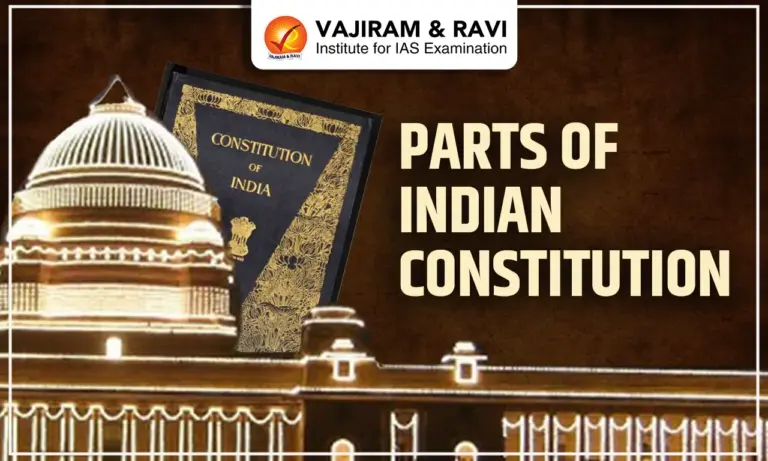
The Constitution of India, adopted in 1950, originally consisted of 395 Articles, 22 Parts, and 8 Schedules. Over time, through amendments, its scope has expanded to address emerging needs of governance and society. Today, the Constitution contains 448 Articles, 25 Parts, and 12 Schedules.
The Parts of Indian Constitution serve as the backbone, organizing its provisions into broad themes such as fundamental rights, directive principles, governance structure, and emergency provisions. Later additions like Part IXA (Municipalities), Part IXB (Co-operative Societies), and Part XIVA (Tribunals) highlight the evolving nature of constitutional law in India.
It’s also important to note that when new Articles or Parts are inserted, they are numbered alphabetically (like Article 21A) to maintain the document’s structure without disrupting the original sequence.
Parts of Indian Constitution
The Constitution of India is not just a legal document but also the supreme law of the land. It lays down the framework of governance by defining the roles of people in positions of authority and clearly outlining the limitations on their power. At the same time, it secures the rights, powers, procedures, and duties of both the government and the citizens.
What makes it unique is its emphasis on the supremacy of the Constitution itself, rather than the supremacy of the legislature. This ensures that every law and every action of the government remains within the constitutional framework.
To understand this structure better, here’s an overview of the Parts of the Indian Constitution presented in a table:
| Parts of Indian Constitution Overview | |
|
Particulars |
Details |
|
Constitution formed on |
26th November 1949 |
|
Parts of Indian Constitution Originally |
22 Parts |
|
Parts of Indian Constitution at Present |
25 Parts |
|
New Parts added in Constitution |
|
List of Parts of Indian Constitution
The Indian Constitution is a written document that serves as the supreme law of the land. It was drafted by the Constituent Assembly, with key contributions from leaders like Dr. B.R. Ambedkar, Rajendra Prasad, and Jawaharlal Nehru, and came into effect on January 26, 1950.
To ensure clarity and proper governance, the Constitution is divided into distinct sections that address specific subjects. Over time, it has expanded and now consists of 25 Parts, each focusing on different aspects of governance, rights, and duties.
| List of Parts of Indian Constitution | |
|
Parts and Subject |
Articles |
|
Part I – The Union and its Territories |
1 – 4 |
|
Part II – Citizenship |
5 -11 |
|
Part III – Fundamental Rights |
12 – 35 |
|
Part IV – Directive Principles of State Policy |
36 – 51 |
|
Part IV A – Fundamental Duties |
51A |
|
Part V – The Union |
52 – 151 |
|
Part VI – The States |
152 – 237 |
|
Part VII – The States in Part B of First Schedule |
238 [Repealed] |
|
Part VIII – The Union Territories |
239 – 242 |
|
Part IX – The Panchayats |
243 – 243O |
|
Part IXA – The Municipalities |
243P – 243ZG |
|
Part IXB – The Co-operative Societies |
243ZH – 243ZT |
|
Part X – The Scheduled and Tribal Areas |
244 – 244A |
|
Part XI – Relation between the Union and the States |
245 – 263 |
|
Part XII – Finance, Property, Contracts and Suits |
264 – 300A |
|
Part XIII – Trade, Commerce and Intercourse within the territory of India |
301 – 307 |
|
Part XIV – Services Under the Union and the States |
308 – 323 |
|
Part XIVA – Tribunals |
323A – 323B |
|
Part XV – Elections |
324 – 329A |
|
Part XVI – Special provisions relating to certain classes |
330 – 342 |
|
Part XVII – Official language |
343 – 351 |
|
Part XVIII – Emergency Provisions |
352 – 360 |
|
Part XIX – Miscellaneous |
361 – 367 |
|
Part XX – Amendment of the Constitution |
368 |
|
Part XXI – Temporary, Transitional and Special Provisions |
369 – 392 |
|
Part XXII – Short Title, Commencement, Authoritative Text in Hindi and Repeals |
393 – 395 |






Parts of Indian Constitution Details
The Constitution of India is the supreme law of the land. It was adopted on 26 January 1950 and originally contained 395 Articles, 22 Parts, and 8 Schedules. Today, through amendments, it has expanded to 448 Articles, 25 Parts, and 12 Schedules.
Each Part of the Constitution deals with a specific subject – from Union and State structures to rights, duties, emergency provisions, and governance frameworks.
| Parts of Indian Constitution Details | |||
|
Part |
Articles Covered |
Subject / Theme |
Brief Explanation |
|
Part I |
Articles 1 – 4 |
The Union and its Territory |
Defines India as a Union of States; regulates formation of new states and alteration of boundaries. |
|
Part II |
Articles 5 – 11 |
Citizenship |
Lays down provisions for citizenship at the commencement of the Constitution and rules for acquisition/termination. |
|
Part III |
Articles 12 – 35 |
Fundamental Rights |
Guarantees six categories of Fundamental Rights to citizens, inspired by the US Bill of Rights. |
|
Part IV |
Articles 36 – 51 |
Directive Principles of State Policy (DPSP) |
Guidelines for the State to establish a just society; non-justiciable but fundamental to governance. |
|
Part IVA |
Article 51A |
Fundamental Duties |
Lists 11 duties of citizens, added by the 42nd Amendment (1976) on recommendation of Swaran Singh Committee. |
|
Part V |
Articles 52 – 151 |
The Union |
Deals with the Union Government – Executive (President, PM, Council of Ministers), Parliament, and Judiciary. |
|
Part VI |
Articles 153 – 237 |
The States |
Deals with State Governments – Governors, State Legislature, and High Courts. |
|
Part VII |
[Repealed] |
States in Part B |
Dealt with Part B states; repealed by the 7th Amendment (1956). |
|
Part VIII |
Articles 239 – 242 |
Union Territories |
Provides for administration of Union Territories by the President through Administrators. |
|
Part IX |
Articles 243 – 243O |
The Panchayats |
Establishes Panchayati Raj system (73rd Amendment, 1992) for rural local self-government. |
|
Part IXA |
Articles 243P – 243ZG |
The Municipalities |
Establishes urban local bodies (74th Amendment, 1992) with structure, powers, and responsibilities. |
|
Part IXB |
Articles 243ZH – 243ZT |
Co-operative Societies |
Provides for regulation and management of co-operatives (97th Amendment, 2011). |
|
Part X |
Articles 244 – 244A |
Scheduled and Tribal Areas |
Deals with administration of Scheduled Areas (Fifth Schedule) and Tribal Areas (Sixth Schedule). |
|
Part XI |
Articles 245 – 263 |
Relations between the Union and States |
Lays down legislative, administrative, and financial relations between the Centre and States. |
|
Part XII |
Articles 264 – 300A |
Finance, Property, Contracts, and Suits |
Covers distribution of revenues, borrowing powers, property rights, and legal suits involving government. |
|
Part XIII |
Articles 301 – 307 |
Trade, Commerce, and Intercourse |
Ensures freedom of trade and commerce across India; modeled on Australian Constitution. |
|
Part XIV |
Articles 308 – 323 |
Services under Union and States |
Covers recruitment, conditions of service, and role of Public Service Commissions. |
|
Part XIVA |
Articles 323A – 323B |
Tribunals |
Provides for Administrative Tribunals and other tribunals for speedy justice (42nd Amendment, 1976). |
|
Part XV |
Articles 324 – 329A |
Elections |
Deals with conduct of elections; empowers Election Commission of India. |
|
Part XVI |
Articles 330 – 342 |
Special Provisions for Certain Classes |
Safeguards for SCs, STs, and Anglo-Indians, including reservation of seats. |
|
Part XVII |
Articles 343 – 351 |
Official Language |
Declares Hindi in Devanagari script as official language; provides for use of English and development of regional languages. |
|
Part XVIII |
Articles 352 – 360 |
Emergency Provisions |
Provides for National Emergency, President’s Rule, and Financial Emergency. |
|
Part XIX |
Articles 361 – 367 |
Miscellaneous |
Covers protection of President/Governors, privy purses, interpretation of Constitution, etc. |
|
Part XX |
Article 368 |
Amendment of the Constitution |
Provides the procedure for constitutional amendments – flexible yet rigid. |
|
Part XXI |
Articles 369 – 392 |
Temporary, Transitional, and Special Provisions |
Deals with temporary and special provisions for certain states and union territories. |
|
Part XXII |
Articles 393 – 395 |
Short title, Commencement, Authoritative Text, Repeals |
Specifies short title, date of commencement, authoritative text in Hindi, and repeals of previous laws. |

 Last updated on March, 2026
→ UPSC Final Result 2025 is now out.
→ UPSC has released UPSC Toppers List 2025 with the Civil Services final result on its official website.
→ Anuj Agnihotri secured AIR 1 in the UPSC Civil Services Examination 2025.
→ UPSC Marksheet 2025 is now out.
→ UPSC Notification 2026 & UPSC IFoS Notification 2026 is now out on the official website at upsconline.nic.in.
→ UPSC Calendar 2026 has been released.
→ Check out the latest UPSC Syllabus 2026 here.
→ UPSC Prelims 2026 will be conducted on 24th May, 2026 & UPSC Mains 2026 will be conducted on 21st August 2026.
→ The UPSC Selection Process is of 3 stages-Prelims, Mains and Interview.
→ Prepare effectively with Vajiram & Ravi’s UPSC Prelims Test Series 2026 featuring full-length mock tests, detailed solutions, and performance analysis.
→ Enroll in Vajiram & Ravi’s UPSC Mains Test Series 2026 for structured answer writing practice, expert evaluation, and exam-oriented feedback.
→ Join Vajiram & Ravi’s Best UPSC Mentorship Program for personalized guidance, strategy planning, and one-to-one support from experienced mentors.
→ Shakti Dubey secures AIR 1 in UPSC CSE Exam 2024.
→ Also check Best UPSC Coaching in India
Parts of Indian Constitution FAQs
Q1. Are there 22 or 25 parts in the Indian Constitution?+
Q2. Why is part 7 removed?+
Q3. What is part 8 of the Indian Constitution?+
Q4. What are the articles 1, 2, 3, 4, 5 of the Constitution?+
Q5. How to remember 25 parts of the Indian Constitution?+
Tags: parts of indian constitution