Parts of Plants together form a highly organised living system that enables growth, nutrition, reproduction, transport, and survival across diverse environments. Plants are autotrophic organisms that synthesise food using sunlight and act as the foundational producers in terrestrial and aquatic ecosystems. Their body structure is adapted for a stationary lifestyle, efficient resource absorption, internal transport, mechanical support, and long term survival. Each part of a plant is structurally specialised and functionally coordinated, ensuring division of labour at cellular, tissue, and organ levels. This structural efficiency allows plants to thrive from deserts to rainforests and from freshwater to saline habitats.
Also Read: Plant Tissue
Parts of Plants Classification
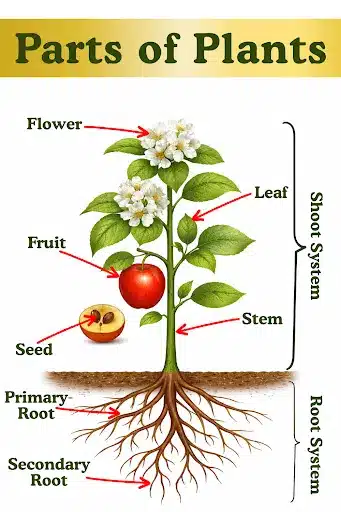
Parts of Plants are broadly classified into major organ systems based on position and function. The two major classes of a Plant Anatomy are:
1. Root System (Underground Parts of Plants)
The root system comprises underground structures responsible for anchorage, absorption, storage, and respiration in special conditions.
- Types of Root System
- Tap Root System
- Primary root + secondary and tertiary roots
- Found in dicot plants (e.g., mustard)
- Fibrous Root System
- Many roots of similar size from stem base
- Found in monocot plants (e.g., wheat)
- Adventitious Root System
- Roots arising from stem or leaves
- Found in banyan, grass, Monstera
- Structural Regions of Root
- Root Cap: Protects growing tip
- Meristematic Zone: Cell division
- Elongation Zone: Increase in length
- Maturation Zone: Root hairs for absorption
- Root Modifications
- Storage Roots: Carrot, sweet potato
- Support Roots: Prop roots (banyan), stilt roots (maize)
- Respiratory Roots: Pneumatophores (Rhizophora)
2. Shoot System (Aerial Parts of Plants)
The shoot system includes all above ground parts such as stem, leaves, flowers, fruits, and seeds, which together perform photosynthesis, transport, reproduction, and dispersal.
- Stem
-
-
- External Structure
- Node: Region where leaves arise
- Internode: Region between two nodes
- Axillary Bud: Develops into branches
- Terminal Bud: Responsible for growth in length
- Stem Modifications
- Underground Stems: Storage (potato, ginger)
- Aerial Stems: Tendrils (cucumber), thorns (Bougainvillea)
- Photosynthetic Stems: Opuntia, Euphorbia
- External Structure
-
2. Leaf
-
-
- Main Parts of a Leaf
- Leaf Base: Attaches leaf to stem
- Petiole: Holds lamina towards light
- Lamina (Leaf Blade): Broad green surface
- Venation
- Reticulate Venation: Network pattern (dicots)
- Parallel Venation: Parallel veins (monocots)
- Leaf Modifications
- Tendrils: Pea (climbing)
- Spines: Cactus (protection)
- Fleshy Leaves: Onion (storage)
- Insectivorous Leaves: Pitcher plant
- Main Parts of a Leaf
-
3. Flower (Reproductive Structure)
-
-
- Floral Whorls
- Calyx (Sepals): Protection
- Corolla (Petals): Attraction
- Androecium (Stamens): Male part
- Gynoecium (Carpels): Female part
- Types of Flowers
- Bisexual: Both androecium and gynoecium
- Unisexual: Only male or female organs
- Floral Whorls
-
4. Fruit
-
-
- Structure of Fruit
- Pericarp: Fruit wall
- Seed(s): Fertilised ovules
- Types
- Fertilised Fruit: Normal fruit formation
- Parthenocarpic Fruit: Fruit without fertilisation
- Structure of Fruit
-
5. Seed
-
- Components of Seed
- Seed Coat: Protection
- Embryo: Future plant
- Cotyledons: Food storage
- Types
- Monocot Seeds: One cotyledon
- Dicot Seeds: Two cotyledons
- Components of Seed
Also Read: Plant Kingdom
Parts of Plants Structures
Parts of Plants show specialised anatomical structures enabling absorption, transport, photosynthesis, reproduction, protection, and survival across varied ecological conditions.
- Root Structure: Roots consist of root cap, meristematic zone, elongation zone, and maturation zone, with root hairs increasing absorptive surface area for water and mineral uptake.
- Tap Root System: Formed from radicle elongation in dicots like mustard, comprising a primary root with secondary and tertiary branches, providing strong anchorage and deep soil penetration.
- Fibrous Root System: Found in monocots like wheat, where numerous equal sized roots arise from stem base, enhancing surface absorption but offering weaker anchorage.
- Adventitious Roots: Originate from non radicle regions such as stems or leaves, seen in banyan (prop roots), maize (stilt roots), and sweet potato (storage roots).
- Pneumatophores: Specialized upward growing roots in swamp plants like Rhizophora that possess lenticels for gaseous exchange in oxygen deficient soils.
- Stem Structure: Stem contains nodes, internodes, vascular bundles, and buds, acting as a mechanical axis and transport pathway between roots and leaves.
- Modified Underground Stems: Potato (tuber), ginger (rhizome), turmeric, and colocasia store carbohydrates and enable vegetative reproduction.
- Stem Tendrils: Slender, coiled structures arising from axillary buds in climbers like cucumber and grapevine, aiding mechanical support through twining.
- Thorns: Woody, pointed stem modifications in Citrus and Bougainvillea that provide protection against herbivores.
- Photosynthetic Stems: Flattened stems in Opuntia and cylindrical stems in Euphorbia contain chlorophyll and compensate for reduced leaves.
- Leaf Structure: Leaves originate from shoot apical meristems and consist of leaf base, petiole, and lamina with midrib, veins, and veinlets.
- Venation Pattern: Reticulate venation in dicots forms a network, while parallel venation in monocots runs longitudinally, reflecting evolutionary divergence.
- Stomatal Apparatus: Epidermal pores surrounded by guard cells regulate gas exchange and transpiration, maintaining water balance and temperature control.
- Flower Structure: Flowers consist of calyx (sepals), corolla (petals), androecium (stamens), and gynoecium (carpels), forming reproductive units in angiosperms.
- Androecium: Male reproductive part with filament and bilobed anther containing pollen sacs where microspores develop into pollen grains.
- Gynoecium: Female reproductive part composed of stigma, style, and ovary containing ovules that develop into seeds after fertilisation.
- Fruit Structure: Fruits are mature ovaries with pericarp layers enclosing seeds, aiding protection and dispersal; parthenocarpic fruits form without fertilisation.
- Seed Structure: Seeds contain embryo, cotyledons, protective seed coat, and stored food supporting early seedling development before photosynthesis begins.





Parts of Plants Functions
Parts of Plants perform coordinated physiological functions ensuring nutrition, transport, reproduction, growth regulation, and environmental adaptation.
- Absorption Function: Roots absorb water and dissolved minerals through root hairs using diffusion, osmosis, and active transport mechanisms.
- Anchorage Function: Extensive root networks stabilise plants against wind and soil erosion, especially in tall trees and grasses.
- Storage Function: Modified roots and stems store starch, sugars, and proteins, enabling survival during unfavourable seasons.
- Transport of Water: Xylem tissue conducts water and minerals from roots to aerial parts through transpiration pull and capillary action.
- Transport of Food: Phloem tissue distributes photosynthates from leaves to growing and storage regions using a pressure flow mechanism.
- Photosynthesis: Leaves synthesise glucose using chlorophyll, sunlight, carbon dioxide, and water, forming the energy base of ecosystems.
- Transpiration: Evaporation of water through stomata generates suction force, cools plant surfaces, and facilitates mineral transport.
- Reproduction: Flowers enable sexual reproduction through pollination and fertilisation, ensuring genetic variation and species continuity.
- Seed Dispersal: Fruits aid dispersal by wind, water, animals, or mechanical bursting, expanding plant distribution.
- Protection: Thorns, spines, thick cuticles, and seed coats defend plants against herbivory, dehydration, and mechanical damage.
- Vegetative Propagation: Modified stems, leaves, and roots allow rapid asexual reproduction without seed formation.
- Respiration Support: Pneumatophores and lenticels facilitate oxygen diffusion in waterlogged or compact soils.
- Environmental Adaptation: Structural modifications enable plants to survive in deserts, aquatic habitats, cold regions, and nutrient poor soils.

 Last updated on March, 2026
→ UPSC Final Result 2025 is now out.
→ UPSC has released UPSC Toppers List 2025 with the Civil Services final result on its official website.
→ Anuj Agnihotri secured AIR 1 in the UPSC Civil Services Examination 2025.
→ UPSC Marksheet 2025 is now out.
→ UPSC Notification 2026 & UPSC IFoS Notification 2026 is now out on the official website at upsconline.nic.in.
→ UPSC Calendar 2026 has been released.
→ Check out the latest UPSC Syllabus 2026 here.
→ UPSC Prelims 2026 will be conducted on 24th May, 2026 & UPSC Mains 2026 will be conducted on 21st August 2026.
→ The UPSC Selection Process is of 3 stages-Prelims, Mains and Interview.
→ Prepare effectively with Vajiram & Ravi’s UPSC Prelims Test Series 2026 featuring full-length mock tests, detailed solutions, and performance analysis.
→ Enroll in Vajiram & Ravi’s UPSC Mains Test Series 2026 for structured answer writing practice, expert evaluation, and exam-oriented feedback.
→ Join Vajiram & Ravi’s Best UPSC Mentorship Program for personalized guidance, strategy planning, and one-to-one support from experienced mentors.
→ Shakti Dubey secures AIR 1 in UPSC CSE Exam 2024.
→ Also check Best UPSC Coaching in India
Parts of Plants FAQs
Q1. What are the main Parts of Plants?+
Q2. What are the two organ systems of Plants?+
Q3. What is the function of roots in Plants?+
Q4. Why are leaves called the food factory of Plants?+
Q5. What role do flowers play in Plants?+
Tags: parts of plants