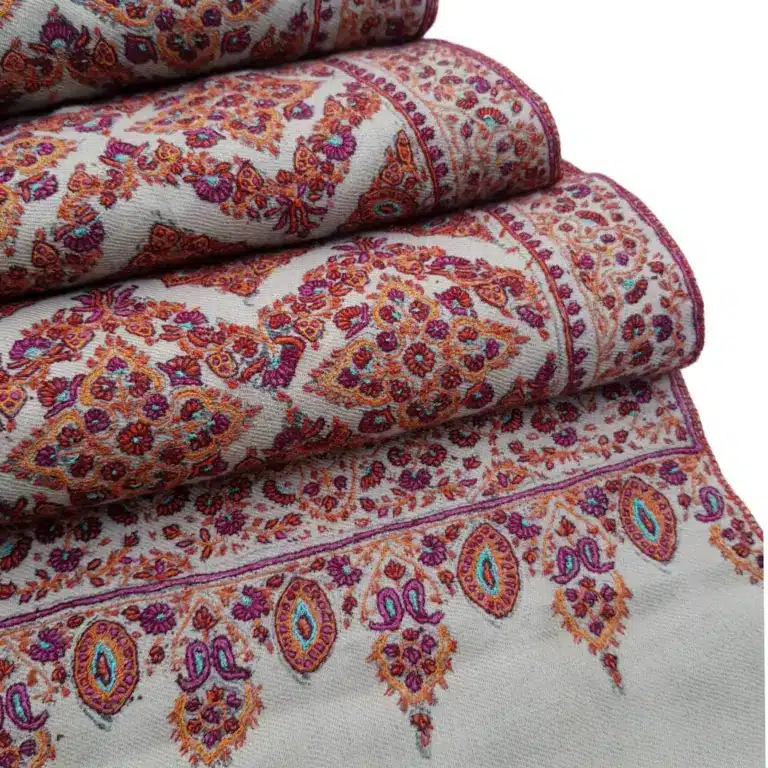
About Pashmina Shawl:
- Originating from Kashmir, these shawls are known for their exceptional craftsmanship and the use of fine Ladakhi Cashmere wool.
- The word “Pashmina” is derived from the Persian word “Pashm,” which means “soft gold” or “soft wool.”
- A cashmere wool itself is obtained from the undercoat of the Changthangi goat (Capra aegagrus hircus), also known as the Pashmina goat, which is native to the high altitudes of the Himalayas in regions like Ladakh in India, Nepal, and Tibet.
- These goats develop a unique undercoat to withstand the harsh winters, and it is this undercoat that is meticulously collected to create Pashmina shawls.
- Kashmir’s Pashmina has earned G.I certification or G.I Tag due to the unique traditional process used by local artisans in the Kashmir valley.
- Process:
- Cashmere wool, known for its exceptional fineness and warmth, is spun into yarn using traditional spinning wheels, a practice that has been passed down through generations.
- Once the yarn is ready, skilled artisans begin the intricate process of weaving, either by handloom or traditional wooden looms.
- Each shawl is meticulously crafted, with patterns ranging from delicate floral motifs to intricate paisley designs, reflecting the rich cultural heritage of Kashmir.
- The weaving process can take weeks or even months to complete, depending on the complexity of the design and the skill of the artisan.
- Natural dyes from plants and minerals in the region decorate the shawl with captivating colours.
Q1: What is Geographical Indication (GI) Tag?
It is a sign used on products that have a specific geographical origin and possess qualities or a reputation that are due to that origin. This is typically used for agricultural products, foodstuffs, wine and spirit drinks, handicrafts and industrial products. The Geographical Indications of Goods (Registration and Protection) Act, 1999 seeks to provide for the registration and better protection of geographical indications relating to goods in India. This GI tag is valid for 10 years following which it can be renewed.
Source: PM Modi gifts antique silver train model to President Biden and pashmina shawl to First Lady





 Last updated on March, 2026
→ UPSC Final Result 2025 is now out.
→ UPSC has released UPSC Toppers List 2025 with the Civil Services final result on its official website.
→ Anuj Agnihotri secured AIR 1 in the UPSC Civil Services Examination 2025.
→ UPSC Marksheet 2025 is now out.
→ UPSC Notification 2026 & UPSC IFoS Notification 2026 is now out on the official website at upsconline.nic.in.
→ UPSC Calendar 2026 has been released.
→ Check out the latest UPSC Syllabus 2026 here.
→ UPSC Prelims 2026 will be conducted on 24th May, 2026 & UPSC Mains 2026 will be conducted on 21st August 2026.
→ The UPSC Selection Process is of 3 stages-Prelims, Mains and Interview.
→ Prepare effectively with Vajiram & Ravi’s UPSC Prelims Test Series 2026 featuring full-length mock tests, detailed solutions, and performance analysis.
→ Enroll in Vajiram & Ravi’s UPSC Mains Test Series 2026 for structured answer writing practice, expert evaluation, and exam-oriented feedback.
→ Join Vajiram & Ravi’s Best UPSC Mentorship Program for personalized guidance, strategy planning, and one-to-one support from experienced mentors.
→ Shakti Dubey secures AIR 1 in UPSC CSE Exam 2024.
→ Also check Best UPSC Coaching in India