Pax Silica Latest News
- India’s belated induction into US-led initiatives like Minerals Security Partnership and Pax Silica has evoked a sense of déjà vu among policymakers.
- As with MSP—where India joined a year after launch—its entry into Pax Silica came after the initiative was already underway, seen largely as a conciliatory gesture amid efforts to steady bilateral ties.
- The significance lies in what these groupings signal about the emerging global tech order, especially as countries reorganise supply chains in strategic sectors with Chinese presence.
- Platforms like Pax Silica could shape rules by addressing chokepoints in inputs such as magnets and critical minerals—effectively determining where leverage will sit.
- India’s initial exclusion, followed by a late inclusion, carries a subtle message: strategic goodwill alone may not suffice.
- To be a partner of first choice in US-led initiatives, India must be seen as bringing tangible capabilities and value to the table in shaping resilient, rules-setting supply chains.
About Pax Silica
- Pax Silica is a US-led strategic initiative aimed at countering China’s dominance in next-generation technologies.
- It seeks to reduce “coercive dependencies” and protect materials and capabilities foundational to artificial intelligence, enabling aligned nations to develop and deploy transformative technologies at scale.
Objectives and Scope
- According to the US State Department, Pax Silica is designed to build a secure, prosperous, and innovation-driven silicon supply chain.
- It aims to ensure access across the entire AI stack—from critical minerals and semiconductor chips to security and logistics infrastructure.
Key Thrust Areas Under Pax Silica
- Under Pax Silica, participating countries aim to:
- Pursue joint ventures and strategic co-investments
- Protect sensitive technologies and critical infrastructure from undue foreign control
- Build trusted technology ecosystems spanning ICT systems, fibre-optic cables, data centres, foundational AI models, and applications
Founding Members and Their Strengths
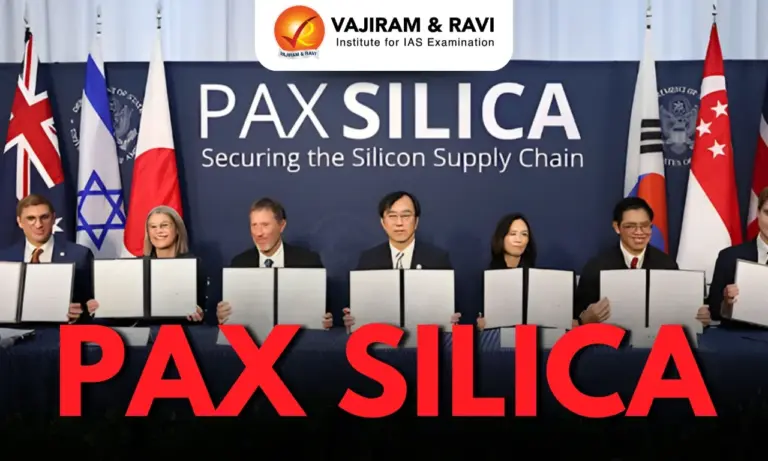
- The inaugural Pax Silica Summit brought together Japan, the Republic of Korea, Singapore, the Netherlands, the United Kingdom, Israel, the United Arab Emirates, and Australia.
- These countries collectively host key companies and investors that power the global AI and semiconductor supply chain, reflecting their technological or resource-based leverage.





Why India Was Initially Excluded from Pax Silica
- Pax Silica aims to secure supply chains spanning critical minerals, energy inputs, advanced manufacturing, and semiconductors.
- India’s initial absence reflects perceptions that it lacks decisive edge technologies or control over key resources central to the grouping’s objectives.
What the Selected Countries Bring
- Each of the eight founding members offers a distinct strategic advantage:
- The Netherlands controls specialised lithography machines vital for chipmaking.
- Japan and South Korea bring deep technology and manufacturing expertise.
- Australia contributes critical mineral reserves and mining capabilities.
- Israel is a global innovation and technology hub.
- Singapore serves as a major transhipment and logistics hub.
- The UK offers strengths in services and technology.
- The UAE has rapidly built AI capabilities and supporting infrastructure.
A Familiar Pattern from MSP
- A similar logic shaped the initial membership of the Minerals Security Partnership, where early partners included countries with clear mineral, technology, or institutional advantages.
- India joined later, despite its efforts to position itself as a node in global supply-chain realignment as firms diversify away from China.
The Takeaway for India
- The common thread among the founding members is a tangible lead in AI or semiconductor supply chains—an area where India currently lacks comparable processing capacity and expertise.
- As with earlier initiatives such as the MSP, this gap explains India’s absence at the outset.
- The exclusion underscores a consistent message: entry into US-led strategic groupings hinges on demonstrable capabilities and leverage—not just intent.
- To be a first-choice partner, India must strengthen its control over critical inputs, technologies, or platforms that shape supply-chain rules.
Shared Challenge: China’s Critical Minerals Dominance
- Experts point out that China’s dominance in critical minerals has created sharp global price gaps, disadvantaging non-Chinese supply chains.
- While this opens space for India to attract US investment, it also raises risks of Chinese coercion as India deepens alignment with Washington.
- US Treasury Secretary Scott Bessent framed China’s export controls as “China versus the rest of the world,” calling for support from Europe, India, and Asian democracies.
- Despite this rhetoric and shared concerns, India remained outside Pax Silica’s initial list, underscoring a gap between strategic alignment and perceived capabilities.

 Last updated on March, 2026
→ UPSC Final Result 2025 is now out.
→ UPSC has released UPSC Toppers List 2025 with the Civil Services final result on its official website.
→ Anuj Agnihotri secured AIR 1 in the UPSC Civil Services Examination 2025.
→ UPSC Marksheet 2025 is now out.
→ UPSC Notification 2026 & UPSC IFoS Notification 2026 is now out on the official website at upsconline.nic.in.
→ UPSC Calendar 2026 has been released.
→ Check out the latest UPSC Syllabus 2026 here.
→ UPSC Prelims 2026 will be conducted on 24th May, 2026 & UPSC Mains 2026 will be conducted on 21st August 2026.
→ The UPSC Selection Process is of 3 stages-Prelims, Mains and Interview.
→ Prepare effectively with Vajiram & Ravi’s UPSC Prelims Test Series 2026 featuring full-length mock tests, detailed solutions, and performance analysis.
→ Enroll in Vajiram & Ravi’s UPSC Mains Test Series 2026 for structured answer writing practice, expert evaluation, and exam-oriented feedback.
→ Join Vajiram & Ravi’s Best UPSC Mentorship Program for personalized guidance, strategy planning, and one-to-one support from experienced mentors.
→ Shakti Dubey secures AIR 1 in UPSC CSE Exam 2024.
→ Also check Best UPSC Coaching in India
Pax Silica FAQs
Q1. What is Pax Silica?+
Q2. Why is Pax Silica important for India?+
Q3. Why did India join Pax Silica late?+
Q4. How is Pax Silica similar to MSP?+
Q5. What is the key lesson from Pax Silica for India?+
Tags: mains articles pax silica upsc current affairs upsc mains current affairs