About ‘Project Collaboration Agreement
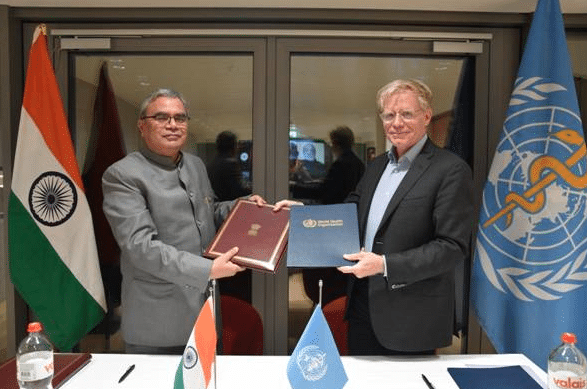
- It aims to bridge Traditional and Complementary Medical Systems with the mainstream of the National Health System, a key initiative outlined in the Traditional Medicine Global Strategy 2025-34 to be prepared by the WHO with the support of the Ministry of Ayush.
- Objective: To standardize Traditional and Complementary Medical Systems, incorporating their quality and safety aspects into the National Health System, and disseminating these practices on an international scale.
- This strategy will play a crucial role in achieving the objective of elevating Traditional and Complementary Medical Systems within the national health framework.
- The major goals of this agreement is the strengthening of training and practice in the field of the Complementary Medicine System, specifically ‘Siddha.’
- Additionally, the formulation of guidelines for the listing of Traditional and Complementary Medicines, safety protocols, and related efforts are outlined.
- The Ministry, in collaboration with the WHO, will also develop an International Herbal Pharmacopoeia focusing on herbs found in South-East Asia.
- This marks the third collaboration between the Ministry of Ayush and the WHO, with previous agreements signed in 2016 and 2017 focusing on taking Traditional Medical systems like Yoga, Ayurveda, Unani, and Panchakarma to the global level and strengthening the Ayurveda, Unani, and Siddha medical systems.
Q1) What is the Panchakarma process?
It is often a comprehensive treatment procedure whose main aim is to help detoxify the body and eliminate the toxins that might have accumulated over prolonged periods of time. The three stages in Panchakarma are – Purva karma (preparatory stage) Pradhana karma (main therapy stage).






 Last updated on March, 2026
→ UPSC Final Result 2025 is now out.
→ UPSC has released UPSC Toppers List 2025 with the Civil Services final result on its official website.
→ Anuj Agnihotri secured AIR 1 in the UPSC Civil Services Examination 2025.
→ UPSC Marksheet 2025 is now out.
→ UPSC Notification 2026 & UPSC IFoS Notification 2026 is now out on the official website at upsconline.nic.in.
→ UPSC Calendar 2026 has been released.
→ Check out the latest UPSC Syllabus 2026 here.
→ UPSC Prelims 2026 will be conducted on 24th May, 2026 & UPSC Mains 2026 will be conducted on 21st August 2026.
→ The UPSC Selection Process is of 3 stages-Prelims, Mains and Interview.
→ Prepare effectively with Vajiram & Ravi’s UPSC Prelims Test Series 2026 featuring full-length mock tests, detailed solutions, and performance analysis.
→ Enroll in Vajiram & Ravi’s UPSC Mains Test Series 2026 for structured answer writing practice, expert evaluation, and exam-oriented feedback.
→ Join Vajiram & Ravi’s Best UPSC Mentorship Program for personalized guidance, strategy planning, and one-to-one support from experienced mentors.
→ Shakti Dubey secures AIR 1 in UPSC CSE Exam 2024.
→ Also check Best UPSC Coaching in India