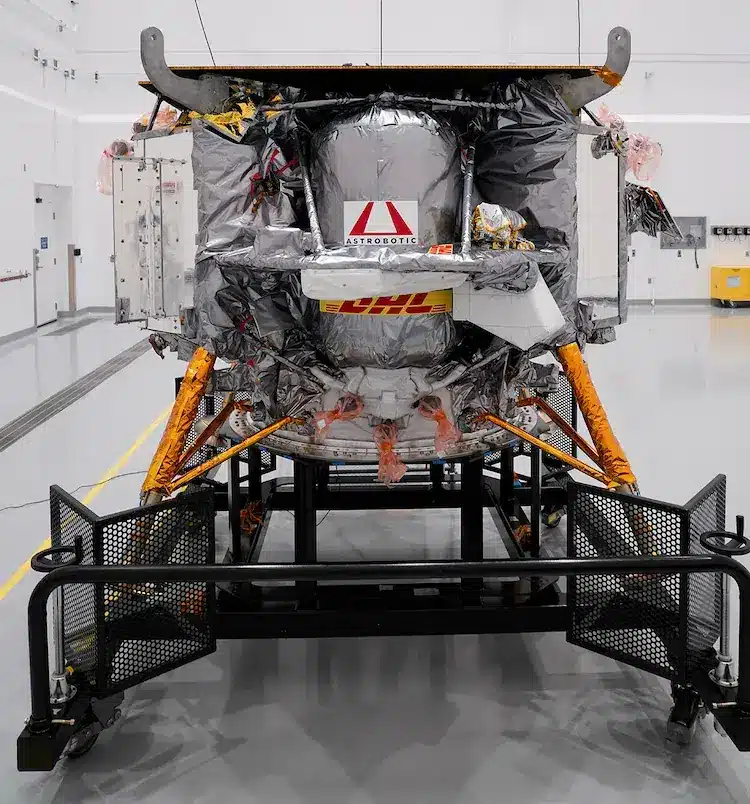
About Peregrine Lander
- It is designed to carry scientific instruments and other payloads to the Moon’s surface, specifically targeting the Sinus Viscositatis region.
- This area, also known as the Bay of Stickiness, lies adjacent to the Gruitheisen Domes near the Oceanus Procellarum, or Ocean of Storms.
- Aim: To locate water molecules on the moon, measure radiation and gases around the lander, and evaluate the lunar exosphere (the thin layer of gases on the moon’s surface)”
- The mission’s scientific goals are ambitious:
- To analyze the lunar exosphere, assess the thermal properties and hydrogen content of the lunar regolith, study magnetic fields, examine the radiation environment, and test advanced solar arrays.
- Peregrine Mission 1 will transport approximately ten payloads, with a total mass capacity of 90 kilograms.
- The scientific payload features cutting-edge instruments such as the Laser Retro-Reflector Array (LRA), Linear Energy Transfer Spectrometer (LETS), Near-Infrared Volatile Spectrometer System (NIRVSS), PROSPECT Ion-Trap Mass Spectrometer (PITMS), and Neutron Spectrometer System (NSS).
Q1) What is the Laser Retroreflector Array (LRA)?
It is designed to use reflected laser light from orbiting spacecraft laser (typically a laser altimeter or light detection and ranging – lidar) to precisely determine the location of the lander, as a fiducial marker, and the distance to that point on the lunar surface with respect to the orbiter. The retroreflectors reflect any light striking them directly back to the source. They can be tracked by an orbiting laser altimeter or lidar from a few hundred kilometers.
Source: Nasa launches Peregrine lander to explore Moon’s ‘Bay of Stickiness’






 Last updated on March, 2026
→ UPSC Final Result 2025 is now out.
→ UPSC has released UPSC Toppers List 2025 with the Civil Services final result on its official website.
→ Anuj Agnihotri secured AIR 1 in the UPSC Civil Services Examination 2025.
→ UPSC Marksheet 2025 is now out.
→ UPSC Notification 2026 & UPSC IFoS Notification 2026 is now out on the official website at upsconline.nic.in.
→ UPSC Calendar 2026 has been released.
→ Check out the latest UPSC Syllabus 2026 here.
→ UPSC Prelims 2026 will be conducted on 24th May, 2026 & UPSC Mains 2026 will be conducted on 21st August 2026.
→ The UPSC Selection Process is of 3 stages-Prelims, Mains and Interview.
→ Prepare effectively with Vajiram & Ravi’s UPSC Prelims Test Series 2026 featuring full-length mock tests, detailed solutions, and performance analysis.
→ Enroll in Vajiram & Ravi’s UPSC Mains Test Series 2026 for structured answer writing practice, expert evaluation, and exam-oriented feedback.
→ Join Vajiram & Ravi’s Best UPSC Mentorship Program for personalized guidance, strategy planning, and one-to-one support from experienced mentors.
→ Shakti Dubey secures AIR 1 in UPSC CSE Exam 2024.
→ Also check Best UPSC Coaching in India