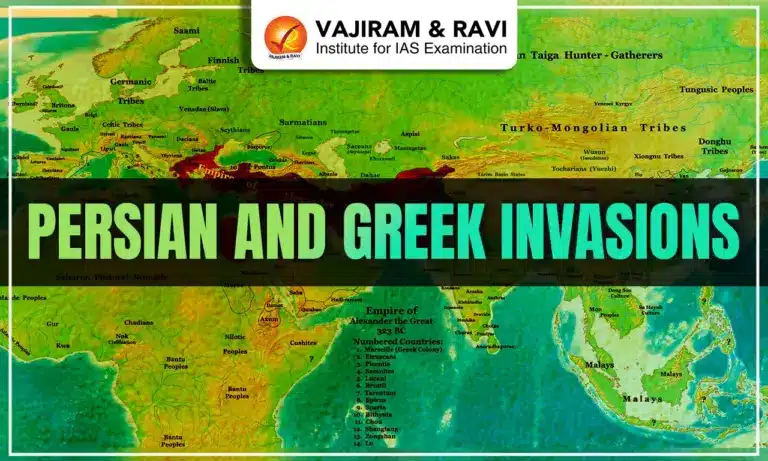
The Persian and Greek Invasions into India became an important turning point in the history of the subcontinent. These foreign conquests started in the 6th century BCE and brought not only conflict but also long-lasting cultural, political and economic consequences. During the time of invasion, the northwestern frontiers of India lacked strong central authority and were divided into small principalities such as Gandhara and Kamboja, constantly at war with one another. The natural passes of the Hindukush mountains provide an easy entry into the fertile plains of India, making the region highly vulnerable to repeated invasions. The Persians were the first to march into this frontier, followed later by the Greeks under the leadership of Alexander the Great. In this article, we are going to cover the Persian and Greek Invasions in India.
Persian and Greek Invasion in India
The Persian and Greek invasions of India were far more than mere military encounters. While the Persians introduced administrative practices, new scripts, and artistic influences, the Greeks opened India to western cultural exchanges, trade, and art forms. Both invasions, though external, shaped India’s internal development, particularly in terms of political unity and cultural enrichment. Their legacies continued to influence Indian history, leading to the rise of the Mauryan Empire, which became the first great pan-Indian political power.
Also Read: Mahajanapadas
Persian Invasion of India
The Persian Invasion of India took place in the sixth century BCE, while Magadha was emerging as a powerful force in eastern India and the northwestern part of India remained fragmented. The rich resources and lack of a unified kingdom attracted foreign powers. The Achaemenid rulers of Persia, sensed the disunity and began their eastward campaigns laying the foundation of India-Persia contact.
Cyrus the Great
Cyrus was the founder of Achaemenid Empire and the first to invade India around 535 BCE. His conquests extended as far as the Indus River and the tribes west of the Indus submitted to him and the Gandhara was incorporated into his empire. According to the Behistun Inscription, the conquered Indian Territory was brought under the Satrapy province of Gandhara, administered by a satrap, governor. Although his campaigns in India were limited, they marked the beginning of foreign incursions into the subcontinent.
Darius I
Cyrus’s son Cambyses neglected India, but his successor and grandson, Darius I, expanded Persian influence further. In 516 BCE, Darius annexed Punjab, Sindh, and the region west of the Indus. These areas became part of the 20th satrapy of the Persian Empire, recognized as one of the most fertile and revenue gaining provinces. Surprisingly, the tribute collected from India amounted to 360 talents of gold, nearly one-third of Persia’s total revenue from Asia. Indians were recruited into the Persian army, and Darius even sent an expedition under Skylax to explore the Indus River, improving geographical knowledge and opening new trade routes.
Xerxes
Darius was succeeded by Xerxes, who also utilized Indian resources for his military campaigns. Indian army and infantry were sent to fight in Greece during his wars with the Greeks. However, the defeat of Xerxes led to a decline in Persia’s aggressive policy towards India, decreasing their ambitions in the region.





Persian Invasion Impact
Persian contact with India lasted for nearly two centuries and created significant changes:
- Trade and Commerce: Indo-Iranian trade flourished, as seen in the circulation of Persian coins in northwestern India.
- Script: The Kharoshthi script, written from right to left, was introduced by Iranian scribes and remained in use for centuries.
- Art and Architecture: Mauryan art, especially Ashoka’s pillars and monuments, bore clear Iranian influence in their polished finish and stylistic features.
- Administration: The idea of issuing royal edicts, along with certain administrative practices, can be traced to Persian traditions.
- Link to Greek Invasion: Crucially, Persian campaigns introduced the Greeks to India’s wealth, laying the path for Alexander’s later invasion.
Also Read: Magadha Empire
Greek Invasion of India
By the fourth century BCE, the Persian Empire came into conflict with the Greeks. Alexander of Macedonia, succeeding his father Philip in 334 BCE, launched an ambitious campaign against Persia. After defeating Darius III in the famous Battle of Arbela, Alexander conquered Persia, Iraq, and much of Asia. Inspired by accounts of India’s immense wealth and driven by the belief that India marked the eastern edge of the known world, Alexander advanced towards the subcontinent. He entered India through Kabul and the Khyber Pass, benefiting from the disunity of Indian states.
Battle of Hydaspes
One of the most significant confrontations occurred with Porus, the ruler of Punjab. When Porus refused to submit, the two armies clashed in the Battle of Hydaspes (326 BCE) on the banks of the Jhelum River. Though Porus was defeated, Alexander was deeply impressed by his valor and reinstated him as a subordinate ruler. Alexander’s armies went eastward up to the River Beas. However, his soldiers were tired by years of continuous warfare and doubtful of facing the powerful kingdoms further east, mutinied and refused to proceed. Reluctantly, Alexander turned back.
Retreat and Administration
During his retreat, Alexander reorganized his Indian territories by dividing them among three governors. He restored autonomy to rulers who accepted his authority. Unfortunately, Alexander fell ill during his journey back and died at Babylon in 323 BCE, leaving behind no clear successor.
Greek Invasion Impact
The Greek invasion also had huge consequences on the Indian Subcontinent:
- Cultural Exchange: Direct contact was established between India and Greece, paving the way for cultural fusion.
- Trade Routes: Four new routes by land and sea were opened, improving connectivity between India and the Mediterranean world.
- Settlements: Several Greek communities settled in northwestern India, continuing even under Mauryan rule.
- Historical Records: Greek historians accompanying Alexander documented Indian society, economy, and polity, providing invaluable accounts.
- Artistic Influence: The Gandhara School of Art, blending Indian themes with Greco-Roman techniques, emerged as a legacy of this cultural synthesis.
- Political Unity: The disunity witnessed by Alexander highlighted the need for political consolidation. This indirectly set the stage for Chandragupta Maurya to unify northern India under the Mauryan Empire. Tradition also suggests that Chandragupta learned from Alexander’s military tactics, which aided his success against the Nandas.

 Last updated on March, 2026
→ UPSC Final Result 2025 is now out.
→ UPSC has released UPSC Toppers List 2025 with the Civil Services final result on its official website.
→ Anuj Agnihotri secured AIR 1 in the UPSC Civil Services Examination 2025.
→ UPSC Marksheet 2025 is now out.
→ UPSC Notification 2026 & UPSC IFoS Notification 2026 is now out on the official website at upsconline.nic.in.
→ UPSC Calendar 2026 has been released.
→ Check out the latest UPSC Syllabus 2026 here.
→ UPSC Prelims 2026 will be conducted on 24th May, 2026 & UPSC Mains 2026 will be conducted on 21st August 2026.
→ The UPSC Selection Process is of 3 stages-Prelims, Mains and Interview.
→ Prepare effectively with Vajiram & Ravi’s UPSC Prelims Test Series 2026 featuring full-length mock tests, detailed solutions, and performance analysis.
→ Enroll in Vajiram & Ravi’s UPSC Mains Test Series 2026 for structured answer writing practice, expert evaluation, and exam-oriented feedback.
→ Join Vajiram & Ravi’s Best UPSC Mentorship Program for personalized guidance, strategy planning, and one-to-one support from experienced mentors.
→ Shakti Dubey secures AIR 1 in UPSC CSE Exam 2024.
→ Also check Best UPSC Coaching in India
Persian and Greek Invasions FAQs
Q1. Who invaded India first, Persian or Greek?+
Q2. How did the Persians invade Greece?+
Q3. How did the Greeks invade India?+
Q4. Who fought the Battle of Hydaspes?+
Q5. Who was Darius I?+
Tags: persian and greek invasions