Petrochemicals Latest News
- The government has exempted customs duty on critical petrochemical products to address supply disruptions amid the West Asia crisis.
Petrochemical Industry in India
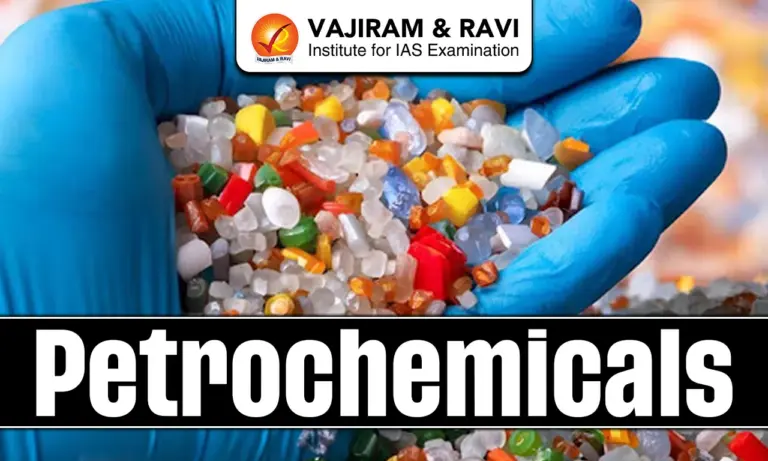
- Petrochemicals are chemical products derived primarily from crude oil and natural gas.
- They form the backbone of modern manufacturing and are used as key inputs across multiple industries.
- Major petrochemical products include polymers such as polyethene and polypropylene, synthetic fibres, chemicals like methanol and ammonia, and intermediates such as styrene and toluene.
- In India, petrochemicals are crucial for sectors such as plastics, textiles, pharmaceuticals, fertilisers, and automobiles. The industry is closely linked with refining and natural gas processing.
- India is both a producer and importer of petrochemicals. However, domestic production is often insufficient to meet rising industrial demand, making imports essential.





Importance of Petrochemicals in the Economy
- Petrochemicals play a strategic role in industrial development and economic growth.
- They serve as feedstock for manufacturing value-added products.
- They support employment generation across downstream industries.
- They are critical for sectors such as packaging, infrastructure, healthcare, and consumer goods.
- Any disruption in petrochemical supply chains can have cascading effects on industrial output and inflation.
India’s Dependence on Imports
- India relies significantly on imports for certain petrochemical products and feedstock.
- A large portion of imports originates from West Asia, due to proximity and established trade routes. However, geopolitical tensions in the region can disrupt supply chains and increase prices.
- Additionally, domestic petrochemical production has been affected due to the diversion of feedstock such as propane and butane for LPG production.
- This highlights the structural vulnerability in India’s petrochemical supply chain.
News Summary
- The Union government has announced a full customs duty exemption on around 40 critical petrochemical products until June 30, 2026.
- The exemption is designed as a temporary and targeted relief measure. It aims to ensure the availability of key petrochemical inputs, reduce cost pressures on industries, and stabilise supply chains.
- The list of exempted products includes chemicals and intermediates such as methanol, acetic acid, toluene, styrene, polypropylene, polyvinyl chloride, and polycarbonates.
- The government expects that the measure will provide relief not only to industries but also to consumers by moderating the prices of final goods.
- However, the exemption will result in an estimated revenue loss of about Rs. 1,800 crore for the government over the three-month period.
- The policy decision is also linked to rising crude oil prices following geopolitical tensions, including conflicts involving Iran. This has led to increased costs of petrochemical inputs and disruptions in shipping routes.
- For example, the textile industry has faced sharp increases in raw material prices such as Purified Terephthalic Acid (PTA) and Mono Ethylene Glycol (MEG), which are essential for synthetic fibres.
- The government has also taken complementary measures, such as increasing the allocation of commercial LPG to industries, to address fuel and feedstock shortages.
Impact on Industries
- The exemption is expected to provide immediate relief to several sectors.
- Textiles. Reduction in input costs for synthetic fibre production.
- Automobiles. Improved availability of inputs such as paints and chemicals.
- Pharmaceuticals. Stabilisation of supply chains for chemical intermediates.
- Packaging and Plastics. Lower raw material costs, benefiting consumer goods.
- Overall, the measure is aimed at maintaining industrial production and preventing supply shocks.
Challenges and Concerns
- Despite its benefits, the policy raises certain concerns.
- The revenue loss of Rs. 1,800 crore may impact fiscal balances.
- The exemption is temporary, and long-term supply vulnerabilities remain.
- Continued dependence on imports exposes India to geopolitical risks.
- Additionally, domestic production constraints need to be addressed to reduce reliance on imports.
Way Forward
- India needs a multi-pronged strategy to strengthen its petrochemical sector.
- Expand domestic petrochemical production capacity.
- Diversify import sources beyond West Asia.
- Develop strategic reserves of critical inputs.
- Promote research and innovation in alternative materials.
- Such measures will enhance resilience against global supply disruptions.

 Last updated on March, 2026
→ UPSC Final Result 2025 is now out.
→ UPSC has released UPSC Toppers List 2025 with the Civil Services final result on its official website.
→ Anuj Agnihotri secured AIR 1 in the UPSC Civil Services Examination 2025.
→ UPSC Marksheet 2025 is now out.
→ UPSC Notification 2026 & UPSC IFoS Notification 2026 is now out on the official website at upsconline.nic.in.
→ UPSC Calendar 2026 has been released.
→ Check out the latest UPSC Syllabus 2026 here.
→ UPSC Prelims 2026 will be conducted on 24th May, 2026 & UPSC Mains 2026 will be conducted on 21st August 2026.
→ The UPSC Selection Process is of 3 stages-Prelims, Mains and Interview.
→ Prepare effectively with Vajiram & Ravi’s UPSC Prelims Test Series 2026 featuring full-length mock tests, detailed solutions, and performance analysis.
→ Enroll in Vajiram & Ravi’s UPSC Mains Test Series 2026 for structured answer writing practice, expert evaluation, and exam-oriented feedback.
→ Join Vajiram & Ravi’s Best UPSC Mentorship Program for personalized guidance, strategy planning, and one-to-one support from experienced mentors.
→ Shakti Dubey secures AIR 1 in UPSC CSE Exam 2024.
→ Also check Best UPSC Coaching in India
Petrochemicals FAQs
Q1. What are petrochemicals?+
Q2. Why has India exempted customs duty on petrochemicals?+
Q3. How many products are covered under the exemption?+
Q4. What is the duration of the exemption?+
Q5. What is the estimated revenue loss for the government?+
Tags: mains articles petrochemicals upsc current affairs upsc mains current affairs