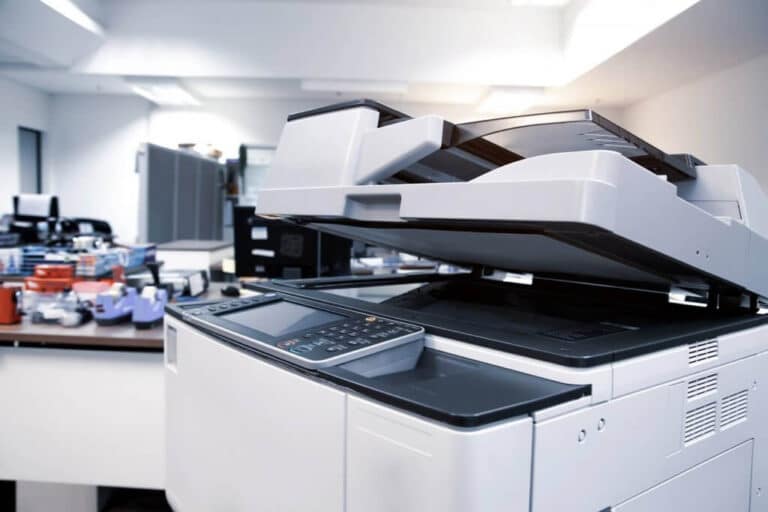
About Photocopying
- It is a set of techniques with which to duplicate some content using, among other things, light. However, the contemporary colloquial use of the word ‘photocopying’ refers almost exclusively to xerography.
- Both the word ‘xerography’ and the name ‘Xerox’ come from the Greek root-word ‘xero’, meaning ‘dry’.
- This is because xerography is a type of photocopying method whose process doesn’t involve messy liquid chemicals.
- Xerographic machines are in ubiquitous use around the world today to quickly and cheaply reproduce printed material.
How does xerography work?
- Xerography has a few basic elements.
- Photoconductive surface: A surface coated with a photoconductive material. Such a material, when exposed to light, allows electrons to flow through it (i.e. conducts electricity) but blocks them when it’s dark.
- This surface is negatively charged by placing a thin negatively charged wire with a high voltage next to it.
- Then, the sheet of paper to be copied is illuminated with a bright light. The darker parts of the paper – where something is printed, i.e. – don’t reflect the light whereas the unmarked parts do.
- This reflected light is carried by lenses and mirrors to fall on the photoconductive surface.
- In the parts of the surface where light falls, the photo conducting material will become conductive and allow the electrons near its surface to dissipate downwards (into a grounding).
- So the parts that remain negatively charged at the end of this step will correspond to parts of the paper-to-be-copied (TBC) where something was printed.
- Next, a powdery substance called toner is applied to the surface.
- The toner is positively charged, so it will settle where negative charge persists on the surface.
- The surface then transfers the pattern of toner on it to a sheet of paper. The paper has a stronger negative charge that causes the toner to jump.
- Finally, the toner is heated so that it melts and fuses with the paper. This is the paper that rolls out of the photocopying machine, the whole process having been completed in a few seconds.
- In practice, a rotating drum is used instead of a flat surface, and the paper TBC is illuminated by a flashing or stroboscopic light or a moving scanner.
Q1) What are Electrons?
Electrons are subatomic particles that orbit the nucleus of an atom. They carry a negative electric charge, and they are a fundamental component of all matter. Electrons are one of the three main types of subatomic particles in an atom, alongside protons and neutrons.
Source: What is photocopying and how does it work?






 Last updated on April, 2026
→ UPSC Final Result 2025 is now out.
→ UPSC has released UPSC Toppers List 2025 with the Civil Services final result on its official website.
→ Anuj Agnihotri secured AIR 1 in the UPSC Civil Services Examination 2025.
→ UPSC Marksheet 2025 is now out.
→ UPSC Notification 2026 & UPSC IFoS Notification 2026 is now out on the official website at upsconline.nic.in.
→ UPSC Calendar 2026 has been released.
→ Check out the latest UPSC Syllabus 2026 here.
→ UPSC Prelims 2026 will be conducted on 24th May, 2026 & UPSC Mains 2026 will be conducted on 21st August 2026.
→ The UPSC Selection Process is of 3 stages-Prelims, Mains and Interview.
→ Prepare effectively with Vajiram & Ravi’s UPSC Prelims Test Series 2026 featuring full-length mock tests, detailed solutions, and performance analysis.
→ Enroll in Vajiram & Ravi’s UPSC Mains Test Series 2026 for structured answer writing practice, expert evaluation, and exam-oriented feedback.
→ Join Vajiram & Ravi’s Best UPSC Mentorship Program for personalized guidance, strategy planning, and one-to-one support from experienced mentors.
→ Shakti Dubey secures AIR 1 in UPSC CSE Exam 2024.
→ Also check Best UPSC Coaching in India