What’s in today’s article?
- Why in News?
- East Asia Summit
- Key highlights of the speech delivered by PM Modi
Why in News?
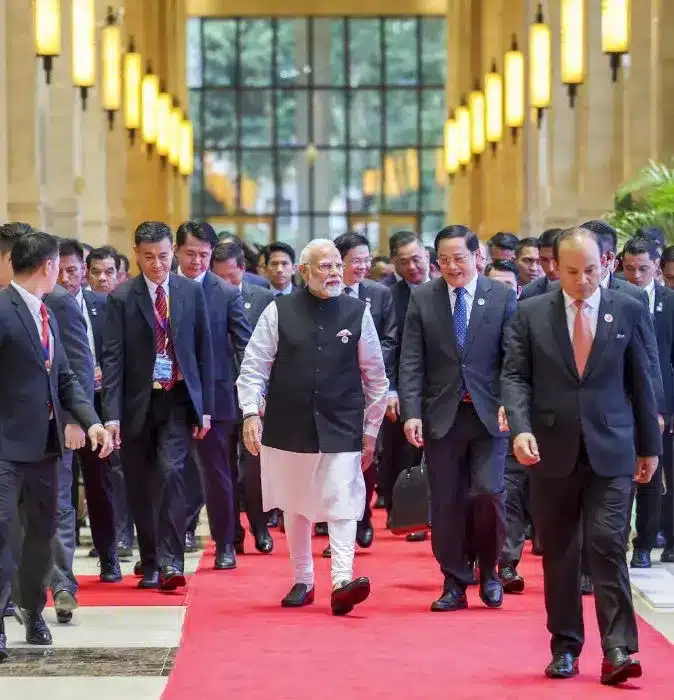
PM Modi attended the 19th East Asia Summit (EAS) on 11 October 2024 in Vientiane, Lao PDR. In his address, PM stressed on ASEAN’s central role in the Indo-Pacific regional architecture, in India’s Indo-Pacific Vision and in Quad cooperation.





East Asia Summit
- About
- The East Asia Summit (EAS) is a forum for leaders of countries in the Indo-Pacific region to discuss political, security, and economic challenges.
- The EAS was established in 2005 by the Association of Southeast Asian Nations (ASEAN) and is held annually.
- The EAS was launched in Kuala Lumpur, Malaysia in 2005.
- Members
- The EAS was originally attended by 16 countries from East Asia, Southeast Asia, South Asia, and Oceania.
- In 2011, membership expanded to 18 countries, including Russia and the United States.
- Currently, EAS is a forum of 18 countries that represent 54% of the world’s population and 58% of global GDP. The 18 countries are:
- Ten member states of the ASEAN – Brunei, Cambodia, Indonesia, Laos, Malaysia, Myanmar, the Philippines, Singapore, Thailand, and Vietnam;
- along with Australia, China, Japan, India, New Zealand, the Republic of Korea, Russia and the United States.
- The EAS is the only leaders-led forum that brings together the US, China, Russia, India, RoK, and Australia.
- To become a member of the EAS, countries must:
- Sign the ASEAN Treaty of Amity and Cooperation (TAC)
- Be a formal dialogue partner of ASEAN
- Have substantive cooperative relations with ASEAN
- Six priority areas of regional cooperation within the framework of the EAS
- Environment and Energy,
- Education,
- Finance,
- Global Health Issues and Pandemic Diseases,
- Natural Disaster Management, and
- ASEAN Connectivity
- India and EAS
- India is member of EAS since 2005.
- At the 4th EAS in Thailand in 2009, leaders endorsed the proposal to revive Nalanda University.
- The idea was first proposed by former President APJ Abdul Kalam in 2006.
Key highlights of the speech delivered by PM Modi
- Called for Peace and Stability in Eurasia and West Asia
- PM Modi urged the restoration of peace in conflict-ridden regions, emphasizing the impact on the Global South.
- He stated that solutions cannot be achieved through war and called for diplomacy and dialogue.
- Emphasis on Development Over Expansionism
- In a veiled reference to China’s assertiveness in the South China Sea, Modi stressed the importance of a development-focused approach rather than expansionism.
- He reiterated the need for a free, open, inclusive, and rules-based Indo-Pacific region for maintaining peace and progress.
- Call for Compliance with UNCLOS
- Modi highlighted the importance of maritime activities adhering to the United Nations Convention on the Law of the Sea (UNCLOS), emphasizing freedom of navigation and airspace.
- He advocated for an effective Code of Conduct that does not impose restrictions on the foreign policies of regional countries.
- Addressing Global Conflicts and Terrorism
- Modi condemned the ongoing conflicts, including the Israel-Hamas war and the Russian-Ukraine war.
- He reiterated that war is not a solution and emphasized respect for sovereignty and international laws.
- He also called for global cooperation to combat terrorism, particularly in cyber, maritime, and space domains.
- Support for ASEAN and Myanmar Engagement
- The PM expressed India’s support for ASEAN unity and centrality and endorsed ASEAN’s approach to the situation in Myanmar.
- He emphasized India’s commitment to engaging Myanmar rather than isolating it in the peace process.
- Humanitarian Assistance and Quad Cooperation
- Modi mentioned India’s humanitarian efforts, including Operation Sadbhav, in response to Typhoon Yagi.
- He also reiterated India’s commitment to its Act East Policy and Quad cooperation for a free and inclusive Indo-Pacific region.
Q.1. What was the key message of PM Modi at the 19th East Asia Summit?
PM Modi called for peace and stability in conflict-affected regions, emphasizing the importance of diplomacy and dialogue over war. He also stressed the need for a free, inclusive, and rules-based Indo-Pacific region.
Q.2. How did PM Modi address global conflicts during the 19th East Asia Summit?
PM Modi condemned ongoing conflicts, including the Israel-Hamas and Russia-Ukraine wars, highlighting that war is not a solution. He advocated for respect of sovereignty, international laws, and the importance of dialogue for resolving disputes.
Source: Should focus on development, not expansionism, says Modi | MEA | The Hindu

 Last updated on March, 2026
→ UPSC Final Result 2025 is now out.
→ UPSC has released UPSC Toppers List 2025 with the Civil Services final result on its official website.
→ Anuj Agnihotri secured AIR 1 in the UPSC Civil Services Examination 2025.
→ UPSC Marksheet 2025 is now out.
→ UPSC Notification 2026 & UPSC IFoS Notification 2026 is now out on the official website at upsconline.nic.in.
→ UPSC Calendar 2026 has been released.
→ Check out the latest UPSC Syllabus 2026 here.
→ UPSC Prelims 2026 will be conducted on 24th May, 2026 & UPSC Mains 2026 will be conducted on 21st August 2026.
→ The UPSC Selection Process is of 3 stages-Prelims, Mains and Interview.
→ Prepare effectively with Vajiram & Ravi’s UPSC Prelims Test Series 2026 featuring full-length mock tests, detailed solutions, and performance analysis.
→ Enroll in Vajiram & Ravi’s UPSC Mains Test Series 2026 for structured answer writing practice, expert evaluation, and exam-oriented feedback.
→ Join Vajiram & Ravi’s Best UPSC Mentorship Program for personalized guidance, strategy planning, and one-to-one support from experienced mentors.
→ Shakti Dubey secures AIR 1 in UPSC CSE Exam 2024.
→ Also check Best UPSC Coaching in India