PM Modi Energy Independence Latest News
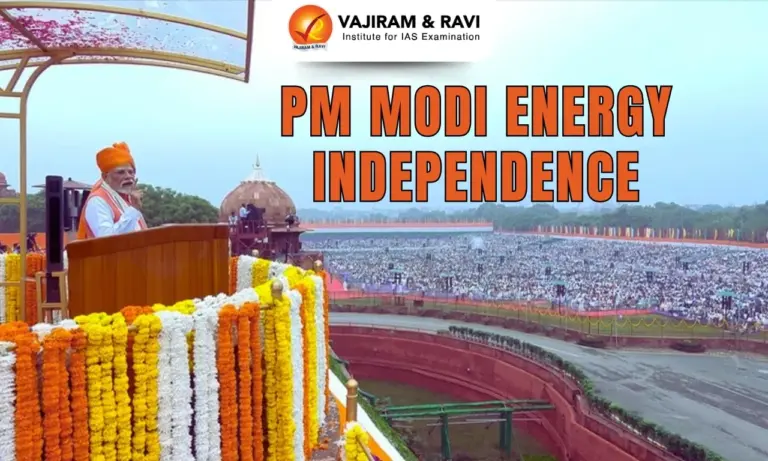
- In his Independence Day address from the Red Fort, PM Modi emphasized the urgent need for India to achieve self-reliance in energy and critical minerals.
- He linked this to the country’s large petroleum import bill, highlighting how dependency drains resources that could otherwise support development, agriculture, and poverty alleviation.
- PM Modi announced a landmark policy shift by declaring that the government has “opened the doors” of nuclear energy to private participation.
- The aim is to expand India’s nuclear power generation capacity tenfold by 2047, positioning nuclear energy as a major pillar of the country’s clean energy future.
India’s Heavy Energy Import Dependence
- Currently, India remains heavily dependent on imported fossil fuels:
- Crude oil imports (2024–25): $137 billion
- Petroleum products: $24 billion
- Liquefied Natural Gas (LNG): $15 billion
- Together, energy imports constituted 22.3% of total imports in 2024–25, compared to 23% in 2023–24, according to data from the Petroleum Planning and Analysis Cell (PPAC).
- The lakhs of crores spent on energy imports could have been invested in India’s long-term growth — building infrastructure, supporting farmers, and fighting poverty.
- By reducing dependency through self-reliance and clean energy expansion, India could redirect critical resources toward domestic priorities.





India’s Push for Critical Mineral Self-Reliance
- PM Modi underlined the importance of critical minerals in powering key technologies across energy, industrial, and defence sectors.
- He announced that exploration is underway at over 1,200 sites under the National Critical Mineral Mission (NCMM).
- So far, the Ministry of Mines has auctioned 24 blocks and plans to auction 100 more by 2030.
- However, experts caution that operationalising these blocks could take years due to regulatory bottlenecks.
- To fast-track progress, the government has set up a Project Monitoring Unit (PMU) to streamline approvals and expedite mine development.
- At the same time, India is diversifying its strategy by pursuing overseas exploration and acquisitions.
- This is supported by recent amendments to the Mines and Minerals (Development & Regulation) Act, which now allows the National Mineral Exploration Trust (NMET) to fund international projects.
India’s Nuclear Energy Expansion and Private Sector Entry
- In his Independence Day address, PM Modi also announced plans to increase India’s nuclear energy capacity tenfold by 2047.
- Currently, the country’s installed nuclear capacity stands at 8.8 GW, contributing just under 2% to total electricity generation.
- Ten nuclear reactors are operational, with further expansion underway.
- The government has also opened the nuclear sector to private participation.
- In the 2024-25 Budget, provisions were made for partnerships with private companies to finance and build Bharat Small Reactors (BSRs) for captive use, though operation will remain with NPCIL.
- Full-scale private involvement, however, will require amendments to the Atomic Energy Act and the Civil Liability for Nuclear Damage Act, with a task force examining issues such as fuel procurement, waste management, and safeguards.
- PM Modi also highlighted India’s climate achievements, noting that the country has met its target of 50% non-fossil fuel electricity capacity five years ahead of schedule.
- This marks a significant rise from 30% in 2015 and 38% in 2020, driven largely by growth in solar and wind power, along with nuclear and large hydro projects.
Operation Sindoor and Mission Sudarshan Chakra: India’s Defence Self-Reliance Drive
- Operation Sindoor showcased India’s growing defence self-reliance, with terror networks and Pakistan-based infrastructure dismantled using Made-in-India weapons.
- The operation signalled that India would no longer accept nuclear blackmail or external pressure, reinforcing its strategic autonomy.
- Building on this momentum, India announced Mission Sudarshan Chakra, inspired by Lord Krishna’s legendary weapon.
- The initiative is aimed at neutralising enemy infiltrations and enhancing offensive and deterrent capabilities with rapid, precise, and powerful responses.
- The government emphasised that indigenous innovation is key to future security, urging Indian youth to develop advanced technologies such as jet engines within India. By 2035, India also plans to expand a nationwide security shield across all public places, highlighting its vision of comprehensive protection backed by self-reliant defence systems.

 Last updated on March, 2026
→ UPSC Final Result 2025 is now out.
→ UPSC has released UPSC Toppers List 2025 with the Civil Services final result on its official website.
→ Anuj Agnihotri secured AIR 1 in the UPSC Civil Services Examination 2025.
→ UPSC Marksheet 2025 is now out.
→ UPSC Notification 2026 & UPSC IFoS Notification 2026 is now out on the official website at upsconline.nic.in.
→ UPSC Calendar 2026 has been released.
→ Check out the latest UPSC Syllabus 2026 here.
→ UPSC Prelims 2026 will be conducted on 24th May, 2026 & UPSC Mains 2026 will be conducted on 21st August 2026.
→ The UPSC Selection Process is of 3 stages-Prelims, Mains and Interview.
→ Prepare effectively with Vajiram & Ravi’s UPSC Prelims Test Series 2026 featuring full-length mock tests, detailed solutions, and performance analysis.
→ Enroll in Vajiram & Ravi’s UPSC Mains Test Series 2026 for structured answer writing practice, expert evaluation, and exam-oriented feedback.
→ Join Vajiram & Ravi’s Best UPSC Mentorship Program for personalized guidance, strategy planning, and one-to-one support from experienced mentors.
→ Shakti Dubey secures AIR 1 in UPSC CSE Exam 2024.
→ Also check Best UPSC Coaching in India
PM Modi Energy Independence FAQs
Q1. What did PM Modi stress on Independence Day?+
Q2. What is India’s energy import bill?+
Q3. What is the National Critical Mineral Mission?+
Q4. How will nuclear power expand?+
Q5. What is Mission Sudarshan Chakra?+
Tags: mains articles PM Modi energy independence upsc current affairs upsc mains current affairs