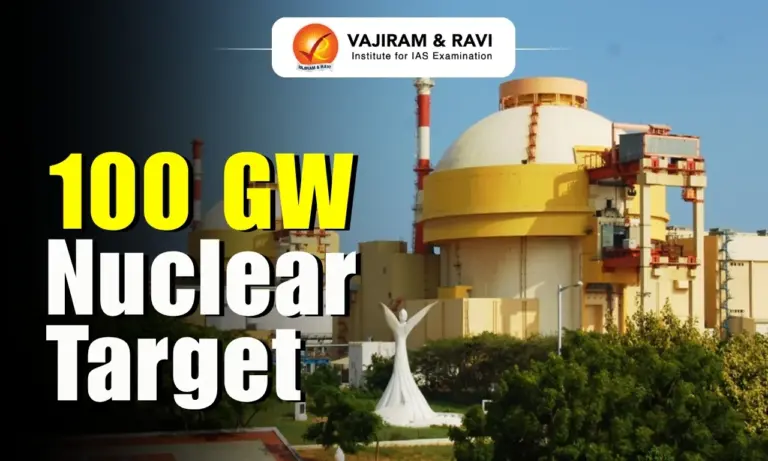
100 GW Nuclear Target Latest News
- In his Independence Day address, PM Modi set a target of expanding India’s nuclear power capacity to 100 GW by 2047, along with commissioning five new nuclear reactors within the current decade.
- This comes as India bets on nuclear power to meet the rapidly rising electricity demand from emerging sectors like semiconductors, artificial intelligence (AI), and data centres
Why India Needs More Nuclear Power
- PM Modi highlighted that the growing adoption of future technologies would sharply increase electricity demand: “It will be difficult to run this new world without energy… whether it is chips, AI or data centres, we will need very large amounts of electricity.”
- Nuclear power is being positioned as a carbon-neutral, reliable baseload source to meet this demand alongside the growing renewable energy mix.


Policy Backdrop: The SHANTI Act
- PM Modi’s announcement follows Parliament’s passage of the SHANTI Act last year, which:
- Opens the door to wider private participation in India’s tightly regulated civil nuclear power sector.
- Has drawn interest from global nuclear technology suppliers from Russia, the US, and France.
- The Department of Atomic Energy (DAE) recently released draft rules under the Act, laying out the regulatory framework for private participation, captive generation, licensing, safety oversight, and nuclear liability.
Two-Pronged Strategy: Large Reactors + SMRs
- To achieve the 100 GW target by 2047, the government is pursuing a two-pronged approach:
- Large-capacity reactors — continuing to expand conventional nuclear capacity.
- Small Modular Reactors (SMRs) — for faster, more flexible deployment.
Why SMRs Matter
- India’s indigenous Pressurised Heavy Water Reactors (PHWRs) will remain the backbone of nuclear expansion, but SMRs are gaining importance for industrial decarbonisation.
- SMRs offer flexible baseload power, helping grid operators balance the variability of large-scale renewable energy integration.
- High costs of large Light Water Reactors (LWRs) have raised questions about their large-scale feasibility, making SMRs the focal point of India’s international nuclear collaborations.
- In May 2026, a high-level American nuclear delegation was briefed on India’s plans to enter the SMR manufacturing value chain.
India’s Indigenous SMR Programme
- The Bhabha Atomic Research Centre (BARC) is developing three types of SMRs for demonstration:
- Bharat Small Modular Reactor (BSMR-200) — 200 MWe
- A 55 MWe small modular reactor
- A 5 MWt high-temperature gas-cooled reactor for hydrogen production via thermochemical coupling
- Target: At least five indigenously designed and operational SMRs by 2033.
- The Nuclear Energy Mission, with a budgetary outlay of ₹20,000 crore, has been launched for research, design, development, and deployment of SMRs.
- The government is also studying the repurposing of old thermal power plant sites for nuclear use, particularly suited for SMRs and smaller nuclear projects.
Current Status of India’s Nuclear Sector
- 25 operational reactors, totalling 8.7 GWe capacity.
- 10 reactors under construction, adding around 8 GWe.
- 10 more units in the pre-project stage, with approximately 6.6 GWe capacity.
India’s Three-Stage Nuclear Programme
- India follows a three-stage nuclear power programme aimed at achieving long-term fuel self-reliance, leveraging its abundant thorium reserves:
- Stage 1: PHWRs using natural uranium as fuel.
- Stage 2: Fast Breeder Reactors (FBRs) use the plutonium generated from Stage 1’s spent fuel, combined with depleted uranium, to convert Thorium-232 (Th-232) into Uranium-233 (U-233).
- Stage 3: Th-232 is converted into U-233, which becomes fuel for advanced reactors — completing the shift toward thorium-based self-reliance.
- FBRs serve as the crucial bridge between Stages 1 and 3, enabling India to tap its thorium resources.
Recent Milestone
- In April 2026, India’s first indigenous fast breeder reactor at Kalpakkam attained criticality — a major milestone.
- PM Modi noted: “This year, India crossed an important milestone by mastering fast breeder nuclear technology… a major step towards achieving self-reliance in nuclear fuel.”
Conclusion
- India’s 100 GW nuclear ambition reflects a broader recognition that the AI-driven digital economy demands massive, reliable, carbon-neutral power.
- By combining indigenous thorium-based self-reliance with SMR innovation and private participation, India aims to position nuclear energy as a cornerstone of both its technological future and climate commitments.
Source: IE

 Last updated on Oct, 2026
→ UPSC 2027 Notification will be released on 13 January 2027 at upsconline.nic.in.
→ Check Nobel Prize 2026 Winners List here.
→ Download PIB PRiSM Monthly Magazine 2026 here.
→ Check UPSC Monthly Current Affairs Magazine The Recitals here.
→ Check out the latest UPSC Syllabus here.
→ Download UPSC Model Answers for Mains 2026
→ UPSC Mains Question Paper 2026 is out now for Essay & GS Paper 1, 2, 3 & 4.
→ UPSC Calendar 2027 has been released.
→ Enroll in Vajiram & Ravi’s UPSC Mains Test Series 2027 for structured answer writing practice, expert evaluation, and exam-oriented feedback.
→ Join Vajiram & Ravi’s UPSC Mentorship Program 2027 for personalized guidance, strategy planning, and one-to-one support from experienced mentors.
→ Go through the UPSC Mains Previous Year Papers to enhance your preparation.
→ UPSC has released UPSC Toppers List 2025 with the Civil Services final result on its official website.
→ Also check Best UPSC Coaching in India
100 GW nuclear target FAQs
Q1. What is India's 100 GW nuclear target?+
Q2. Why is India pursuing the 100 GW nuclear target now?+
Q3. What role does the SHANTI Act play in the 100 GW nuclear target?+
Q4. How do SMRs support achieving the 100 GW nuclear target?+
Q5. What is India's three-stage nuclear programme linked to the 100 GW nuclear target?+
Tags: 100 GW nuclear target mains articles upsc current affairs upsc mains current affairs