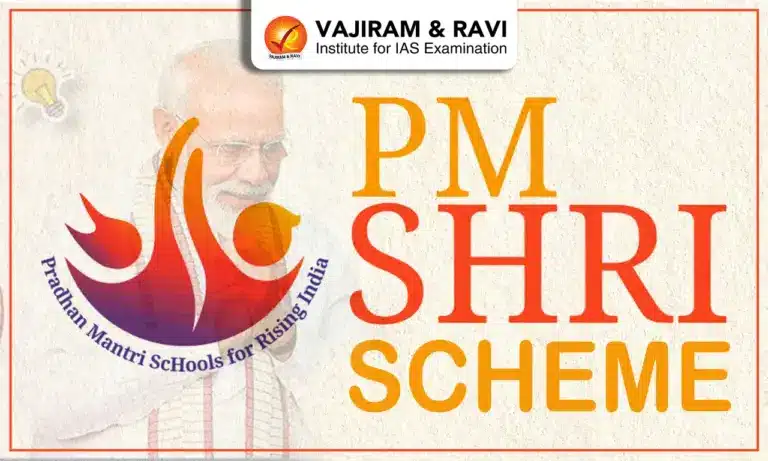
The Pradhan Mantri Schools for Rising India (PM-SHRI) Scheme is a centrally sponsored initiative launched by the Government of India under the guidance of the Ministry of Education. This visionary scheme aims to transform school education across the nation by developing over 14,500 model schools that reflect the spirit and vision of the National Education Policy (NEP) 2020.
Pradhan Mantri Schools for Rising India (PM-SHRI) Scheme
The Pradhan Mantri Schools for Rising India (PM-SHRI) Scheme aims to transform existing schools into exemplary institutions that provide equitable, inclusive, and quality education. Aligned with NEP 2020, these schools focus on holistic development, experiential learning, and modern infrastructure.
These schools will be managed by the Central Government, State and Union Territory Governments, local bodies, Kendriya Vidyalaya Sangathan (KVS), and Navodaya Vidyalaya Samiti (NVS).
PM-SHRI Scheme 2025 Overview
The PM-SHRI Scheme 2025 aims to transform schools into model institutions offering inclusive and high-quality education aligned with NEP 2020. The table below highlights details regarding the same.
| PM-SHRI Scheme 2025 Overview | |
| Particulars | Details |
|
Scheme Name |
Pradhan Mantri Schools for Rising India (PM-SHRI) |
|
Launched By |
Government of India |
|
Implementing Ministry |
Ministry of Education |
|
Launch Year |
2022 |
|
Target Schools |
Over 14,500 across India |
|
Key Partners |
Central Govt, State/UT Govts, KVS, NVS, Local Bodies |
|
Main Objective |
To provide quality, inclusive, and holistic education aligned with NEP 2020 |
|
Funding Type |
Centrally Sponsored Scheme |





PM-SHRI Scheme Objectives
The main objective of the PM-SHRI Schools is to strengthen the school education system in India by transforming existing schools into model institutions that provide:
- High-quality education rooted in equity and inclusivity.
- Holistic and multidisciplinary learning experiences for students.
- A safe, welcoming, and modern learning environment.
- Implementation of NEP 2020 through innovative teaching practices.
- Opportunities for students’ overall development, including cognitive, emotional, and social growth.
Pradhan Mantri Schools for Rising India (PM-SHRI) Scheme Features
PM-SHRI Schools are being established as benchmark institutions that demonstrate how the National Education Policy 2020 can be effectively implemented at the ground level. The features of Pradhan Mantri Schools for Rising India (PM-SHRI) Scheme are:
- Holistic Learning Environment: Emphasis on creating an atmosphere that promotes curiosity, creativity, and collaboration among students.
- Inclusive and Equitable Education: Ensuring that children from diverse social, linguistic, and cultural backgrounds have equal access to quality education.
- Modern Infrastructure: Schools will be equipped with smart classrooms, libraries, science labs, ICT facilities, and green campuses to promote sustainability.
- Digital and Skill-Based Learning: Integration of digital tools, vocational education, and life skills training to prepare students for the 21st-century workforce.
- Performance-Based Funding: Schools will be incentivized to improve their outcomes through funding mechanisms linked to quality parameters.
- Community and Alumni Engagement: Active participation of communities and celebration of school events such as Foundation Day to enhance the institution’s cultural value.
PM-SHRI Scheme Funding Pattern
The Pradhan Mantri Schools for Rising India (PM-SHRI) Scheme follows a centrally sponsored funding model, ensuring equitable financial support across all states and union territories.
- For General States and UTs with Legislature: The funding ratio is 60:40, where 60% of the funds are provided by the Central Government and 40% by the State or UT Government.
- For Northeastern and Himalayan States, including Jammu & Kashmir: The funding ratio is 90:10, with the Centre contributing 90% of the total cost.
- For Union Territories without a Legislature: The scheme is fully funded by the Central Government (100%), ensuring complete financial support for the establishment and development of PM-SHRI Schools.
PM-SHRI Schools Selection Process
The selection of schools under the PM-SHRI Scheme is carried out through a competitive “Challenge Mode” to maintain transparency, fairness, and merit-based inclusion. The process involves three key stages:
- Memorandum of Understanding (MoU) Signing: In the first stage, States and Union Territories are required to sign an MoU with the Central Government. This ensures their commitment to implement the National Education Policy (NEP) 2020 and to adhere to the standards set under the PM-SHRI framework.
- Identification of Eligible Schools: Once the MoU is signed, eligible schools are shortlisted based on UDISE+ data. Schools must meet minimum infrastructure, learning, and governance benchmarks to qualify for the next phase.
- Challenge-Based Selection: In the final stage, schools that meet the eligibility criteria undergo a challenge-based assessment, where their compliance with quality indicators is verified through physical inspections conducted by state authorities or independent bodies. After thorough evaluation, an expert committee finalizes the list of schools to be upgraded as PM-SHRI Schools.
Expected Outcomes of the PM-SHRI Scheme
PM-SHRI Schools aim to create a new generation of confident, capable, and compassionate citizens who contribute to India’s progress and global leadership. Here are the expected outcomes of PM-SHRI Scheme.
- Implementation of NEP 2020 in true spirit.
- Enhanced learning outcomes for all students.
- Holistic and joyful learning experiences.
- Equity and inclusion in school education.
- Strengthening of schools as community development centers.
Conclusion
The Pradhan Mantri Schools for Rising India (PM-SHRI) Scheme is a transformative step toward building an equitable, modern, and future-ready education system. By integrating technology, innovation, and inclusive pedagogy, PM-SHRI Schools are set to redefine the standards of school education in India.
| Also Check Related Links | |
| PM Vishwakarma Scheme | Poshan Abhiyan |
| SAMARTH Scheme | Atal Innovation Mission |

 Last updated on March, 2026
→ UPSC Final Result 2025 is now out.
→ UPSC has released UPSC Toppers List 2025 with the Civil Services final result on its official website.
→ Anuj Agnihotri secured AIR 1 in the UPSC Civil Services Examination 2025.
→ UPSC Marksheet 2025 is now out.
→ UPSC Notification 2026 & UPSC IFoS Notification 2026 is now out on the official website at upsconline.nic.in.
→ UPSC Calendar 2026 has been released.
→ Check out the latest UPSC Syllabus 2026 here.
→ UPSC Prelims 2026 will be conducted on 24th May, 2026 & UPSC Mains 2026 will be conducted on 21st August 2026.
→ The UPSC Selection Process is of 3 stages-Prelims, Mains and Interview.
→ Prepare effectively with Vajiram & Ravi’s UPSC Prelims Test Series 2026 featuring full-length mock tests, detailed solutions, and performance analysis.
→ Enroll in Vajiram & Ravi’s UPSC Mains Test Series 2026 for structured answer writing practice, expert evaluation, and exam-oriented feedback.
→ Join Vajiram & Ravi’s Best UPSC Mentorship Program for personalized guidance, strategy planning, and one-to-one support from experienced mentors.
→ Shakti Dubey secures AIR 1 in UPSC CSE Exam 2024.
→ Also check Best UPSC Coaching in India
PM-SHRI Scheme FAQs
Q1. What is PM-SHRI?+
Q2. How many schools are planned under PM-SHRI?+
Q3. What are the main objectives of PM-SHRI?+
Q4. How are schools selected for the PM-SHRI Scheme?+
Q5. What is the funding pattern of PM-SHRI?+
Tags: pm shri scheme