PM-SHRI Latest News
- The PM-SHRI schools scheme has sparked a fresh political controversy in Kerala, as the CPI(M)-led LDF government reversed its earlier stance and agreed to implement the scheme by signing an MoU with the Centre.
- The move has faced criticism from both the opposition and within the LDF itself, with the CPI objecting that it was not consulted and reminding that the Left had previously opposed the National Education Policy (NEP) 2020, under which the scheme operates.
PM-SHRI Schools: Model Institutions for Implementing NEP 2020
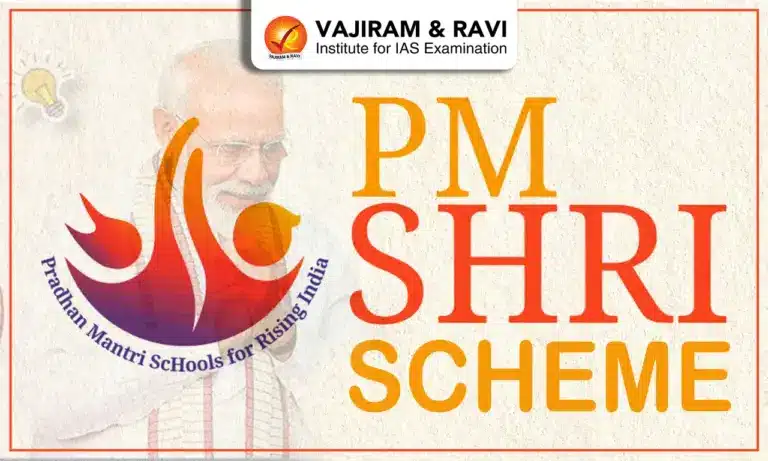
- Approved in 2022, the PM Schools for Rising India (PM-SHRI) scheme aims to develop 14,500 schools across the country as model institutions showcasing the core principles of the National Education Policy (NEP) 2020.
- So far, 13,070 schools have been selected, including 1,533 Kendriya Vidyalayas and Navodaya Vidyalayas.
- The scheme covers existing government and local body schools at the elementary, secondary, and senior secondary levels.
- These schools are expected to adopt innovative learning methods such as art-based and toy-based learning, introduce vocational education, and establish skill labs.
- They must ensure foundational literacy and numeracy, zero dropouts, and improved learning outcomes.
- Curriculum will follow either the National Curriculum Framework (NCF) or the State Curriculum Framework (SCF) aligned with NEP 2020.
- Schools will be assessed through a School Quality Assessment Framework, with funding linked to their performance.
- The scheme follows a 60:40 funding ratio between the Centre and states, aiming to transform schools into exemplars of modern, inclusive, and competency-based education.





States Implementing the PM-SHRI Scheme
- With Kerala now agreeing to join, most Indian states have come on board with the PM Schools for Rising India (PM-SHRI) scheme.
- Congress-ruled states such as Karnataka, Telangana, and Himachal Pradesh have implemented the scheme, along with AAP-ruled Punjab and Delhi, which had earlier relented after the Education Ministry stopped Samagra Shiksha funds.
States Opposing the Scheme
- Only Tamil Nadu and West Bengal continue to hold out.
- West Bengal objects to prefixing “PM-SHRI” to school names despite sharing project costs.
- Tamil Nadu opposes the scheme because it implies adopting the National Education Policy (NEP) 2020 “in entirety.”
Conditions for Implementing the PM-SHRI Scheme
- The implementation of the PM-SHRI scheme is closely linked to the Centre’s Samagra Shiksha programme, which shares the same 60:40 funding ratio between the Centre and states.
Link Between PM-SHRI and Samagra Shiksha Funding
- The Centre has made PM-SHRI participation a condition for the release of Samagra Shiksha funds, which support key education initiatives such as:
- Implementation of the Right to Education Act (RTE),
- Provision of uniforms and textbooks for government school students,
- Support for children with disabilities, and
- Reimbursements to private schools for EWS admissions.
- States that refused to implement PM-SHRI — including Kerala, Tamil Nadu, and West Bengal — did not receive Samagra Shiksha funds.
Kerala’s Funding Shortfall
- Kerala has received no central funds for Samagra Shiksha in 2024-25 and 2025-26, and only a partial allocation in 2023-24, amounting to about ₹1,150 crore.
- The state has used its own share of funds to cover essential expenses like RTE entitlements, textbooks, and salaries, but scholarships, uniforms, and school grants remain pending.
Signing the MoU and NEP Clause
- To access funds, Kerala recently signed an MoU with the Centre, which requires states to implement the NEP 2020 in entirety.
- However, Kerala’s General Education Minister clarified that the state will adopt only selective provisions of NEP, retaining control over its curriculum and textbooks while complying with central funding norms.
Source: IE

 Last updated on March, 2026
→ UPSC Final Result 2025 is now out.
→ UPSC has released UPSC Toppers List 2025 with the Civil Services final result on its official website.
→ Anuj Agnihotri secured AIR 1 in the UPSC Civil Services Examination 2025.
→ UPSC Marksheet 2025 is now out.
→ UPSC Notification 2026 & UPSC IFoS Notification 2026 is now out on the official website at upsconline.nic.in.
→ UPSC Calendar 2026 has been released.
→ Check out the latest UPSC Syllabus 2026 here.
→ UPSC Prelims 2026 will be conducted on 24th May, 2026 & UPSC Mains 2026 will be conducted on 21st August 2026.
→ The UPSC Selection Process is of 3 stages-Prelims, Mains and Interview.
→ Prepare effectively with Vajiram & Ravi’s UPSC Prelims Test Series 2026 featuring full-length mock tests, detailed solutions, and performance analysis.
→ Enroll in Vajiram & Ravi’s UPSC Mains Test Series 2026 for structured answer writing practice, expert evaluation, and exam-oriented feedback.
→ Join Vajiram & Ravi’s Best UPSC Mentorship Program for personalized guidance, strategy planning, and one-to-one support from experienced mentors.
→ Shakti Dubey secures AIR 1 in UPSC CSE Exam 2024.
→ Also check Best UPSC Coaching in India
PM-SHRI FAQs
Q1. What is the PM-SHRI Schools Scheme?+
Q2. Which states are implementing the scheme?+
Q3. Why is Kerala’s decision controversial?+
Q4. What are the funding conditions for the scheme?+
Q5. How does the scheme link to NEP 2020?+
Tags: mains articles PM-SHRI upsc current affairs upsc mains current affairs