Pocso Law Latest News
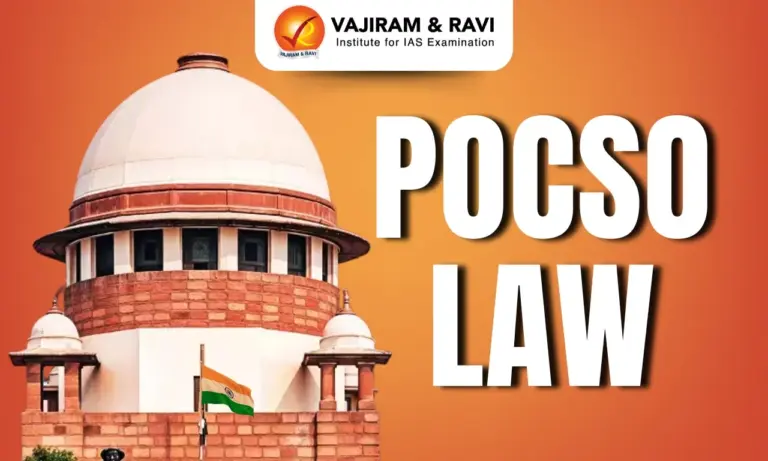
- The Supreme Court of India has urged the Union Law Secretary to consider steps to prevent the misuse of the Protection of Children from Sexual Offences (POCSO) Act, 2012, particularly in cases involving consensual adolescent relationships.
- While setting aside an Allahabad High Court order on age determination in a bail matter, a bench of Justices recommended exploring a “Romeo-Juliet clause”.
- Such a provision would exempt consensual sexual activity between teenagers close in age from criminal prosecution, an approach followed in several countries, including the US.
- The observation comes amid a pending public interest litigation on the age of consent and reflects growing judicial concern over the blanket criminalisation of consensual sexual acts between minors under the existing POCSO framework.
POCSO Act: Balancing Child Protection and Adolescent Autonomy
- Under the Protection of Children from Sexual Offences Act, 2012, anyone below 18 is considered a child, and the law does not recognise consent by minors.
- As a result, all sexual activity involving a minor is criminalised, irrespective of whether it is consensual or non-exploitative.
- In its recent judgment, the Supreme Court of India acknowledged that while POCSO is a “solemn articulation of justice” aimed at protecting children from abuse, its misuse has created a “grim societal chasm”.
- The court observed that the law is often invoked by families to oppose consensual relationships between adolescents, raising concerns about over-criminalisation and the denial of young people’s autonomy.





Growing Momentum for Reform
- The demand to amend the Protection of Children from Sexual Offences Act, 2012 has gained renewed traction through a pending public interest litigation before the Supreme Court of India concerning safeguards for women in sexual offence prosecutions.
Arguments for Adolescent Autonomy
- Senior Advocate Indira Jaising, assisting the court as amicus curiae, has argued for either reading down the age of consent or introducing statutory exceptions.
- In her submissions, she contended that blanket criminalisation violates adolescents’ fundamental rights under Articles 14, 15, 19, and 21 of the Constitution.
‘Evolving Capacity’ and the Mature Minor Doctrine
- Jaising maintained that adolescents aged 16–18 possess an “evolving capacity” to make informed decisions about sexual autonomy.
- Drawing on the common law “mature minor” doctrine, she argued that treating all under-18s as incapable of consent ignores scientific realities, including the biological onset of puberty.
Proposal for a Close-in-Age Exception
- To address misuse of the law, Jaising proposed a “close-in-age” or “Romeo-Juliet” exception.
- Under this approach, consensual relationships between adolescents close in age—such as a 16- and 17-year-old—would not attract criminal liability, preventing unnecessary incarceration under the POCSO framework.
Union Government’s Case for Retaining the Existing Law
- The Union Government of India has opposed any reduction in the age of consent or the creation of legislative exceptions under the POCSO Act, 2012.
- In its submissions before the Supreme Court of India, it argued that fixing the age of consent at 18 is a deliberate and carefully considered choice to provide an absolute protective shield for children.
Rationale: Vulnerability and Strict Liability
- The government maintained that minors lack the legal and developmental capacity to give meaningful consent.
- It defended the Act’s strict liability framework—where consent is irrelevant—on the ground that children are especially vulnerable to manipulation and coercion by adults, including those in positions of trust.
Concerns Over Dilution and Misuse
- According to the government, introducing exceptions or lowering the age of consent could create loopholes that allow child abuse and trafficking to be disguised as consensual relationships.
- Diluting the age threshold, it warned, would revive the very mischief the law was enacted to address.
Preference for Judicial Discretion
- The Centre argued that relief in hard cases should come through judicial discretion exercised on a case-by-case basis, rather than through statutory dilution of protections built into the law.
Law Commission’s View
- In 2023, the Law Commission of India also advised against lowering the age of consent to 16.
- However, it acknowledged the concern by recommending guided judicial discretion in sentencing for cases involving tacit consent by adolescents aged 16–18, instead of creating a blanket statutory exception.
Data Highlights Misuse and Unintended Consequences of POCSO
- Empirical evidence supports judicial concerns over the application of the POCSO Act, 2012.
- A study by Enfold Proactive Health Trust and UNICEF found that nearly 25% of POCSO cases in Maharashtra, Assam, and West Bengal between 2016 and 2020 involved consensual “romantic” relationships between adolescents.
- The data indicates frequent misuse of the law by families to control daughters’ choices, particularly in inter-caste or inter-religious relationships.
- Beyond legal misuse, the criminalisation of adolescent sexuality has serious public health implications.
- Mandatory reporting under POCSO compels doctors to inform police about underage pregnancies or sexual activity, discouraging adolescents from accessing essential sexual and reproductive healthcare due to fear of prosecution.
Conclusion
- The Supreme Court’s recent judgment underscored that this problem cannot be resolved through case-by-case discretion alone.
- It signalled the need for a structural legislative solution, warning that when a law designed to protect children is misused as “a tool for exacting revenge”, the very idea of justice risks being inverted.

 Last updated on March, 2026
→ UPSC Final Result 2025 is now out.
→ UPSC has released UPSC Toppers List 2025 with the Civil Services final result on its official website.
→ Anuj Agnihotri secured AIR 1 in the UPSC Civil Services Examination 2025.
→ UPSC Marksheet 2025 is now out.
→ UPSC Notification 2026 & UPSC IFoS Notification 2026 is now out on the official website at upsconline.nic.in.
→ UPSC Calendar 2026 has been released.
→ Check out the latest UPSC Syllabus 2026 here.
→ UPSC Prelims 2026 will be conducted on 24th May, 2026 & UPSC Mains 2026 will be conducted on 21st August 2026.
→ The UPSC Selection Process is of 3 stages-Prelims, Mains and Interview.
→ Prepare effectively with Vajiram & Ravi’s UPSC Prelims Test Series 2026 featuring full-length mock tests, detailed solutions, and performance analysis.
→ Enroll in Vajiram & Ravi’s UPSC Mains Test Series 2026 for structured answer writing practice, expert evaluation, and exam-oriented feedback.
→ Join Vajiram & Ravi’s Best UPSC Mentorship Program for personalized guidance, strategy planning, and one-to-one support from experienced mentors.
→ Shakti Dubey secures AIR 1 in UPSC CSE Exam 2024.
→ Also check Best UPSC Coaching in India
Pocso Law FAQs
Q1. Why is the POCSO law under scrutiny?+
Q2. What is a Romeo-Juliet exception in POCSO law?+
Q3. What did the Supreme Court observe about POCSO law?+
Q4. What arguments support reforming the POCSO law?+
Q5. Why does the government oppose changes to the POCSO law?+
Tags: mains articles pocso law upsc current affairs upsc mains current affair