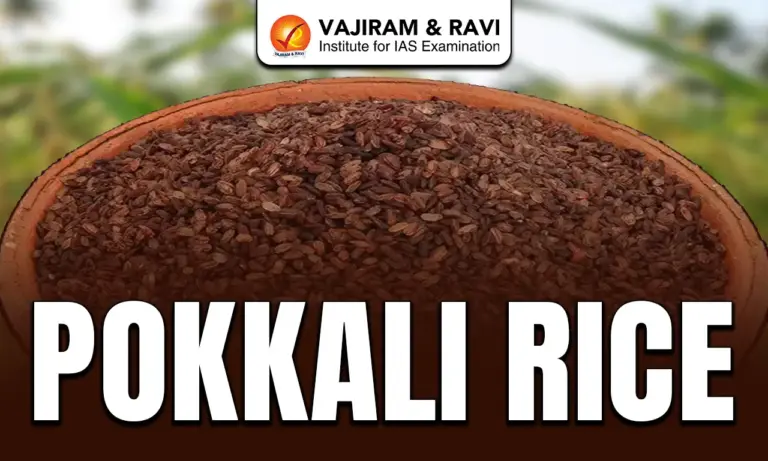
Pokkali rice is a unique, salt-tolerant rice variety cultivated organically in the waterlogged coastal regions of Alappuzha, Thrissur, and Ernakulam in Kerala, India. It represents an important example of climate-resilient agriculture in India.
Pokkali Rice Key Features
- Pokkali is cultivated in low-lying coastal fields that are subject to tidal action, waterlogged for several months and affected by high salinity during summer.
- Pokkali rice is grown in the Vembanad-Kol wetland ecosystem around Vembanad Lake, which is a Ramsar site recognized for its ecological importance.
- Pokkali Rice has high salinity tolerance. It can survive salinity levels that are fatal to ordinary rice varieties. This makes it extremely valuable in areas facing sea-water intrusion and soil salinization.
- Pokkali Rice is generally sown before the onset of the southwest monsoon and harvested after floodwaters recede.
- It is largely grown without chemical fertilizers and pesticides, making it an organic and environmentally sustainable crop.
- Its tall and elongating stem prevents damage from rising floodwaters.
- The crop develops strong roots that help it remain anchored in soft, waterlogged soils.
- Traditional varieties like Pokkali are naturally more resistant to pests compared to hybrid varieties.
- One of the most significant features of Pokkali cultivation is its rotational farming system. During monsoon (June-October), rice cultivation takes place in rain-fed conditions and during Post-harvest (November onwards), fields are opened to saline tidal water for prawn cultivation. This integrated system:
-
- Enhances soil fertility naturally.
- Controls pests through ecological balance.
- Provides dual income to farmers
- Reduces dependency on chemical inputs.
- Pokkali rice is nutritionally superior to many modern rice varieties. It is rich in protein, high in antioxidants, contains iron and micronutrients.
- Due to its health benefits, it has increasing demand in niche health-conscious markets. It also serves as valuable genetic material in breeding programs aimed at developing salt-resistant rice varieties.
- Pokkali rice received a Geographical Indication (GI) tag in 2007, protecting its unique identity and traditional cultivation practices.
- The Pokkali farming system has been recognized under the Globally Important Agricultural Heritage Systems (GIAHS) initiative by the Food and Agriculture Organization.






 Last updated on March, 2026
→ UPSC Final Result 2025 is now out.
→ UPSC has released UPSC Toppers List 2025 with the Civil Services final result on its official website.
→ Anuj Agnihotri secured AIR 1 in the UPSC Civil Services Examination 2025.
→ UPSC Marksheet 2025 is now out.
→ UPSC Notification 2026 & UPSC IFoS Notification 2026 is now out on the official website at upsconline.nic.in.
→ UPSC Calendar 2026 has been released.
→ Check out the latest UPSC Syllabus 2026 here.
→ UPSC Prelims 2026 will be conducted on 24th May, 2026 & UPSC Mains 2026 will be conducted on 21st August 2026.
→ The UPSC Selection Process is of 3 stages-Prelims, Mains and Interview.
→ Prepare effectively with Vajiram & Ravi’s UPSC Prelims Test Series 2026 featuring full-length mock tests, detailed solutions, and performance analysis.
→ Enroll in Vajiram & Ravi’s UPSC Mains Test Series 2026 for structured answer writing practice, expert evaluation, and exam-oriented feedback.
→ Join Vajiram & Ravi’s Best UPSC Mentorship Program for personalized guidance, strategy planning, and one-to-one support from experienced mentors.
→ Shakti Dubey secures AIR 1 in UPSC CSE Exam 2024.
→ Also check Best UPSC Coaching in India
Pokkali Rice FAQs
Q1. Pokkali rice is mainly grown in which state?+
Q2. Pokkali rice is known for which special characteristic?+
Q3. Pokkali cultivation is associated with which wetland ecosystem?+
Q4. In which year did Pokkali rice receive the GI tag?+
Q5. What is unique about the Pokkali farming system?+
Tags: pokkali rice