What’s in today’s article?
- Why in News?
- The Poverty Estimation in India (Meaning, need, approaches)
- Key Highlights of the Paper – ‘Poverty and Inequality in India: Before and After Covid-19’
Why in News?
- According to a new paper authored by former Niti Aayog Vice Chairman (Arvind Panagariya), rural poverty as a percentage of total rural population declined continuously every quarter beginning July-September 2020.
- Based on household expenditures reported in the Periodic Labour Force Survey (PLFS 2020-21), this estimate contradicts widespread claims showing a large rise in poverty in both rural and urban India post the Covid-19 pandemic.
The Poverty Estimation in India:
- Meaning of poverty: Poverty can be defined as a condition in which an individual or household lacks the financial resources to afford a basic minimum standard of living.
- Need for poverty estimation:
- Poverty elimination has remained a major challenge and lies at the core of India’s national development agenda to create a just and equitable society.
- Reliable estimation of poverty is the first step towards eradication of poverty as a basic input for design, implementation and monitoring of anti-poverty programmes.
- Approaches of poverty estimation:
- The conventional approach is to specify a minimum expenditure/income (poverty line) required to purchase a basket of goods and services necessary to satisfy basic human needs.
- Estimation of poverty in India has been based on two critical components:
- Information on the consumption expenditures and its distribution across households is provided by the NSS consumption expenditure surveys;
- These expenditures by households are evaluated with reference to a given poverty line.
- In India, the official poverty definition and numbers are estimated based on the Consumption Expenditure Survey (CES) conducted by the National Statistical Office (NSO).
- The last published data of CES is available for 2011-12, while the government had junked the CES conducted in 2017-18.

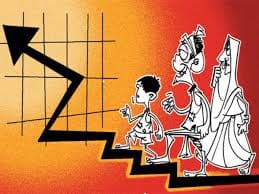
Image Caption: India’s Poverty Analysis


Key Highlights of the Paper – ‘Poverty and Inequality in India: Before and After Covid-19’:

Image Caption: Poverty and Inequality in India: Before and After Covid-19
- Poverty in rural India:
- It is only during the strict lockdown period (April-June 2020) that rural poverty saw a modest rise.
- It fell for the full year 2019-20, at a significantly lower rate and witnessed a sharp decline in 2020-21 as in the pre-Covid year of 2018-19.
- These results are consistent with the robust performance of agriculture (in 2019-20 and 2020-21), significant expansion of NREGA and free distribution of 5 kg food grain per person per month under the Food Security Act.
- Poverty in urban India:
- It saw a modest rise on an annual basis in 2020-21 and started to decline by April-June 2021.
- The rise in urban poverty for four quarters beginning April-June 2020 was consistent with the large decline in the production of contact-intensive industries.
- The free distribution of additional 5 kg food grain helped arrest a sharper rise in urban poverty.
- Why does the paper’s findings (reduction in poverty and inequality) differ from earlier findings (showing increase)?
- This is mainly due to differences in sample design between the Current Employment Statistics (CES 2011-12) and PLFS (2017-18).
- This makes poverty estimates derived from the two sources entirely non-comparable.
Q1) Why was the Suresh Tendulkar Committee constituted?
In 2005, another expert group to review methodology for poverty estimation, chaired by Suresh Tendulkar, was constituted by the Planning Commission to address the shortcomings of the previous methods.
Q2) Why is the Periodic Labour Force Survey (PLFS)?
It gives estimates of key employment and unemployment indicators like, the Labour Force Participation Rates (LFPR), Worker Population Ratio (WPR), Unemployment Rate (UR), etc.
Source: After pandemic, poverty kept falling every quarter from July-Sept 2020 | Rural.nic.in

 Last updated on Oct, 2026
→ UPSC 2027 Notification will be released on 13 January 2027 at upsconline.nic.in.
→ Check Nobel Prize 2026 Winners List here.
→ Download PIB PRiSM Monthly Magazine 2026 here.
→ Check UPSC Monthly Current Affairs Magazine The Recitals here.
→ Check out the latest UPSC Syllabus here.
→ Download UPSC Model Answers for Mains 2026
→ UPSC Mains Question Paper 2026 is out now for Essay & GS Paper 1, 2, 3 & 4.
→ UPSC Calendar 2027 has been released.
→ Enroll in Vajiram & Ravi’s UPSC Mains Test Series 2027 for structured answer writing practice, expert evaluation, and exam-oriented feedback.
→ Join Vajiram & Ravi’s UPSC Mentorship Program 2027 for personalized guidance, strategy planning, and one-to-one support from experienced mentors.
→ Go through the UPSC Mains Previous Year Papers to enhance your preparation.
→ UPSC has released UPSC Toppers List 2025 with the Civil Services final result on its official website.
→ Also check Best UPSC Coaching in India