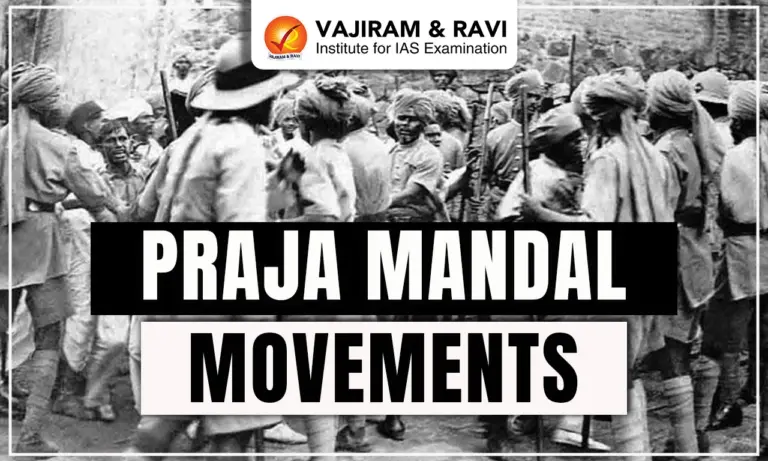
The national movement in the princely states gained momentum after 1920, following the Non-Cooperation Movement which had taken place mainly in the British provinces. Inspired by this, the subjects of princely states began forming people’s organisations to demand political rights and reforms. These organisations were popularly known as Praja Mandals or Praja Parishads, and their struggles collectively came to be called the Praja Mandal Movements.
To coordinate these movements, the State’s People’s Conference was established. It brought together representatives from several princely states such as Baroda, Bhopal, Travancore, and Hyderabad. The conference aimed to provide a common platform for dialogue on issues of governance, political stability, and the broader future of India under colonial rule.
Praja Mandal Movements Nature
The Praja Mandal Movements were directed against both feudalism and colonialism. People living in the princely states had to resist the autocratic rule of their feudal princes as well as the overarching control of the British administration. The central demand of these movements was the extension of democratic rights to the people, ensuring greater participation in governance and freedom from oppressive rule.
Praja Mandal Movements Activity
- Grassroots Implementation of Nationalist Programs: The Praja Mandal movements played a key role in bringing the larger nationalist agenda to the princely states. People actively implemented the constructive programs of the Indian National Movement, ensuring that the spirit of freedom and reform reached even the grassroots level.
- Promotion of Social Reforms: Alongside political demands, the movements also pushed for social change. They established schools to spread education, promoted the use of khadi, encouraged cottage industries for self-reliance, and launched agitations against untouchability and other social evils.





National Movement Associations in the Princely States
- The Hitvardhak Sabha: Founded in Poona in May 1921, the Hitvardhak Sabha focused on addressing the problems faced by the people of the southern princely states. It worked as an early platform for voicing public grievances.
- Akhil Bhor Sansthan Praja Sabha: In November 1921, Wamanrao Patwardhan established this Sabha in the Bhor region. Its aim was to fight against the issues affecting the local population and to push for better rights and governance.
- All India Association of the People’s Council: The Bombay session of this body in 1927 marked a turning point, as the princely states’ national movement was elevated to the national level. During this session, demands were made for responsible government and full citizenship rights for the people of the princely states.
- Advocacy for Electoral Rights: The Madras Session of the Congress later supported the demands raised in Bombay. At the Karachi Session of 1936, the Council opposed the provision of the Government of India Act, 1935, that allowed princes to nominate representatives to the Imperial Legislature. Instead, it insisted that the right to elect representatives must belong to the subjects of the princely states. Alongside these political efforts, the Council and related people’s organisations also fought for relief from farmer loans, unfair taxes, and other economic hardships.
Praja Mandal Movements and Role of Congress
The policies and programs of the Indian National Congress played a decisive role in shaping and strengthening the Praja Mandal Movement. The Gandhian methods of non-cooperation and civil disobedience, the Congress’s role in organising the All India States People’s Conference, and the declaration at the Tripuri Session to involve the states in the national struggle gave much-needed confidence and direction to the people’s organisations. By joining hands with the People’s Council, Congress made the princely state’s struggles part of the larger national movement to end British rule and integrate the states into independent India.
- Formation of the Orissa State People’s Conference (1937): Congress leaders in Orissa took the initiative to form this body in 1937 to investigate the condition of the princely states. In 1938, it was reconstituted with H.K. Mahatab, a member of the Congress Working Committee, as its chairman. The establishment of a popular Congress ministry in Orissa in July 1937 further inspired the people of feudatory states to continue their fight against autocratic rulers.
- Covert Support to the Feudatory States Movement: Though legal restrictions prevented Congress leaders from openly participating in the princely states’ movements, they extended strong moral support and indirect assistance. This backing strengthened the resolve of the local population.
- Orissa State Committee’s Enquiry Report (1939): The sufferings of the people in the feudatory states were documented in the enquiry report prepared by the Orissa State Committee. This report was submitted to Lord Linlithgow, the Viceroy, during his visit to Orissa in the first week of August 1939. The Viceroy even held discussions on the issue with the Congress ministry, showing the growing influence of the movement.
Praja Mandal Movements Importance
The Praja Mandal Movement laid bare the exploitative and autocratic nature of feudal rule in the princely states. More importantly, it gave the people a platform to assert their democratic aspirations and align themselves with the larger freedom struggle. The movement was not just about resisting feudal oppression but about the deeper urge of the people to join the political, social, economic, and cultural mainstream of India. By merging with the national movement, it created the momentum that eventually enabled the smooth integration of princely states into independent India after 1947.

 Last updated on March, 2026
→ UPSC Final Result 2025 is now out.
→ UPSC has released UPSC Toppers List 2025 with the Civil Services final result on its official website.
→ Anuj Agnihotri secured AIR 1 in the UPSC Civil Services Examination 2025.
→ UPSC Marksheet 2025 is now out.
→ UPSC Notification 2026 & UPSC IFoS Notification 2026 is now out on the official website at upsconline.nic.in.
→ UPSC Calendar 2026 has been released.
→ Check out the latest UPSC Syllabus 2026 here.
→ UPSC Prelims 2026 will be conducted on 24th May, 2026 & UPSC Mains 2026 will be conducted on 21st August 2026.
→ The UPSC Selection Process is of 3 stages-Prelims, Mains and Interview.
→ Prepare effectively with Vajiram & Ravi’s UPSC Prelims Test Series 2026 featuring full-length mock tests, detailed solutions, and performance analysis.
→ Enroll in Vajiram & Ravi’s UPSC Mains Test Series 2026 for structured answer writing practice, expert evaluation, and exam-oriented feedback.
→ Join Vajiram & Ravi’s Best UPSC Mentorship Program for personalized guidance, strategy planning, and one-to-one support from experienced mentors.
→ Shakti Dubey secures AIR 1 in UPSC CSE Exam 2024.
→ Also check Best UPSC Coaching in India
Praja Mandal Movements FAQs
Q1. Who was the leader of the Prajamandal movement?+
Q2. What is the Prajamandal movement of Ranpur?+
Q3. What were the demands made by Prajamandal in late 1920 and 1930?+
Q4. What was the main aim of the Prajamandal movement in Odisha?+
Q5. Where was the first Praja Mandal founded?+
Tags: praja mandal movements