About PraVaHa Software:
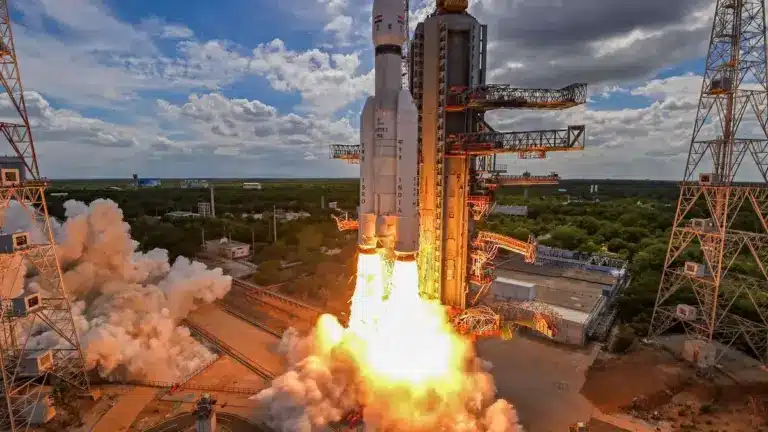
- Parallel RANS Solver for Aerospace Vehicle Aero-thermo-dynamic Analysis (PraVaHa) is a Computational Fluid Dynamics (CFD) software developed in ISRO’s Vikram Sarabhai Space Centre (VSSC).
- It can simulate external and internal flows on launch vehicles, winged and non-winged re-entry vehicles.
- PraVaHa has been extensively used in the Gaganyaan program for aerodynamic analysis of human-rated launch vehicles, viz, HLVM3, Crew Escape System (CES), and Crew Module (CM).
- The software is secure and flexible enough to support collaborative development with academic institutions and government labs.
- Currently, the PraVaHa code is operational to simulate airflow for Perfect Gas and Real Gas conditions.
- Validations of the code are underway for simulating the effects of chemical reactions that occur during air dissociation upon ‘earth re-entry’ and ‘combustion’ as in scramjet vehicles.
- PraVaHa is expected to replace most of the CFD simulations for aero characterisation, which are currently being carried out using commercial software.
- Besides, this software is expected to help academia and other institutions, engaged in the design of missiles, aircraft, and rockets to find solutions to complex aerodynamic problems.
Importance of Computational Fluid Dynamics (CFD):
- Initial aerodynamic design studies for launch vehicles demand evaluation of a large number of configurations.
- Any aerospace vehicle moving through the Earth’s atmosphere during launch or re-entry is subjected to severe aerodynamic and aerothermal loads in terms of external pressure and heat flux.
- Understanding the airflow around aircraft, rocket bodies, or CM during earth re-entry is essential to design the shape, structure, and Thermal Protection System (TPS) required for these bodies.
- The unsteady part of aerodynamics contributes to serious flow issues around such rocket bodies and creates significant acoustic noise during the mission.
- CFD is one such tool to predict the aerodynamic and aerothermal loads, which solve numerically the equations of conservation of mass, momentum, and energy along with the equation of state.
Q1: What is aerodynamics?
Aerodynamics is the study of forces and the resulting motion of objects through the air. Studying the motion of air around an object allows us to measure the forces of lift, which allows an aircraft to overcome gravity, and drag, which is the resistance an aircraft “feels” as it moves through the air. Everything moving through the air (including airplanes, rockets, and birds) is affected by aerodynamics.
Source: ISRO develops PraVaHa software for aerodynamic design and analysis






 Last updated on April, 2026
→ UPSC Final Result 2025 is now out.
→ UPSC has released UPSC Toppers List 2025 with the Civil Services final result on its official website.
→ Anuj Agnihotri secured AIR 1 in the UPSC Civil Services Examination 2025.
→ UPSC Marksheet 2025 is now out.
→ UPSC Notification 2026 & UPSC IFoS Notification 2026 is now out on the official website at upsconline.nic.in.
→ UPSC Calendar 2026 has been released.
→ Check out the latest UPSC Syllabus 2026 here.
→ UPSC Prelims 2026 will be conducted on 24th May, 2026 & UPSC Mains 2026 will be conducted on 21st August 2026.
→ The UPSC Selection Process is of 3 stages-Prelims, Mains and Interview.
→ Prepare effectively with Vajiram & Ravi’s UPSC Prelims Test Series 2026 featuring full-length mock tests, detailed solutions, and performance analysis.
→ Enroll in Vajiram & Ravi’s UPSC Mains Test Series 2026 for structured answer writing practice, expert evaluation, and exam-oriented feedback.
→ Join Vajiram & Ravi’s Best UPSC Mentorship Program for personalized guidance, strategy planning, and one-to-one support from experienced mentors.
→ Shakti Dubey secures AIR 1 in UPSC CSE Exam 2024.
→ Also check Best UPSC Coaching in India