Puducherry UT Latest News
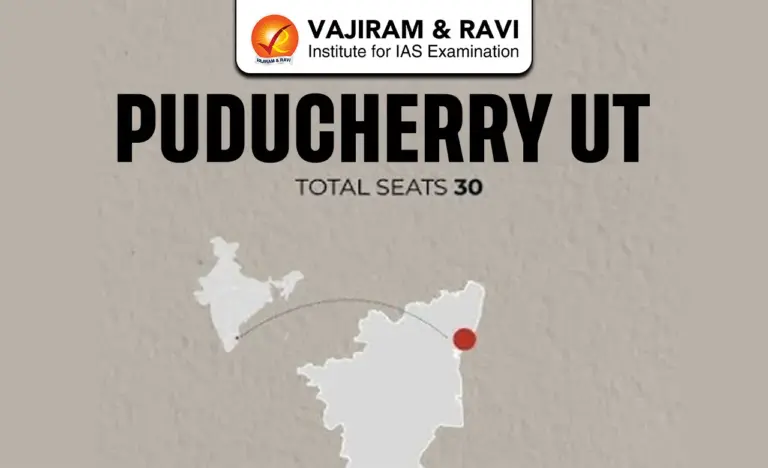
- Elections to the Legislative Assemblies of Kerala, Assam, and the Union Territory of Puducherry began on April 9. Despite being a UT, Puducherry has its own legislative assembly and Chief Minister, similar to Delhi and Jammu & Kashmir.
- This highlights the unique governance structure of certain Union Territories that combine central oversight with elements of state-like legislative authority.
Union Territories in India: Governance and Special Status
- Union Territories (UTs) are governed under Part VIII of the Constitution (Articles 239–242), where administration is vested in the President through appointed administrators.
- Most UTs, such as Chandigarh, Dadra & Nagar Haveli and Daman & Diu, Andaman & Nicobar Islands, and Lakshadweep, do not have elected legislatures.
Puducherry’s Unique Legislative Status
- Puducherry was granted a legislature under the Government of Union Territories Act, 1963, reflecting its historical and political context.
- The Treaty of Cession (1956) formalised the transfer of territories from France, though legal ratification occurred in 1962.
- India had exercised administrative control since 1954. The continuation of a representative assembly followed earlier French practices.
Constitutional Provision for Legislature
- Puducherry’s special status is provided under Article 239A, which allows for a local legislature and a council of ministers.
- Additionally, the President has the power to nominate members to the Assembly, influencing its political dynamics.
- Apart from Puducherry, only Delhi (since 1992) and Jammu & Kashmir (since 2019) have legislatures among Union Territories, making them exceptions within the broader UT governance framework.





Delhi vs Puducherry: Governance, Powers, and Constitutional Framework
- Delhi was granted NCT status through the 69th Constitutional Amendment Act, 1991, introducing Article 239AA.
- It provides for a legislative assembly with powers over State and Concurrent List subjects, except public order, police, and land.
- The division of powers between the Lieutenant-Governor (L-G) and the elected government has been contentious.
- Judicial and legislative developments since 2015 have seen shifting control over “services,” with the balance of power alternating between the elected government and the Centre.
- On the other hand, Puducherry’s legislature enjoys relatively broader powers without specific subject exclusions, but remains subject to Parliament’s overriding authority under Article 246(4), meaning central laws prevail in case of conflict.
Role of Lieutenant-Governor (LG)
- While Delhi’s LG has defined discretionary powers under Article 239AA, Puducherry operates under Article 239A and the 1963 Act, which do not clearly define such powers.
- The Supreme Court in K. Lakshminarayanan v. Union of India (2019) clarified that Puducherry’s LG is bound by the aid and advice of the Council of Ministers, except in exceptional cases.
Constitutional Safeguards and President’s Role
- Under Article 240, the President can make regulations for UTs like Puducherry when the legislature is not functional.
- In Delhi, Article 239AB allows suspension of constitutional provisions and imposition of President’s rule if governance fails.
Key Difference in Governance Structure
- Delhi’s governance involves greater central oversight and defined LG discretion, while Puducherry’s system, though subject to parliamentary supremacy, grants greater operational authority to the elected government in routine administration.
Jammu & Kashmir as a Union Territory: Limited Legislative Autonomy
- In 2019, the abrogation of Article 370 led to the Jammu and Kashmir Reorganisation Act, bifurcating the former state into two UTs—Jammu & Kashmir (with a legislature) and Ladakh (without a legislature).
- The J&K Assembly can legislate on State List subjects, but public order and police remain under the Lieutenant-Governor (LG), limiting its autonomy compared to other UTs like Puducherry.
- The LG holds significant discretionary authority, including control over the bureaucracy and All India Services, extending beyond the Assembly’s legislative scope.
- Under Section 36, any bill involving financial obligations requires prior LG approval, giving the LG substantial control over financial and administrative functioning.
- In practice, Jammu & Kashmir operates with greater central control and reduced legislative independence, making it less autonomous than UTs like Puducherry and even Delhi.
Source: IE

 Last updated on April, 2026
→ UPSC Final Result 2025 is now out.
→ UPSC has released UPSC Toppers List 2025 with the Civil Services final result on its official website.
→ Anuj Agnihotri secured AIR 1 in the UPSC Civil Services Examination 2025.
→ UPSC Marksheet 2025 is now out.
→ UPSC Notification 2026 & UPSC IFoS Notification 2026 is now out on the official website at upsconline.nic.in.
→ UPSC Calendar 2026 has been released.
→ Check out the latest UPSC Syllabus 2026 here.
→ UPSC Prelims 2026 will be conducted on 24th May, 2026 & UPSC Mains 2026 will be conducted on 21st August 2026.
→ The UPSC Selection Process is of 3 stages-Prelims, Mains and Interview.
→ Prepare effectively with Vajiram & Ravi’s UPSC Prelims Test Series 2026 featuring full-length mock tests, detailed solutions, and performance analysis.
→ Enroll in Vajiram & Ravi’s UPSC Mains Test Series 2026 for structured answer writing practice, expert evaluation, and exam-oriented feedback.
→ Join Vajiram & Ravi’s Best UPSC Mentorship Program for personalized guidance, strategy planning, and one-to-one support from experienced mentors.
→ Shakti Dubey secures AIR 1 in UPSC CSE Exam 2024.
→ Also check Best UPSC Coaching in India
Puducherry UT FAQs
Q1. What is special about Puducherry UT?+
Q2. How is Puducherry UT different from Delhi?+
Q3. How does Puducherry UT compare with J&K?+
Q4. What is the role of the LG in Puducherry UT?+
Q5. Why do some UTs have legislatures like Puducherry UT?+
Tags: mains articles Puducherry UT upsc current affairs upsc mains current affairs